
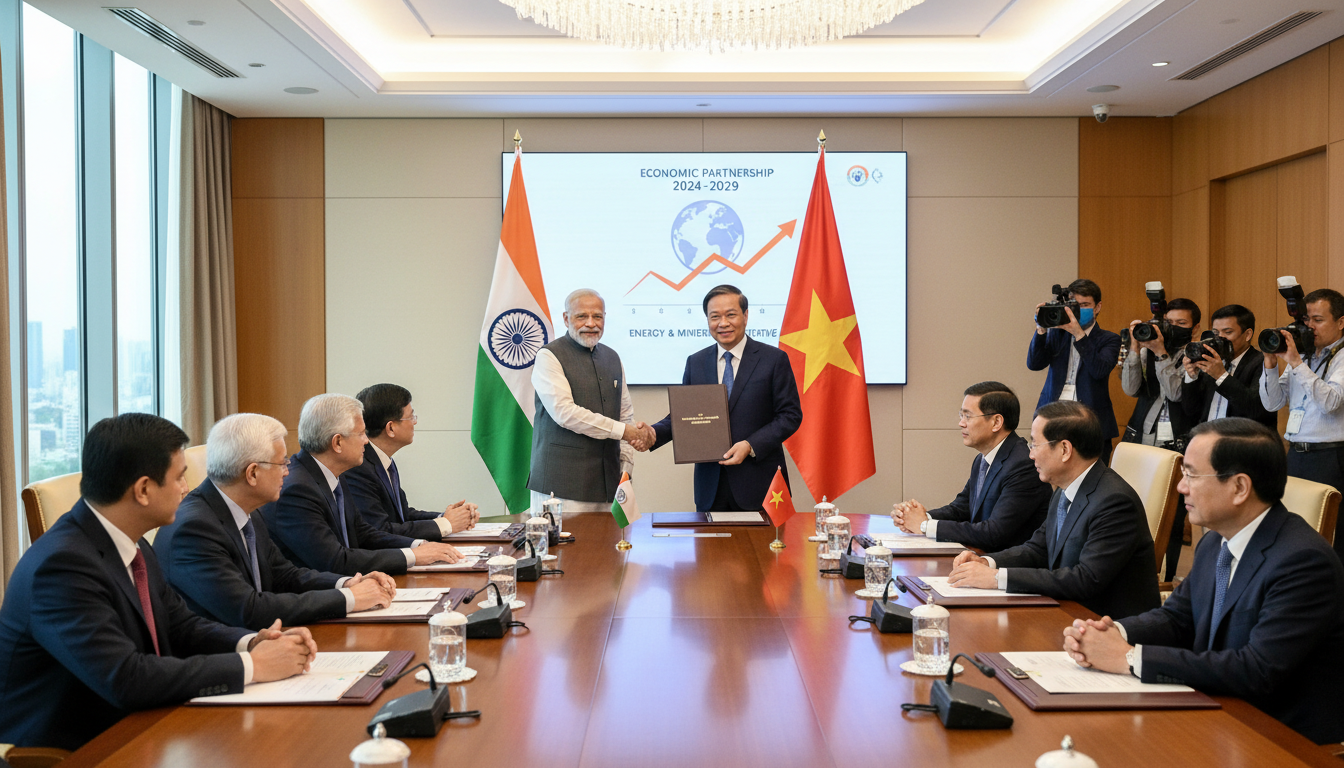
India-Vietnam cooperation deepens as Modi hosts President To Lam in New Delhi
India-Vietnam cooperation advances after talks on May 6, 2026, focusing on energy, critical minerals, rare earths and a plan to raise bilateral trade to $25 billion by 2030.
India and Vietnam on Wednesday announced a stepped-up partnership following talks between Prime Minister Narendra Modi and President To Lam at Rashtrapati Bhavan in New Delhi. India-Vietnam cooperation was placed squarely on an economic and strategic footing with both leaders agreeing to expand collaboration in energy, critical minerals and supply-chain resilience. The meeting set a formal target to grow bilateral trade to $25 billion by 2030, signalling an ambitious push to intensify commercial ties over the coming years.
Modi and To Lam agree to raise trade to $25 billion by 2030
Both leaders endorsed a shared goal to increase bilateral trade to $25 billion by 2030, a figure they said would be pursued through targeted economic initiatives. Indian and Vietnamese officials described the target as a benchmark for closer industrial and investment linkages, including new areas of cooperation beyond traditional goods. The commitment frames upcoming negotiations and working groups that will map sectoral priorities and timelines across trade and investment.
Energy cooperation placed at centre of talks
Energy emerged as a central pillar of the discussions, with both sides signalling interest in joint projects spanning conventional and renewable sources. Officials highlighted opportunities in offshore energy, power grid integration and technology exchange to support Vietnam’s growing demand while advancing India’s clean-energy objectives. Cooperative efforts are expected to focus on project development, financing structures and regulatory frameworks to accelerate deployment.
Critical minerals and rare earths discussed as strategic resources
The leaders identified critical minerals and rare earths as strategic priorities for industrial collaboration and supply-chain diversification. Both countries underscored the importance of securing stable supplies of these materials for sectors such as electric vehicles, batteries and advanced electronics. Talks addressed frameworks for exploration, processing, value-added manufacturing and investment facilitation aimed at reducing dependency on single-source supply chains.
Supply-chain resilience and manufacturing linkages
Strengthening supply-chain resilience formed a core part of the agenda as the two governments explored ways to deepen manufacturing ties and procurement cooperation. Discussions covered logistics, standards alignment, customs facilitation and incentives to attract firms that can relocate or expand production across India and Vietnam. Officials indicated that initiatives would seek to integrate both economies into regional manufacturing networks while improving redundancy for critical industries.
Plans for concrete economic initiatives and working groups
Modi and To Lam agreed to establish or expand technical working groups to translate broad goals into concrete initiatives, according to officials present at the meeting. These groups will reportedly cover fields including energy, minerals, trade facilitation and investment promotion, and will be tasked with drafting action plans and timelines. The leaders also discussed mechanisms to mobilise public and private financing, and to bring state-owned enterprises and private sector partners into joint ventures.
Regional context and strategic implications for the Indo-Pacific
Beyond economics, the meeting carried strategic significance for regional cooperation across the Indo-Pacific, where both India and Vietnam have sought deeper engagement in recent years. Strengthened India-Vietnam cooperation on trade, energy and critical materials was framed as complementary to broader regional efforts to diversify supply chains and enhance resilience. Officials suggested the partnership could bolster regional connectivity and contribute to a more stable and integrated economic architecture.
The visit to Rashtrapati Bhavan included a ceremonial welcome and bilateral protocol followed by extended delegation-level talks intended to work through technical details and implementation steps. Both capitals now face the task of converting high-level commitments into negotiated agreements, regulatory changes and investment projects that will determine the pace and scale of the partnership.
The leaders’ joint focus on energy, critical minerals and supply-chain resilience signals a pragmatic, economically driven agenda designed to leverage complementary strengths and address shared vulnerabilities.

