
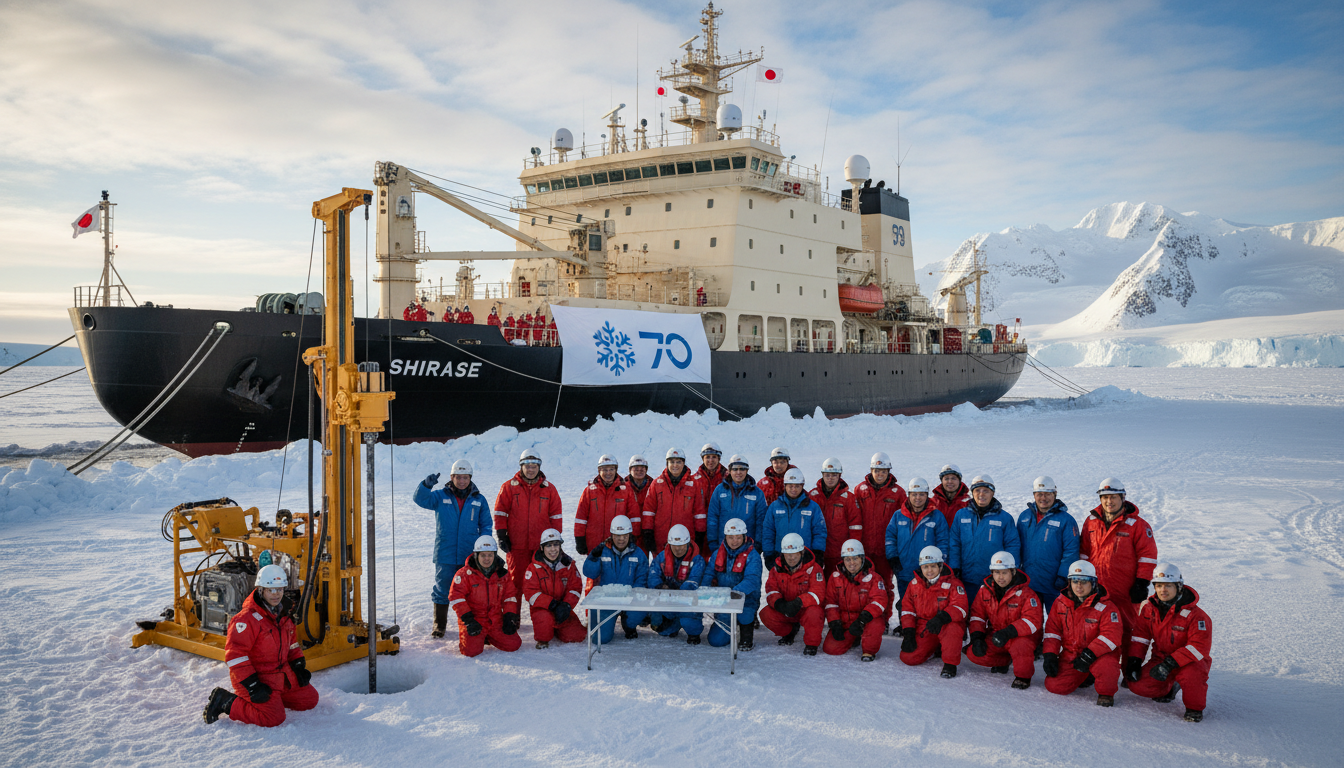
Japan’s Antarctic research marks 70 years of scientific and practical achievements
Japan’s Antarctic research marks its 70th anniversary in 2026, reflecting seven decades of polar science that have advanced climate knowledge and delivered practical benefits at home. The national program, involving agencies, universities and private firms, has engaged roughly 3,600 personnel since the first expedition and continues to combine year-round and seasonal teams. This milestone highlights discoveries from ozone depletion to improved GPS accuracy and recent plans to extract one-million-year-old ice for climate study.
Soya voyage and establishment of Showa Station, 1956–1957
Japan’s formal Antarctic work began with the departure of the research vessel Soya from Harumi Pier in Tokyo in November 1956. A 53-member team led by Takeshi Nagata sailed roughly 80 days to reach East Ongul Island and in January 1957 established Showa Station as a base for meteorological and geological observation. Those founding efforts faced severe weather, logistical hurdles and the harsh isolation that characterizes early polar exploration.
Survival and sacrifice in the program’s early years
The early expeditions produced both poignant survival stories and tragedy that shaped public memory and operational practice. In 1958 a team left 15 sled dogs behind at the base during an emergency evacuation; two animals, later known as Taro and Jiro, were found alive by the following expedition and became national symbols of resilience. The program also suffered human loss, including the death of a fourth-expedition member in a 1960 snowstorm, and a temporary suspension of operations in 1962 while the research fleet was renewed.
1982 detection of ozone depletion and global impact
Scientific outputs from Showa Station have had international consequences, most notably the 1982 detection by the 23rd observation team of significant ozone depletion above the station. Subsequent research linked the thinning layer to chlorofluorocarbons used in refrigeration and air-conditioning, which prompted multinational regulatory responses. That finding exemplifies how Japan’s Antarctic research has informed global environmental policy and contributed to coordinated efforts to protect the atmosphere.
Practical technologies and daily-life benefits from polar research
Work in Antarctica has generated practical technologies and behavioral changes that reached ordinary consumers in Japan. Atmospheric and antenna observations conducted at Showa Station have been integrated into models and satellite systems that improve global positioning accuracy for navigation devices used in vehicles. Construction methods developed to assemble premanufactured panels for blizzard-resistant buildings at Showa Station have been adapted by Japanese homebuilders to accelerate and strengthen housing projects.
Food waste reduction and a popular convenience-store product
Logistical rules requiring teams to remove all generated waste from the continent have encouraged innovation in food preparation and recycling. Chefs on recent expeditions devised ways to repurpose leftovers, and one approach created by a 57th-expedition cook—mixing tempura and udon remnants into rice balls—was later commercialized. The product’s transition from base-camp practicality to retail success underscores how operational constraints in extreme environments can inspire mainstream food ideas.
Dome-Fuji drilling project aims to unlock a million years of climate records
Current Antarctic science led by the National Institute of Polar Research has shifted toward deciphering deep-time climate signals by drilling at Dome-Fuji, a high-altitude ice-covered site. Researchers plan to extract ice cores roughly 2.7 kilometers deep to sample air bubbles trapped over the past one million years, offering direct records of past atmospheric composition and temperature fluctuations. Professor Kenji Kawamura, who is leading the project, has said that analyzing ancient air trapped in the ice will clarify mechanisms of past climate change and improve projections of future warming.
Next expedition timeline and scientific expectations
The program’s 68th expedition is scheduled to depart for Antarctica in November 2026, with the drilling campaign expected to continue into February 2027 for the targeted core retrieval. The large-scale operation requires coordinated teams for seasonal and year-round work, robust logistics and international collaboration on data analysis and storage. Institute director Yoshifumi Nogi has emphasized the project’s intention to build on past achievements and to contribute new evidence that can inform global mitigation and adaptation strategies.
Japan’s Antarctic research has evolved from heroic exploration to systematic, multidisciplinary inquiry that connects polar observations to everyday life. As teams prepare for the current drilling campaign and routine monitoring continues at Showa Station, the program’s seven-decade record will remain a foundation for both scientific understanding and practical innovation.

