
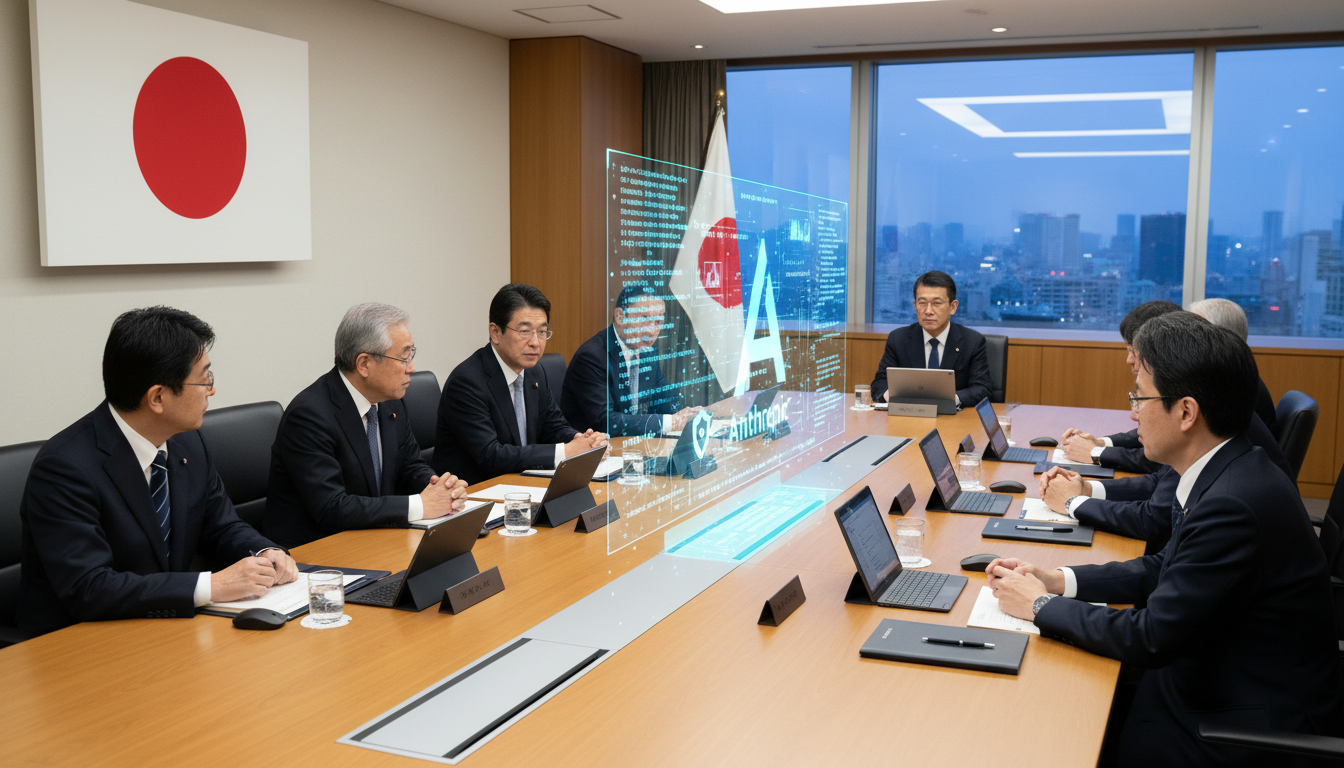
Japan Gains Access to Anthropic’s Claude Mythos to Harden Financial Cyberdefenses
Japan secures access to Anthropic’s Claude Mythos for government and megabanks, accelerating cyberdefense collaboration and recovery planning by May 28, 2026.
The Japanese government and major domestic banks are set to gain access to Anthropic PBC’s latest artificial intelligence model, Claude Mythos, a move officials say will strengthen defenses against AI-driven cyber threats. Sources indicate access could begin as early as May 28, 2026, enabling the public and private sectors to use Mythos for vulnerability detection and remediation planning. Authorities and financial institutions view the deployment as a targeted effort to reduce systemic cyber risk while managing the model’s sensitive capabilities.
Details of the planned access and timeline
Financial institutions participating include the three megabanks — MUFG Bank, Ltd., Sumitomo Mitsui Banking Corp. and Mizuho Bank, Ltd. — alongside government agencies, the Japan Exchange Group and a range of domestic and international IT firms. Sources familiar with the arrangements said the initial roll-out will be confined to controlled trials and selected teams trained to handle outputs securely. The two-week window referenced by officials places initial operational use around May 28, 2026, though wider adoption depends on trial outcomes and negotiated safeguards.
Anthropic’s restricted rollout and rationale
Anthropic PBC is limiting access to Mythos and conducting restricted trials because of the model’s advanced capability to identify system weaknesses, a company spokesperson said in previously released materials. Japanese officials and bank security leaders expressed concern that unrestricted access could increase the risk of the tool being weaponized in cyberattacks against financial infrastructure. As a result, access agreements emphasize tight user controls, oversight protocols and phased deployment to prevent misuse and inadvertent exposure of sensitive data.
Policy discussions before the agreement
High-level talks on the risks posed by cutting-edge AI models took place in April, when Finance Minister Satsuki Katayama, Bank of Japan Governor Kazuo Ueda and leaders of the three megabanks met publicly to discuss coordinated responses. Those discussions highlighted the dual-use nature of models like Claude Mythos — valuable for defensive analysis but potentially dangerous if exploited by malicious actors. Following the April meeting, Prime Minister Sanae Takaichi instructed ministers on May 12, 2026, to compile comprehensive, government-wide countermeasures addressing AI-related cyber threats.
Working group convened to define operational rules
A working group that includes the megabanks, the Japan Exchange Group, domestic and foreign IT vendors, and Anthropic’s Japanese subsidiary convened on May 14, 2026, to set operational procedures. Participants are expected to establish protocols for controlled access, review chains for vulnerability reports, and criteria for escalating critical findings to national authorities. The group will also examine audit trails, data handling standards and live-fire testing restrictions to maintain the stability of financial networks during trials.
Focus on vulnerability patching and recovery methods
Officials say discussions within the working group will concentrate on mechanisms for sharing code fixes, coordinating patch deployment, and sequencing recovery steps in the event of an attack. Banks and regulators plan to develop standard operating procedures for rapidly translating Mythos-generated vulnerability reports into tested mitigations. The emphasis will be on minimizing service disruption and ensuring that any defensive actions taken off the model’s outputs are themselves resilient and auditable.
Expected safeguards and oversight measures
Access agreements are being structured to include technical controls such as role-based permissions, output redaction, and restricted export of model insights outside approved environments. Oversight is likely to combine internal bank security teams with designated government cyber units to review high-risk findings before implementation. Sources indicated that periodic third-party audits and incident response playbooks will be mandatory components of the access regime to ensure transparency and public confidence.
Claude Mythos is being positioned as a specialized tool for strengthening cyber resilience rather than a broadly accessible service for general use. Japanese authorities stressed the need for a cautious, evidence-driven rollout that balances the model’s defensive value with the imperative to prevent its misuse. The coming weeks will be critical as participants finalize access terms, conduct initial trials and assess whether Mythos can be integrated without introducing new systemic risks.
Implementation milestones include the working group’s next sessions to refine operational rules and a ministerial meeting to formalize the government-wide countermeasure package. If trials proceed as planned, select teams at the megabanks and key agencies could begin using Mythos in controlled settings by May 28, 2026, with broader deployment contingent on the results of those evaluations.

