
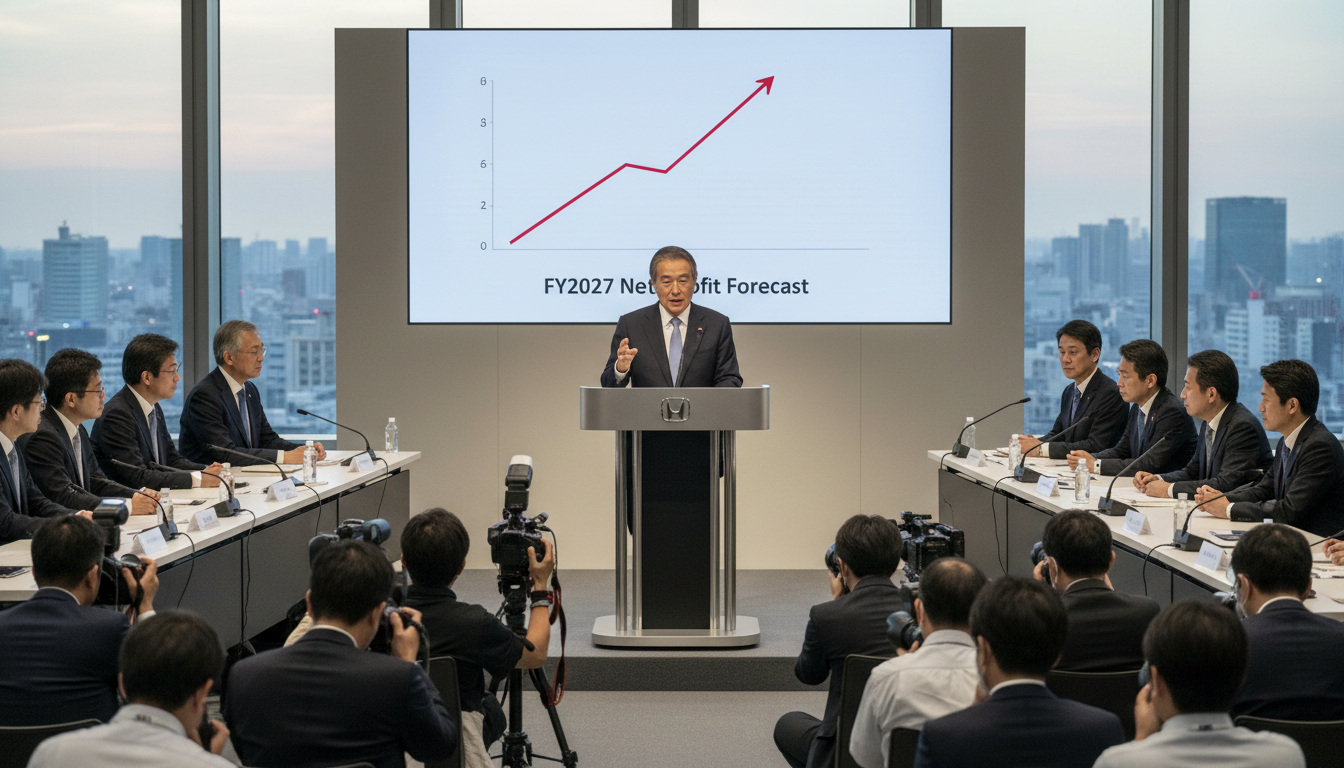
Honda net profit forecast ¥260 billion as company seeks rebound after EV losses
Honda net profit forecast ¥260 billion for fiscal year to March 2027 as company aims to recover after its first listing era net loss from EV related losses.
Honda on May 14, 2026 announced a forecast that aims to restore a positive Honda net profit by the fiscal year ending March 2027, targeting 260 billion yen. The company disclosed that it recorded its first net loss since listing in the previous fiscal year, attributing the shortfall to electric vehicle related losses and restructuring tied to its EV push. The outlook signals a deliberate effort to balance long term electrification goals with near term profitability as management adjusts strategy in response to a shifting market.
Projected return to profitability
Honda set a net profit target of 260 billion yen for the fiscal year to March 2027, signaling management confidence in a financial turnaround. The forecast reflects expectations for improved margins, reduced one off charges, and recovery in core vehicle sales as global markets normalize. Executives framed the projection as a key milestone in restoring investor confidence after the prior year loss that interrupted a decades long record of profitability.
Nature of the recent net loss
The automaker said the loss recorded for the prior year was largely linked to electric vehicle related costs and writedowns tied to ambitious investments. Those costs included large scale R and D outlays, capital spending on production capacity, and adjustments to vehicle programs as demand patterns evolved. Honda described the results as a reassessment of where and how to allocate resources in the transition to electrified mobility.
Shift in EV strategy under President Mibe
Company officials have signaled a scaling back of the aggressive EV strategy launched in 2021 under President Toshihiro Mibe, citing a changing business environment. The revised approach places greater emphasis on prudence in investment timing and on preserving cash flow while maintaining commitments to electrification targets. Honda is recalibrating product roadmaps and go to market plans to align with consumer demand and competitive realities.
Steps to improve margins and cut costs
To meet its net profit target, Honda plans to tighten cost controls and prioritize higher margin models and markets, according to company commentary. Management is also focusing on platform efficiency, supplier negotiations, and streamlined capital expenditure to reduce near term cash burn. Executives indicated that the company will seek productivity gains across manufacturing and logistics while protecting investments essential for future competitiveness.
Implications for investors and markets
Analysts and investors will watch Honda net profit performance closely as a barometer of whether the company can pivot from heavy upfront EV spending back to stable earnings. The forecasted return to profitability is designed to reassure shareholders that management can manage the trade off between strategic transition and shareholder returns. How markets react will depend on subsequent quarterly results and the transparency of execution plans for cost savings and product pacing.
Broader impact on Japan automakers
Honda’s recalibration may influence peers in Japan that are balancing electrification goals with profitability pressures, as companies weigh the pace of EV rollouts against consumer adoption and regulatory timelines. The move underscores a broader industry dilemma where aggressive electrification strategies must coexist with realistic assessments of capital intensity and near term cash flow. Observers say the outcome at Honda will be seen as an important test for whether traditional automakers can sustain investment in new powertrains while protecting earnings.
The company’s forecast and strategic adjustments mark a critical juncture for Honda as it seeks to demonstrate that a large legacy automaker can manage the shift to electrified mobility without compromising financial stability.

