
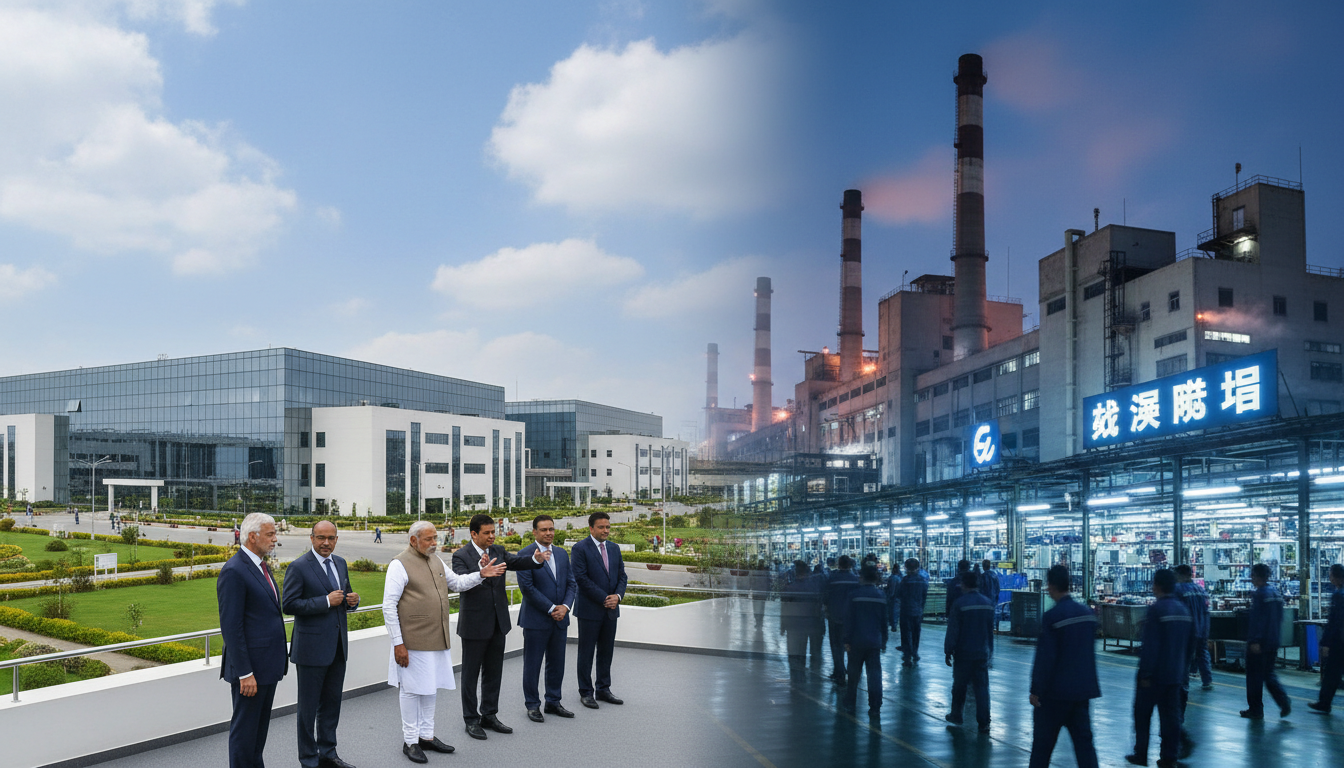
China’s Surge in Mature-Node Chips Clouds India’s First Semiconductor Fab Opening
China’s surge in mature-node chips threatens India’s first semiconductor fab, raising concerns over competitiveness, supply chains and New Delhi’s strategy.
India’s first semiconductor fabrication plant, due to start operations later this year, faces immediate competitive pressure as China rapidly scales production of mature-node chips. Industry analysts warn that Chinese capacity growth — estimated to account for roughly half of global mature-node output — could undercut the economics that New Delhi is banking on to build a domestic semiconductor ecosystem. Tech experts in Bengaluru say the new Indian fab will need clear market niches and policy support to avoid becoming commercially marginal.
China’s rapid expansion in mature-node chips
Analysts point to a sharp increase in Chinese investment in facilities that produce mature-node chips, typically used in power management, automotive systems and sensors. These nodes are less complex than bleeding-edge processes but dominate by volume and revenue in many established segments.
State-backed projects and private firms in China have prioritized capacity at these nodes to capture stable demand and move up value chains. The scale and speed of that expansion are reshaping global capacity balances, creating a tougher environment for late entrants focused on the same product ranges.
Details of India’s first semiconductor fabrication plant
The upcoming plant, backed by a combination of government incentives and private investment, is positioned as India’s inaugural step into wafer fabrication at scale. Officials and industry participants have described the project as foundational for a broader semiconductor ecosystem that includes assembly, testing and design services.
Planners have targeted mature-node production precisely because it aligns with India’s existing industrial strengths and immediate domestic demand. But the facility will confront fierce price and volume competition from established Chinese manufacturers unless it secures long-term contracts or differentiates through specialized outputs.
Competitive pressure and market positioning challenges
Market analysts say competing on cost against Chinese mature-node output will be difficult for a new Indian fab that lacks the integrated supply chain and buyer relationships already in place across East Asia. Large customers in automotive and consumer electronics often source chips from suppliers with deep, geographically diversified capacity and long-term price commitments.
To establish viability, the Indian plant may need to serve adjacent regional markets, pursue specialized variants of mature-node chips, or carve partnerships with global buyers concerned about supply diversification. Without such strategic customers, the plant risks underutilization and steep margins pressure in a crowded market.
Supply-chain and demand-side implications
China’s heavy focus on mature-node capacity is altering supply-chain dynamics, particularly for equipment, materials and testing services. Suppliers that scale production to serve Chinese fabs may prioritize those large-volume contracts, potentially limiting timely access and increasing lead times for new entrants elsewhere.
On the demand side, automotive electrification, telecom upgrades and consumer-device growth continue to sustain global needs for mature-node chips. Analysts say that while demand remains robust, it is increasingly concentrated with buyers who negotiate hard on price and delivery reliability, favoring suppliers with scale and geographic reach.
Policy, incentives and infrastructural hurdles for New Delhi
Indian policymakers have deployed subsidy programs and incentives aimed at luring wafer fab investment, emphasizing job creation and technology transfer. However, building a resilient domestic semiconductor industry requires more than caps on capital expenditure; it calls for predictable long-term procurement, export facilitation and logistics improvements.
Infrastructure gaps, workforce skilling and access to downstream packaging and testing capacities remain challenges. Industry participants note that aligning procurement by state enterprises and private buyers toward the new fab could provide the demand certainty needed to justify its operating costs and future reinvestment.
Industry responses and strategic options for the Indian fab
Executives and consultants recommend a mix of approaches to strengthen the plant’s prospects: secure anchor customers through bilateral industrial agreements, focus on higher-margin specialty mature-node products, and invest in lean manufacturing to narrow cost differentials. Collaborative ventures with overseas firms seeking supply diversification are another pathway frequently proposed.
Some companies are exploring co-located clusters that integrate design, testing and materials suppliers to reduce logistics costs and speed time-to-market. Such clusters could help the Indian facility compete on turnaround time and customization rather than purely on unit price.
International observers warn that success will depend on aligning commercial strategy with realistic assessments of global capacity. Analysts advise Indian planners to avoid overly optimistic assumptions about capturing broad market share in commodity mature-node segments dominated by large Chinese producers.
Final paragraph
The entry of India’s first semiconductor fab marks a significant milestone for New Delhi’s industrial ambitions but also exposes the venture to immediate competitive headwinds driven by China’s mature-node capacity expansion. Success will hinge on securing stable demand, tightening local supply chains and distinguishing the plant’s output in a market where scale and established customer ties now define commercial resilience.

