
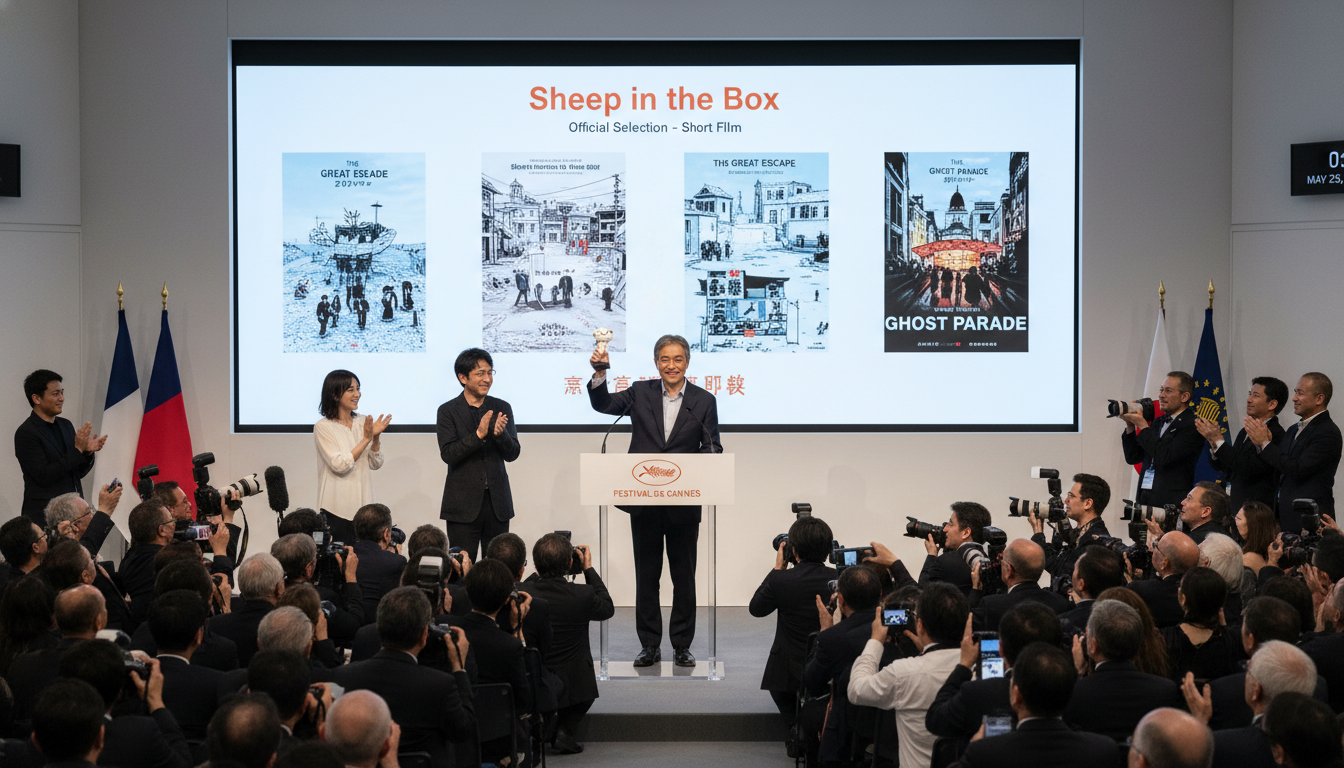
Cannes Film Festival Spotlights Koreeda’s ‘Sheep in the Box’ as Three Japanese Films Enter Main Competition
At the Cannes Film Festival, Hirokazu Koreeda’s new sci‑fi drama "Sheep in the Box" headlines three Japanese entries in the main competition, bringing questions of family and AI to the Riviera. The festival runs May 12–23 and has selected 22 films for its top slate this year.
Three Japanese Films in Main Competition
This year marks the first time since 2001 that three films directed by Japanese filmmakers have been named to Cannes’ main competition. The inclusion signals renewed international attention on contemporary Japanese cinema amid a competitive global lineup.
Hirokazu Koreeda is the only director among them with previous main-competition selections dating back to earlier editions, reaffirming his longstanding presence on the festival circuit. The other two Japanese entries underline a diverse national showing across established and emerging voices.
Koreeda’s ‘Sheep in the Box’ Premise
"Sheep in the Box" is set in the near future and concerns a couple who introduce a humanoid, modeled on their deceased son, into their household. Koreeda, who wrote the original story, frames the plot around grief, technological substitution and the possibility of forming new kinds of family bonds.
The film’s title draws inspiration from a line in Antoine de Saint-Exupéry’s The Little Prince, a nod to literary resonance within the screenplay. Koreeda departs from his recent realist work by placing familiar emotional dynamics into a speculative setting.
Plot and Central Characters
The narrative follows Otone, an architect, and her husband Kensuke, a construction company scion, as they navigate the unresolved loss of their seven-year-old son. To cope, they acquire a state-of-the-art humanoid unit customized with data from their child, an experiment that tests parental limits and moral choices.
As the humanoid begins to develop, the film traces interactions that are at once tender and unsettling, highlighting tensions between memory and simulation. The story raises questions about what constitutes parenthood when technology occupies the space of a child.
Casting and Child Performance
A central element of the film’s reception has been the performance of the young actor who plays the humanoid. Selected from an open search of more than 200 child performers, the actor has been praised for conveying an otherworldly intelligence alongside emerging emotion.
Koreeda’s record for working with compelling young talent continues, and the casting choice is presented as integral to the film’s credibility. The dynamic between the lead adults and the child actor anchors the story’s emotional core.
Themes of Family, Parenthood and Artificial Intelligence
Koreeda translates his well-established interest in family dynamics into a meditation on technology’s role in intimacy and loss. The film juxtaposes the speed of technological advancement with parents’ fears about failing to guide a child’s future.
Rather than offering a purely dystopian warning, the narrative explores whether new forms of coexistence are possible when human values shape artificial beings. The architect protagonist’s effort to harmonize natural and artificial elements becomes a central moral throughline.
Other Competition Titles to Watch
Beyond the Japanese entries, critics and festivalgoers have flagged several international auteurs whose new works are drawing attention. Among them are established directors known for stylistic rigor and genre versatility, whose films are expected to vie for the Palme d’Or.
Several commentators have already singled out titles from Poland and South Korea as among the festival’s highlights, while another Japanese director’s entry has also attracted early buzz. The competition’s varied roster promises a range of cinematic approaches and thematic preoccupations.
Cannes remains a key barometer for global film trends, and this year’s selection underscores how national cinemas persistently reshape international conversation. As "Sheep in the Box" and its compatriot entries screen for critics and audiences, their reception will contribute to ongoing debates about grief, creativity and the ethics of artificial life.
The outcomes of the main competition will be announced toward the close of the festival on May 23, and the response to these Japanese films may influence distribution and festival strategies in the months ahead.

