
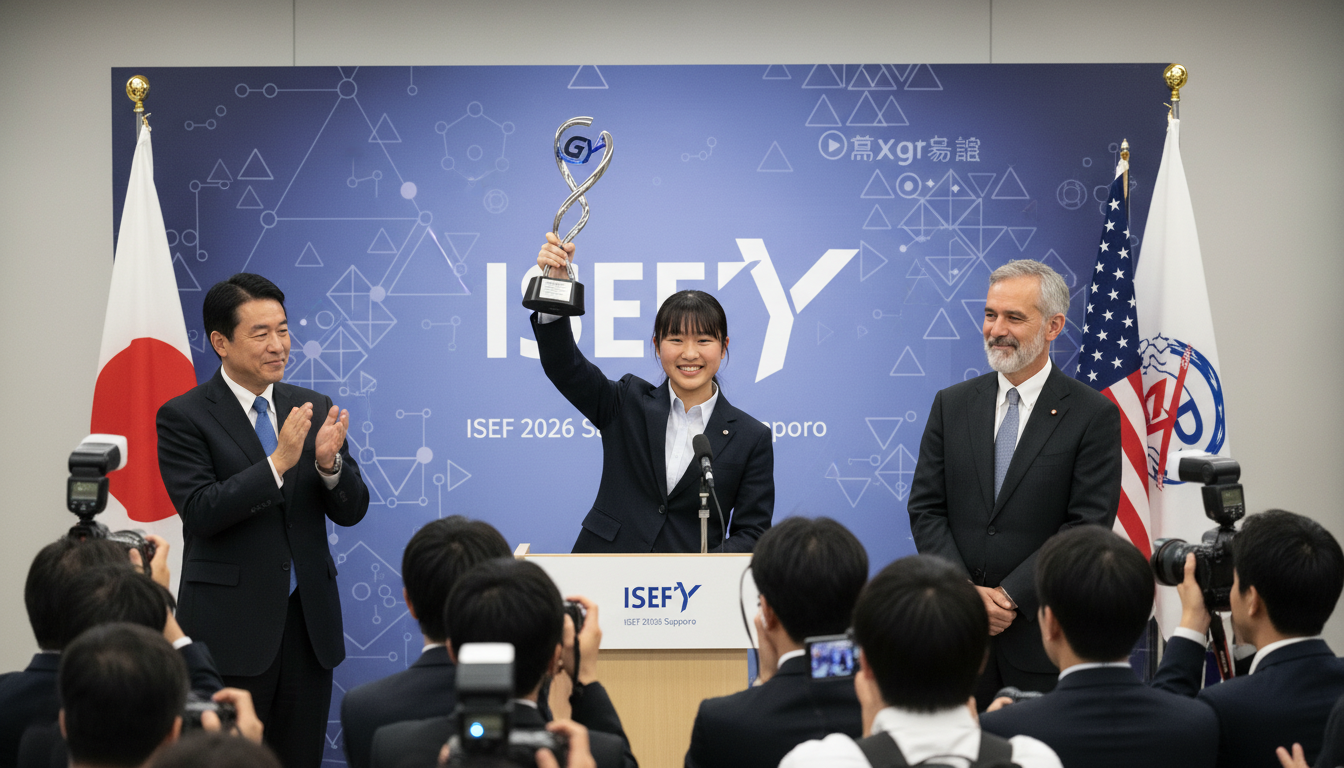
Sapporo Student Hikaru Kuribayashi Wins ISEF 2026 Top Prize for MCMC Research
Hikaru Kuribayashi captured the ISEF 2026 top honor in Phoenix, winning the George Yancopoulos Innovator Award for his MCMC-based structural analysis, a first for Japan.
Strong opening: Japanese student claims ISEF 2026 overall award
Hikaru Kuribayashi, a sixth-year student at Sapporo Kaisei Secondary School, won the overall top prize at ISEF 2026 after receiving first place in the Physics and Astronomy category. The International Student Science and Engineering Fair (ISEF 2026) ran May 9–15 in Phoenix, Arizona, and Kuribayashi’s work on Markov chain Monte Carlo (MCMC) methods earned him the George Yancopoulos Innovator Award. He told reporters he was stunned by the result, saying he could not tell whether it was a dream or reality.
Kuribayashi’s achievement marks the first time a Japanese participant has received the highest honor at ISEF, a milestone for Japan’s secondary-school research community. The award was chosen from winners across 22 subject categories, underscoring the broad field-based competition at the fair.
Details of the winning research and method
Kuribayashi’s project, titled a study of linkage mechanisms using Markov chain Monte Carlo methods, focused on developing numerical techniques to infer structural relationships in target systems. He built computational models that leverage MCMC sampling to reconstruct probable linkages and configurations from incomplete or indirect measurement data. The approach refines parameter estimation and offers a way to resolve structural ambiguity where traditional analytic methods struggle.
Judges praised the work for its methodological rigor and potential applicability to multiple fields that require structural inference, including materials science, biological networks, and complex mechanical systems. Kuribayashi’s methodology emphasized numerical stability and computational efficiency, attributes that distinguished his entry in a crowded physics and astronomy field.
Scale and scope of ISEF 2026 in Phoenix
ISEF 2026 brought together 1,727 students presenting 1,383 projects from 67 countries and regions, according to organizers. The weeklong event hosted judged competitions across 22 judging categories and provided forums for mentorship, industry engagement, and scientific exchange. Winners in each category competed for special awards, fellowships, and scholarships in addition to recognition by scientific institutions.
Organizers said the Phoenix event retained ISEF’s tradition of pairing international youth researchers with professional judges from academia, government, and industry. The fair’s scale and diversity make it one of the world’s premier stages for pre-university scientific research.
Japanese delegation and selection pathway through JSEC 2025
Japan sent 29 students with 19 projects to ISEF 2026, with representatives selected through the national contest High School and Technical College Science and Engineering Challenge (JSEC) 2025. JSEC, organized by Asahi Shimbun and TV Asahi, functions as Japan’s primary qualifying route for ISEF, identifying projects with international competitiveness and scientific depth.
The delegation included students from public, private and international schools as well as recent high-school graduates now enrolled at university. Selection panels for JSEC evaluated submissions on originality, methodology, and societal relevance before choosing teams to represent Japan on the ISEF stage.
Other Japanese awardees at ISEF 2026
Several other Japanese entrants also received recognition at ISEF 2026. Yugo Igarashi of the American School in Japan captured a second-place award in the Robotics and Intelligent Machines category for work presented by that institution’s high-school division. Go Kato, a first-year student at the University of Tokyo and a graduate of Tokyo Gakugei University High School, placed fourth in the Animal Sciences category.
Sophia Rei Nagasaka of Tokyo Metropolitan Hibiya High School earned a fourth-place award in Biochemistry, and Nao Uematsu of Oin High School placed fourth in the category exploring the expansion of art through technology. In total, nine Japanese students across seven projects received category awards in Phoenix, reflecting a range of topics from robotics to life sciences.
Reactions and implications for science education in Japan
Educators and contest organizers in Japan hailed Kuribayashi’s win as a signal of growing strength in student-led research and computational approaches. Officials involved in JSEC noted that the result may encourage greater investment in mentorship, computational resources, and research training at the secondary level. The victory also underscores a trend toward cross-disciplinary methods, where mathematical and computational tools are applied to physical and biological problems.
Observers said the recognition could raise the profile of project-based learning in Japanese schools and prompt schools and local governments to expand support networks for young researchers. Several science educators suggested that the win might also inspire more students to pursue advanced study in computational physics and data-driven experimental design.
Kuribayashi’s success may influence how institutions and sponsors evaluate future entries, with an increased premium on demonstrable methodology and real-world applicability. At the same time, the award highlights the importance of international competitions in benchmarking student research against global peers.
Kuribayashi plans to return to Japan following his prize ceremony and to continue refining his computational methods, aiming to publish his results in a scientific forum and to explore collaborative opportunities with university researchers. The win at ISEF 2026 establishes a new benchmark for Japanese pre-university research on the global stage and may shape the next generation of student scientists.

