
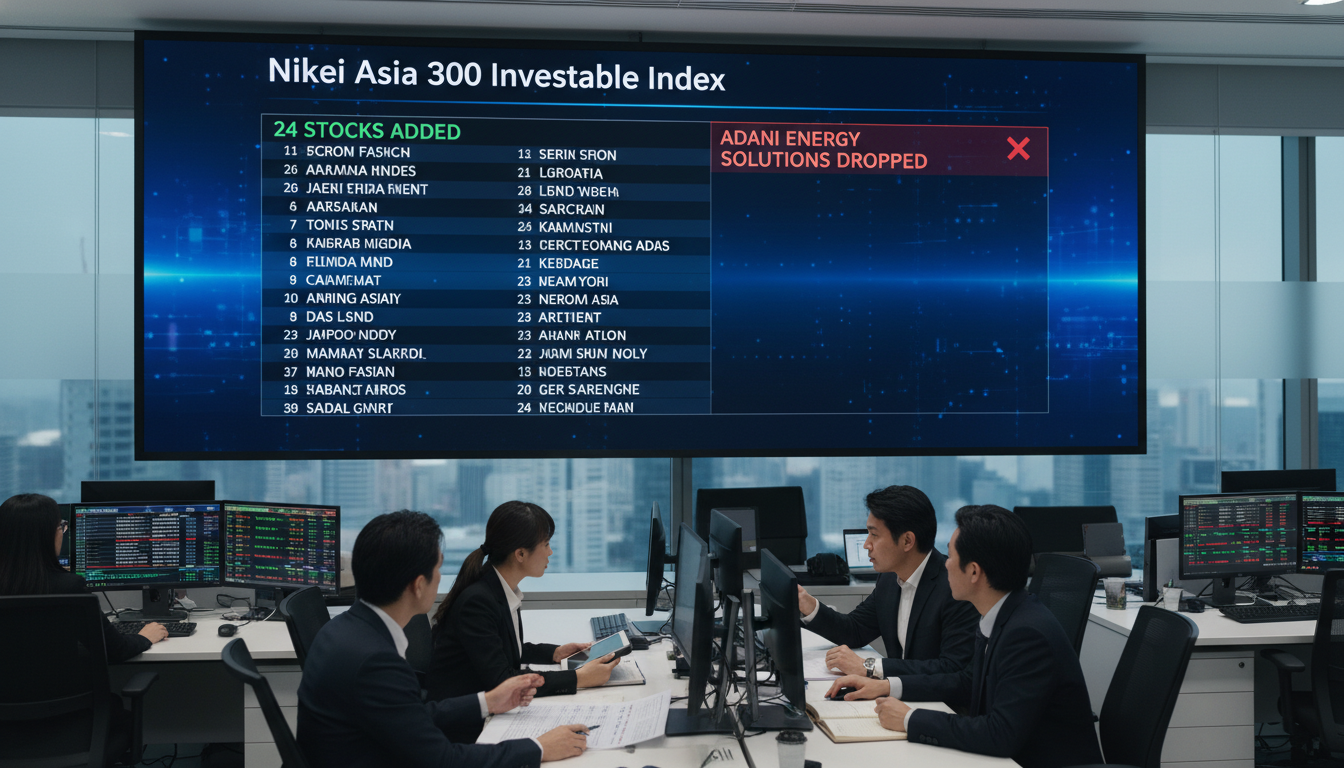
Nikkei Asia300 Investable Index to Add 24 Stocks, Remove 23 Including Adani Energy Solutions in June Review
Nikkei Asia300 Investable Index will add 24 stocks and remove 23 companies, including India’s Adani Energy Solutions, with the changes set to take effect June 1 after the index’s annual review. Nikkei said the additions include Aluminum Corp. of China and reflect adjustments based on market capitalization, trading value, sales growth and free-float ratios. The rebalance covers listed companies across 10 Asian markets and follows a year of shifting sector weights and individual stock performance.
Nikkei Asia300 Review Results
The annual reshuffle increased the index’s roster by one net name this year, with 24 entrants and 23 exits identified in Nikkei’s June review. The imbalance stems partly from an earlier, separate deletion in January when Hong Kong’s Hang Seng Bank was removed from the investable measure. Nikkei confirmed the full set of constituent changes as part of its routine governance of the Asia-wide benchmark.
Changes to the Nikkei Asia300 Investable Index are designed to keep the gauge aligned with liquid, investable companies across the region. The index tracks a cross-section of large and mid-cap names that meet liquidity and free-float requirements, and the June update is the vehicle for incorporating the year’s shifts in market value and trading patterns.
Entrants Highlight: Aluminum Corp. of China Joins
Among the 24 additions, Aluminum Corp. of China stands out as a major industrial entrant that will now be included in the investable lineup. Its inclusion reflects stronger market capitalization and trading activity relative to peers, according to the criteria used by the index committee. Other new constituents span multiple sectors and markets, broadening the index’s exposure to metals, manufacturing and other industry groups.
The addition of larger state-linked industrial firms may alter sector weightings in the index and in funds that replicate it. Passive products tracking the Nikkei Asia300 will typically increase holdings in newly added names, prompting incremental demand in the affected stocks ahead of and after the effective date.
Exclusions Spotlight: Adani Energy Solutions Dropped
India’s Adani Energy Solutions is among the 23 firms removed from the Nikkei Asia300 Investable Index in this cycle. The company’s exclusion follows the committee’s assessment of its relative eligibility on the basis of market metrics used for selection. Removal from a widely-tracked investable index often triggers reallocation by index-linked funds and may lead to short-term pressure on outgoing securities.
Nikkei’s statement did not single out reasons for individual deletions beyond the formal selection framework, which evaluates measurable factors such as market capitalization and trading value. Market participants often monitor such changes closely because index exclusions can influence liquidity and investor attention for the affected companies.
Selection Criteria and Geographic Scope
Nikkei conducts its annual constituent review in June using a transparent set of quantitative filters, including market capitalization, trading value, sales growth and free-float ratio. The review encompasses companies listed in 10 countries and regions across Asia, aiming to balance representativeness with investability for institutional and retail investors. By applying these metrics, the index seeks to maintain a portfolio of stocks that global and regional investors can readily trade.
The committee’s approach is routine and formulaic, though it allows for adjustments tied to corporate actions and market events that alter a company’s eligibility. The June review is the primary mechanism for reconstituting the investable index, ensuring it reflects the evolving structure of Asian equity markets on an annual basis.
Implications for Markets and Funds
Reconstitution of the Nikkei Asia300 Investable Index carries practical consequences for exchange-traded funds, index-tracking mandates and other passive strategies that benchmark to the measure. Managers of such funds typically rebalance holdings to match the updated index composition, which can generate buying pressure in newly added names and selling pressure in delisted stocks. These flows are generally concentrated around the effective date and can temporarily affect share price dynamics and trading volumes.
For active managers, the reshuffle offers signals about shifting market leadership and liquidity trends across the region. Analysts and portfolio teams often reassess sector allocations and stock-specific theses in light of index movements, particularly when prominent companies are added or removed. Market makers and institutional traders also prepare for changes in order patterns tied to index reweights.
Timing and Implementation Details
The changes announced by Nikkei will be implemented on June 1, allowing market participants several weeks to prepare operationally for trades and portfolio adjustments. The rebalancing timetable gives fund managers time to plan transitions and minimize execution costs, while brokers and custodians align settlement operations to accommodate inflows and outflows. Nikkei’s disclosure of the full list of additions and deletions precedes the effective date to ensure transparency and orderly market adjustment.
The one-firm difference between additions and deletions this year reflects the earlier removal of Hang Seng Bank in January, rather than an ad hoc expansion of the index. That prior adjustment reduced the count of constituents ahead of the scheduled June review and explains why 24 entrants now replace 23 exits.
Market participants said they would watch trading patterns around the implementation date and monitor whether index-related flows materially affect valuations. Passive demand associated with the Nikkei Asia300 Investable Index remains an important component of liquidity for many Asian-listed stocks, and reconstitution events are recurring focal points for investors.
The annual review reinforces the index’s role as a barometer of investable Asian equity markets and underscores the ongoing need for transparency in index governance and selection procedures.

