
University of Tokyo May Festival Canceled After Bomb Threat Over Lecture by Sanseitō Speaker
A bomb threat forced the University of Tokyo May Festival cancellation on May 16, 2026, after controversy over a planned lecture by Sanseitō representative Kamiya sparked protests and security concerns.
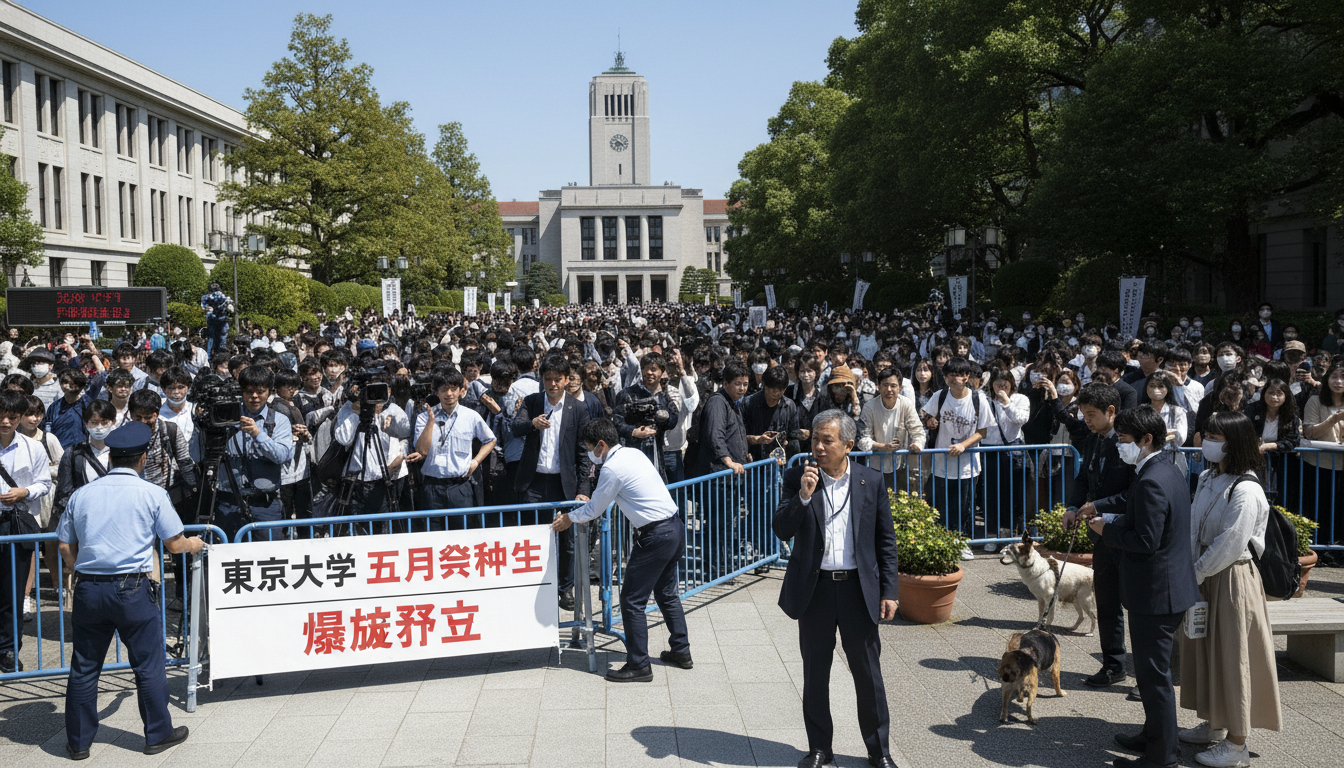
The University of Tokyo announced that all scheduled events at the May Festival were canceled on May 16, 2026, following a reported bomb threat tied to a politically charged lecture. Organizers and students who protested against the guest speaker spoke to reporters as the campus emptied and visitors departed the grounds.
Cancellation After Bomb Threat
The university suspended the entire May Festival program after authorities were informed of a bomb threat connected to a lecture scheduled for that day. Attendees and passersby at the main gate were photographed leaving the campus amid congested exits as organizers halted activities.
University officials cited the security alert as the reason for the shutdown, and several student groups confirmed the decision to reporters on site. Organizers said they cooperated with campus staff and provided information to clarify the sequence of events leading to the cancellation.
Conservative Circle Organized the Lecture
The lecture had been planned and promoted by a small, conservative political circle at the university known as Ugo no Shuu, which the organizers say comprises about 25 members. The circle initially sought to invite Finance Minister Satsuki Katayama but did not secure her participation and subsequently invited Kamiya roughly a month before the festival date.
Representatives of the group described the outreach and scheduling process as routine for campus political programming. The decision to host Kamiya drew swift attention because of his national profile as the leader of the Sanseitō party.
Organizers Say They Sought Debate, Not Endorsement
Yamada, a 20-year-old second-year student in the College of Arts and Sciences who serves as the circle’s representative, told reporters the group did not intend to endorse Sanseitō. He said the planned event aimed to prompt rigorous debate on the party’s policies and to expose attendees to competing views in a university setting.
Organizers also said they had coordinated with Kamiya’s team in advance, including a review of presentation slides, to understand the substance of the planned remarks. They characterized that preparatory work as part of standard event management rather than political advocacy.
Protests and Tensions Around the Lecture
Student demonstrators had gathered to protest Kamiya’s appearance, and witnesses described tense exchanges between protesters and attendees near the lecture venue. Protest organizers said they wanted the university to prevent the event because they viewed the speaker’s positions as incompatible with campus values.
The protests were ongoing at the time authorities became aware of the security threat, though those interviewed by reporters emphasized that the demonstrations were intended as peaceful expressions of opposition. The coexistence of protest activity and the security alert intensified debate over how universities should manage contentious political events.
Campus Response and Aftermath
Following the cancellation, festival organizers and student activists gave separate accounts of the day to news crews gathered outside the university gate. Photographs from the scene show visitors leaving while staff worked to notify participants and clear scheduled venues.
The university has not issued a detailed public timeline of its coordination with law enforcement, and officials said investigations into the threat were continuing. Meanwhile, the abrupt shutdown disrupted a wide range of cultural and academic programs that had been planned as part of the May Festival.
Broader Questions on Free Speech and Safety
The incident has reignited discussion in academic and civic circles about balancing freedom of expression with campus safety. Faculty, student leaders, and civil liberties advocates are likely to consider whether existing event protocols, risk assessments, and channels for protest are adequate to prevent similar disruptions.
Critics on multiple sides have framed the episode as a test of institutional handles on political speech: whether universities should host controversial figures and how campuses should protect participants while allowing robust debate. The May Festival cancellation has become a focal point for that broader conversation.
The cancellation of the University of Tokyo May Festival on May 16 has underscored the challenges of staging politically sensitive events at major universities. As investigations into the threat proceed, organizers, protesters and university officials say the dispute over how to balance open discussion with security precautions is likely to continue.

