
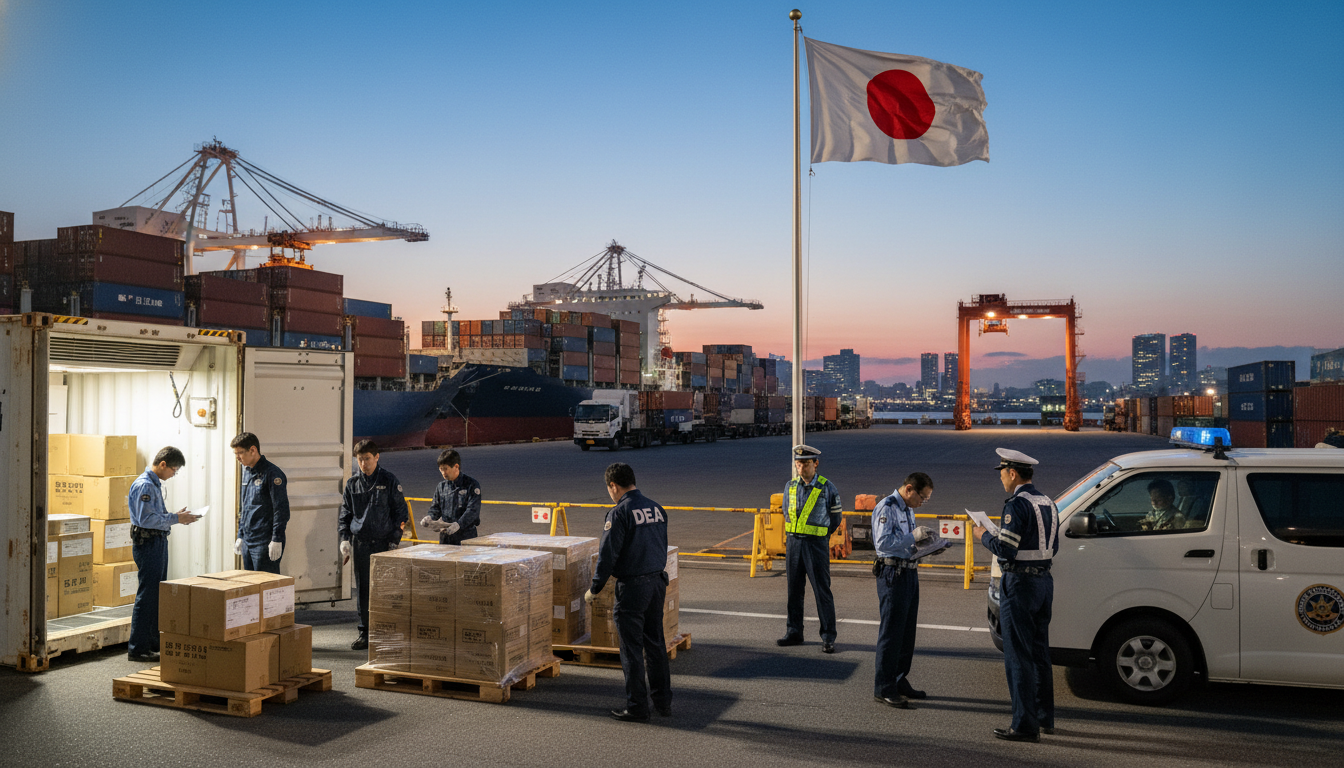
DEA Says Japan Part of Fentanyl Smuggling Route to U.S., DEA Confirms
DEA says Japan is part of a fentanyl smuggling route to the U.S., prompting stepped-up inspections and stronger U.S.-Japan law enforcement cooperation now.
TOKYO — A Drug Enforcement Administration official said on Friday, May 22, 2026, that Japan is part of a fentanyl smuggling route leading to the United States, marking the American agency’s first public acknowledgment of the country’s role in transit of the synthetic opioid. The DEA official made the statement in Tokyo during meetings with Japanese counterparts, saying the finding reflects shifting trafficking patterns in Asia-to-North America flows. Japanese authorities and the DEA are expected to intensify inspections and intelligence sharing in response.
DEA Statement and Context
The DEA official described Tokyo as a transit point rather than a primary production center, noting that shipments often move through multiple jurisdictions before arriving in North America. This announcement represents the agency’s first explicit identification of Japan’s involvement in the transit chain for illicit fentanyl shipments to the U.S. The official did not provide operational details or quantify recent seizures at the Tokyo meeting.
Analysts and law enforcement officers have long warned that synthetic opioid distribution now relies on complex international logistics and parcel services, making interdiction more challenging. The DEA’s comment underscores how traditional maritime and air cargo routes have been supplemented by smaller consignments and commercial mail, which are harder to detect without targeted intelligence.
How Fentanyl Shipments Transit Through Asia
Traffickers increasingly parcelize consignments and employ commercial shipping networks to disguise shipments among legal goods, according to law-enforcement assessments. These methods reduce the visibility of individual consignments and complicate detection by customs and postal inspectors. The use of intermediaries, forged documents and transshipment through third countries further obscures origins and destinations.
Chemical precursors and finished synthetic opioids can be concealed in consumer products, industrial materials or mislabeled packages, making forensic detection and profiling essential. Investigators say the cross-border nature of such shipments often requires cooperation among multiple agencies and governments to trace supply chains and intercept shipments before they reach final markets.
Customs and Postal Controls in Japan
Japan’s customs and postal services face the task of screening a high volume of international parcels while minimizing disruptions to legitimate trade. Small-package inspections and risk-based targeting are central tools, but resource constraints and the sheer volume of e-commerce shipments present operational limits. Japan’s legal and regulatory framework allows for inspection and seizure of contraband, though officials have in the past cautioned that evolving concealment techniques demand continual updates to screening protocols.
Customs agencies typically rely on intelligence-led alerts, electronic data sharing and laboratory analysis to identify suspicious consignments. The DEA’s public acknowledgment of a transit role could prompt Tokyo to increase targeted inspections of particular routes, shippers or commodity types flagged by U.S. and international partners.
U.S.-Japan Law Enforcement Cooperation
The DEA official’s comments came amid scheduled consultations between U.S. and Japanese law-enforcement agencies that are focused on transnational narcotics trafficking. Bilateral cooperation has historically included information exchange, joint investigations and capacity building, and officials indicated that those mechanisms will likely expand in scope and frequency following the announcement.
Enhanced cooperation could involve more systematic sharing of electronic parcel manifests, joint task forces on mail and courier interdiction, and technical assistance for forensic analysis. Diplomats and law-enforcement leaders on both sides are expected to weigh operational options that balance robust interdiction with respect for legal and commercial norms.
Public Health and Policy Repercussions
While the DEA framed Japan’s role as a transit point, the declaration raises broader public-health concerns because fentanyl and its analogues account for a significant share of opioid-related fatalities in the United States. Policymakers in both countries may now confront a heightened imperative to combine interdiction with prevention, treatment and harm-reduction strategies. Public-health experts emphasize that supply-side measures alone cannot eliminate demand or reduce overdose deaths.
In Japan, where opioid misuse has historically been lower than in some Western countries, authorities may nonetheless consider reinforcing surveillance of domestic distribution channels to prevent diversion from international shipments. In the United States, officials could use the DEA’s statement to justify expanded efforts to trace and disrupt supply chains at their points of origin and transit.
The DEA’s Tokyo statement also underscores the need for multilateral approaches that address manufacturing, distribution and the online marketplaces facilitating illicit trade. International coordination on precursor controls, postal data sharing and joint prosecutions will be central to any sustained response.
The DEA’s first public recognition of Japan’s role in a fentanyl-smuggling route to the U.S. is likely to intensify operational and diplomatic activity between the two countries. As agencies move to expand inspections, intelligence sharing and joint enforcement, the announcement may prompt changes in screening practices and legal cooperation designed to interrupt shipments before they reach U.S. markets.

