
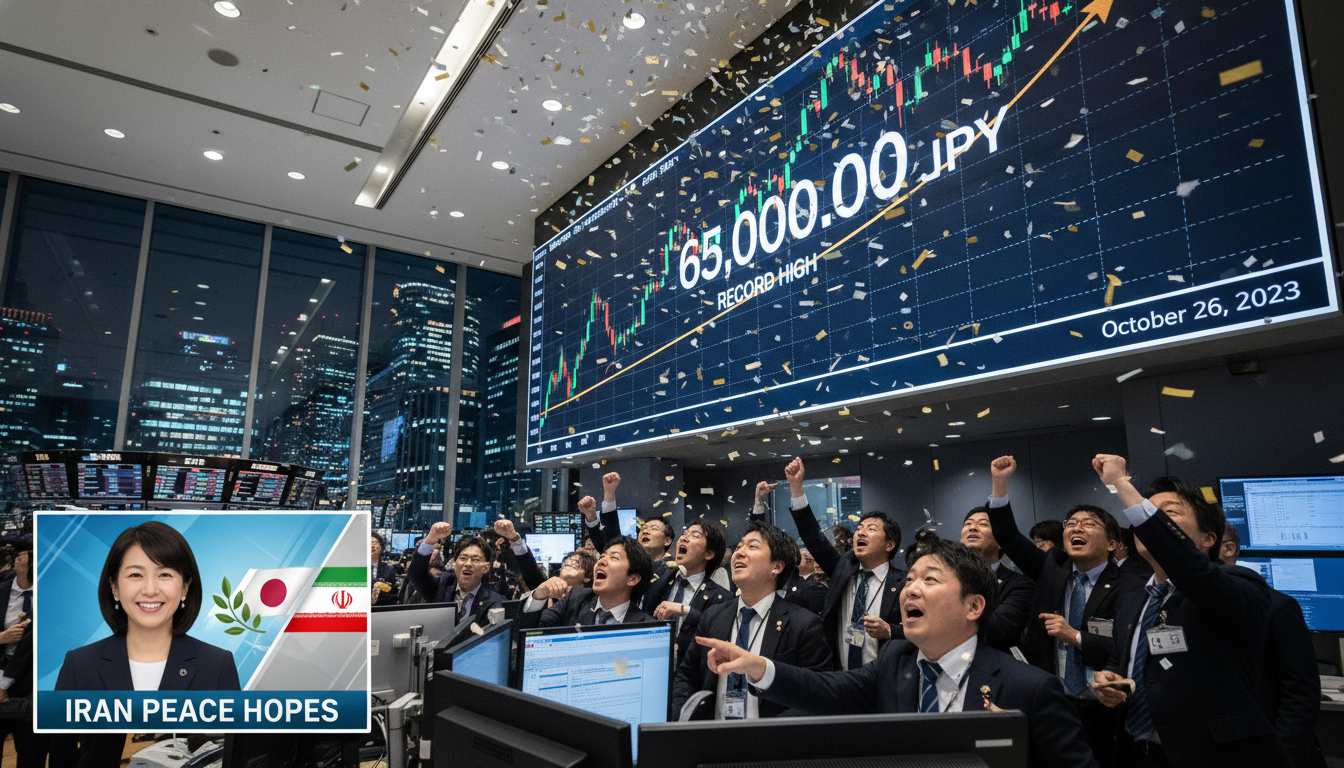
Nikkei average closes above 65,000 for first time as oil falls on U.S.–Iran negotiation hopes
On May 25, 2026 the Nikkei average surged to 65,158.19, climbing 2.87% as oil futures fell on hopes of U.S.–Iran talks, lifting heavyweight semiconductor and AI-linked stocks.
Record close for the Nikkei
The Tokyo Stock Exchange closed on Monday, May 25, 2026, with the Nikkei average finishing at 65,158.19, up 1,819.12 points, or 2.87% from the prior Friday’s close. The index cleared the psychological 65,000 level for the first time, setting a new historical high in intraday and closing trading.
Market participants attributed the sharp gain to an improvement in global risk sentiment after signs of progress in negotiations between the United States and Iran. The move reflected both headline-driven flows and concentrated buying in a handful of large-cap, high-weight stocks.
WTI oil slump cited as catalyst
U.S. West Texas Intermediate (WTI) crude futures fell more than 5% in early New York trade, sliding back into the $90-per-barrel range on renewed optimism about a de-escalation between Washington and Tehran. Traders said expectations that fighting could ease reduced a key geopolitical risk premium that had been supporting oil prices and inflation fears.
The decline in oil futures eased concerns over profit margins for energy-intensive sectors and lowered the near-term inflation outlook, prompting global equity investors to re-enter risk markets. The direct link from lower crude prices to Japanese equities was reinforced by the outsized weighting of resource-sensitive and export-driven companies in major indices.
Semiconductor and AI names led gains
Large-cap technology and semiconductor firms contributed disproportionately to the index rise, with stocks such as SoftBank Group and Tokyo Electron among the top advancers. Analysts noted that persistent demand for artificial intelligence infrastructure and chips has pushed investors back into high-valuation, tech-related names that carry heavy index weights.
This concentration amplified the headline move in the Nikkei average, which is price-weighted and therefore sensitive to large swings in a limited number of components. Portfolio managers cautioned that while headline returns were strong, underlying sector and stock-level dispersion remained significant.
U.S. political messages added to uncertainty
Market commentary highlighted a string of public statements by U.S. President Donald Trump between May 23 and May 24, 2026, that both suggested substantial progress in talks with Iran and urged his delegation not to rush a final agreement. The mixed messages appeared to temporarily boost hopes for a settlement while also reminding investors that diplomatic outcomes remain fragile.
Traders said those political signals were priced into markets rapidly, producing a short-term rally in risk assets but also raising the possibility of reversals if messages or negotiations shift. The episode underscored how sensitive oil and equity markets remain to geopolitical developments and to high-profile commentary.
Analysts flag narrow breadth and caution on sustainability
Despite the historic close, sell-side strategists and independent analysts warned that market breadth across the Tokyo exchange was mixed, with roughly half of listed stocks trading lower on the day. They argued that a headline breakout through a psychological level can attract profit-taking and heightened volatility as investors reassess valuations and rotate positions.
Several analysts suggested that a pause or consolidation in the coming sessions was plausible, particularly if oil prices stabilize or if geopolitical headlines fail to deliver a definitive resolution. Investors were advised to monitor earnings revisions, currency moves, and commodity trends to gauge whether the rally can broaden beyond a small set of megacaps.
The market’s reaction also highlighted the interplay between global macro drivers and domestic positioning, with foreign flows, yen movements and derivatives-implied volatility all likely to influence the next leg of trading.
The Nikkei average’s record close on May 25, 2026 reflected a convergence of improved risk sentiment, falling oil prices and concentrated gains in semiconductor and AI-linked stocks, but market watchers stressed that narrow breadth and ongoing geopolitical uncertainty could temper momentum in the near term.

