
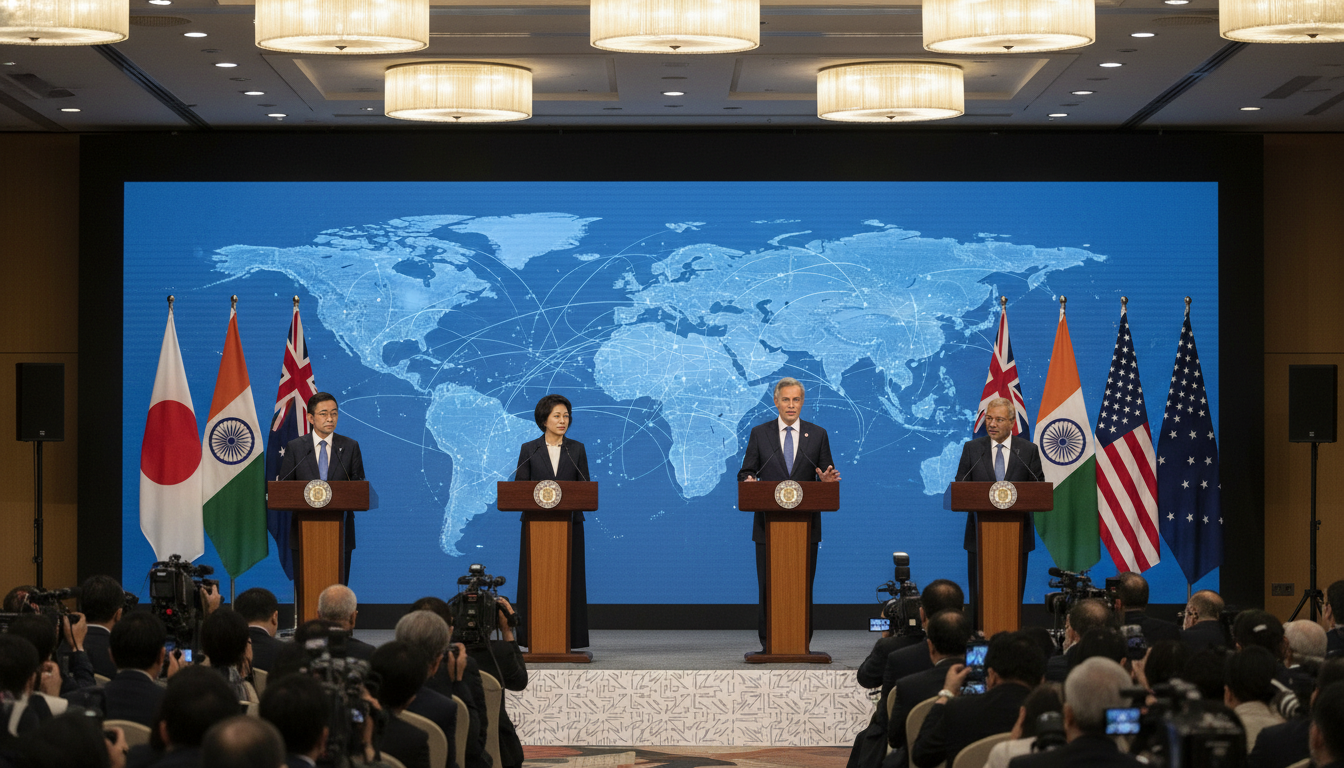
Quad foreign ministers meeting in New Delhi unveils maritime, energy and critical minerals initiatives
Quad foreign ministers meeting in New Delhi on May 26, 2026, saw Australia, India, Japan and the U.S. unveil joint maritime, energy and critical minerals plans.
The Quad foreign ministers meeting in New Delhi on May 26, 2026, brought senior diplomats from Australia, India, Japan and the United States together to announce coordinated initiatives on maritime surveillance, energy security and critical minerals supply chains.
The ministers framed the measures as practical steps to strengthen resilience across the Indo-Pacific amid rising geopolitical tension.
The meeting at Hyderabad House marked a policy push focused on information-sharing and supply-chain diversification rather than new military pacts.
Quad ministers convene in Hyderabad House
The gathering of Quad foreign ministers was held at Hyderabad House in New Delhi and was attended by the Australian, Indian and Japanese foreign ministers alongside their U.S. counterpart.
Officials said the talks aimed to translate strategic alignment into specific, cooperative programs that can be implemented quickly across the region.
Maritime surveillance and information sharing initiatives
Ministers announced plans to expand maritime surveillance cooperation, including enhanced information-sharing protocols and coordinated monitoring of sea lanes.
The initiative will prioritize interoperability and timely exchange of maritime domain awareness data to support search-and-rescue, illegal fishing prevention and incident response.
Measures to bolster energy security
Energy security formed a central pillar of the discussions, with ministers committing to joint steps to reduce regional vulnerability to supply disruptions.
Proposals outlined at the meeting emphasize diversification of energy sources, emergency coordination mechanisms and increased transparency in cross-border energy infrastructure projects.
Strengthening critical minerals supply chains
The Quad ministers highlighted critical minerals as essential to economic and technological resilience, and discussed measures to secure stable, diversified supply chains.
Planned actions include enhanced cooperation on mining, processing and responsible supply-chain practices to reduce dependence on single-source suppliers and to support domestic industrial needs.
Strategic context amid Indo-Pacific tensions
Participants framed these initiatives as responses to growing strategic competition in the Indo-Pacific, noting that economic and maritime stability underpin regional security.
While the ministers avoided singling out any country in public statements, they repeatedly referenced the need for resilient systems in the face of rising assertiveness and disruption risks.
Follow-up mechanisms and implementation timetable
Officials said the ministers instructed senior officials to translate the broad commitments into detailed workplans and timelines for implementation.
Diplomatic sources indicated that technical working groups and joint exercises on surveillance and supply-chain resilience would be convened in the coming months to operationalize the announced measures.
The ministers also signaled an intent to coordinate with like-minded partners and regional institutions to amplify the impact of the initiatives.
This approach aims to attract private-sector participation and leverage existing regional frameworks to accelerate practical outcomes.
The Quad foreign ministers meeting in New Delhi underscored a shift toward concrete, deliverable cooperation on maritime safety, energy resilience and critical minerals supply chains.
By focusing on interoperable systems and supply-chain diversification, the four countries seek to reduce strategic vulnerabilities while maintaining openness and cooperation across the Indo-Pacific.
The ministers pledged to monitor progress closely and to report back at subsequent meetings, setting an implementation horizon that begins immediately and extends through the year.
Observers in the region will be watching how quickly technical arrangements and working groups turn policy announcements into measurable outcomes.

