
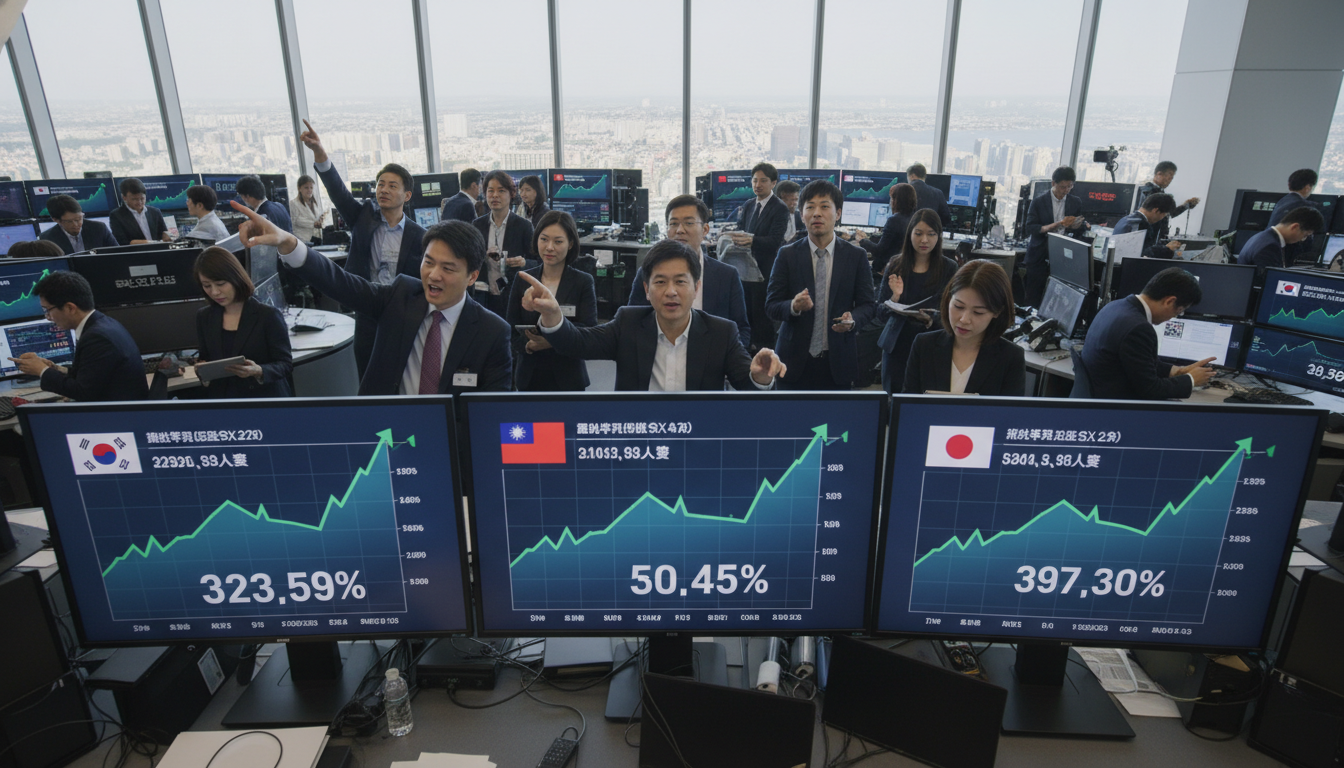
AI capex lifts East Asian stock markets to fresh highs
AI capex and easing Iran-war concerns drive East Asian stock markets higher, with South Korea, Taiwan and Japan reaching records amid semiconductor-led gains.
Receding concerns over the Iran war and a surge in AI capital spending have pushed East Asian stock markets to new highs, with investors favoring semiconductor and AI-related names. The AI capex boom has underpinned strong gains in South Korea, Taiwan and Japan, while market participants caution that profit-taking could introduce momentary volatility. Major tech firms, including memory-chip makers such as SK Hynix, led the rally as expectations for cloud and data-center investment increased.
Markets rally on AI capex and easing geopolitical fears
Markets across East Asia moved in unison as investors priced in stronger corporate spending on artificial intelligence infrastructure. The pick-up in AI capex complemented improving risk sentiment after a period of heightened concern over tensions in the Middle East. Combined, these forces tilted flows toward technology and capital goods sectors, which stand to benefit most from servers, chips and networking equipment demand.
Trading dynamics showed broad participation, with domestic retail buyers and institutional investors both adding to positions in growth-oriented stocks. Money managers cited the clearer geopolitical backdrop as enabling a focus on fundamentals, particularly companies that have announced or signaled higher capital expenditure. That shift helped indexes in Seoul, Taipei and Tokyo repeatedly test and set new intraday and closing highs.
South Korea’s semiconductor surge leads the advance
South Korea emerged as a standout market as semiconductor names posted some of the strongest gains in the region. Memory-chip producers and related equipment suppliers benefited from renewed optimism about demand for AI-optimized memory and high-bandwidth modules. Shares of SK Hynix in particular registered notable upward moves as investors priced in outsized benefit from industry spending cycles.
The broader Korean market also reflected confidence in large-cap exporters and technology conglomerates that are accelerating AI-related investment. Market observers pointed out that the country’s tech ecosystem has been a primary conduit for capital flowing into semiconductor and AI supply chains. Commentary from market participants highlighted the dual effect of corporate capex plans and improving external demand as central to the rally.
Taiwan and Japan post consecutive records on tech strength
Taiwan’s benchmark climbed as chipmakers and foundry-related suppliers rallied on expectations of sustained orders for advanced semiconductors. The island’s market, closely linked to global device and data-center supply chains, reacted to signals of higher AI-related capacity spending by both cloud providers and device makers. Investors also monitored corporate guidance and capital expenditure announcements for confirmation that chip demand trends are durable.
In Tokyo, technology and industrial names contributed to a fresh string of highs even as some traditional defensive sectors lagged. Japanese electronics and machinery firms seen as suppliers to AI and data-center projects drew renewed attention from overseas investors. The combined effect was a rotation toward shares with clear exposure to AI capex, pushing the Nikkei and other Tokyo indices higher in recent sessions.
Investor caution: profit-taking and short-term volatility
Despite the broad advance, market participants warned that sharp rallies can invite profit-taking and intraday reversals. Analysts noted that while AI capex is a structural tailwind, short-term flows are still sensitive to headlines and positioning. Any sudden geopolitical development or a disappointing earnings update could trigger rapid rebalancing, producing temporary blips in otherwise upward-trending markets.
Volatility measures remained subdued relative to spikes seen during acute geopolitical episodes, but trading desks said they were prepared for episodic pullbacks. Risk managers recommended layered execution for new positions and hedging for larger exposures to the most exuberant winners. The consensus view among many portfolio managers was that corrections would likely be buying opportunities for investors with a medium-term horizon.
Policy signals and corporate spending plans underpin momentum
Government policy and central bank communications have also played into investor calculations, with many officials emphasizing economic stability and structural investment. Measures to support semiconductor ecosystems, from subsidies to research partnerships, reinforce the investment case for firms expanding AI-related capacity. Corporate announcements of increased capital expenditure — on data centers, chips and automation — have provided tangible evidence that firms are acting on capacity plans.
Analysts underscored that the sustainability of the rally depends on the pace and scale of actual spending rather than expectations alone. Continued ordering by hyperscalers and steady demand for AI hardware will be key to validating elevated valuations. For now, the alignment of policy, corporate plans and receding geopolitical risk has created fertile ground for equities tied to AI capex.
Market participants will continue to watch incoming earnings, capex disclosures and any shifts in geopolitical risk as they assess whether the recent gains can be extended.

