
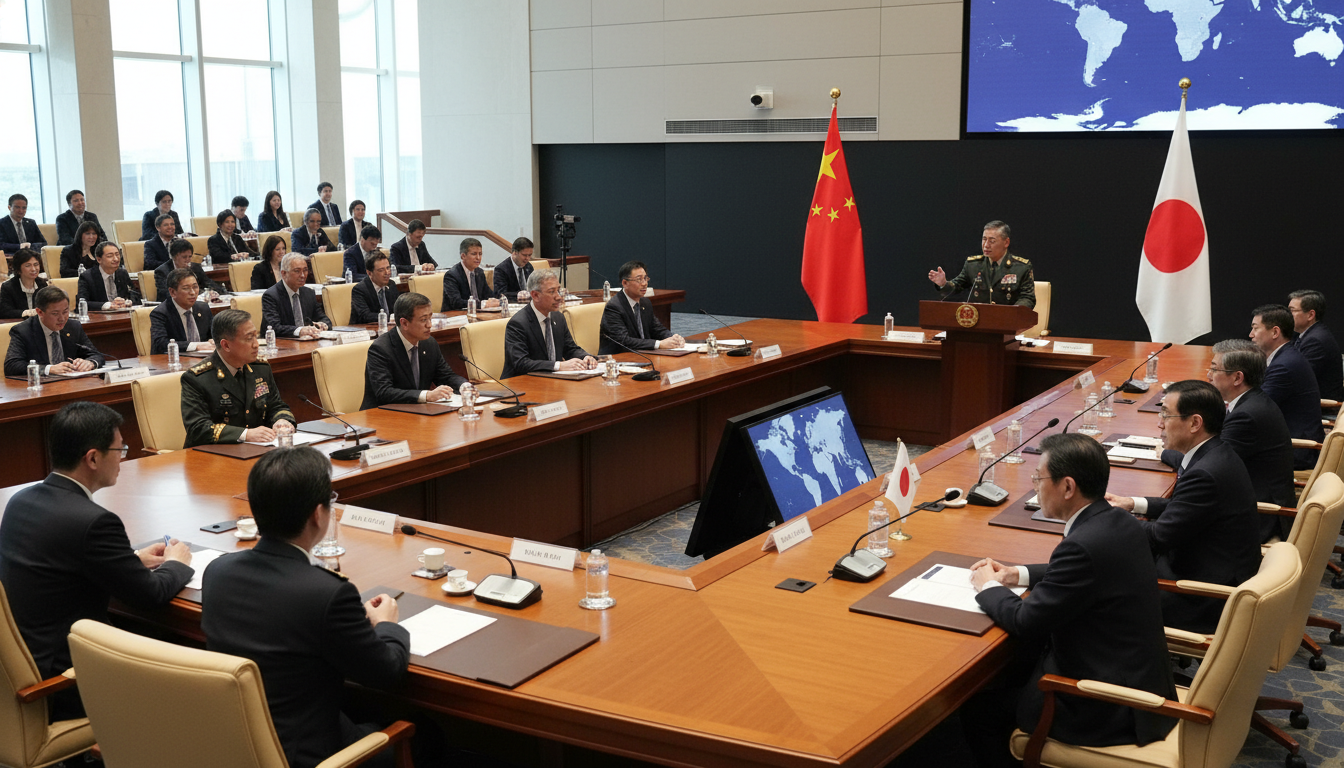
China Accuses Japan of "New Militarism" at International Conference
China criticizes Japan’s "new militarism" at an international forum after Prime Minister Takaichi’s Taiwan remarks, escalating diplomatic and economic tensions between Tokyo and Beijing.
Japan and China entered a fresh diplomatic confrontation after Chinese officials publicly denounced what they called a rise of "new militarism" in Tokyo. The phrase was used repeatedly at an international conference following Prime Minister Sanae Takaichi’s comments on a Taiwan contingency, and the dispute has since broadened into economic and security arenas. Chinese Foreign Ministry spokesman Guo Jiakun raised the issue at a May 22, 2026 press briefing, signaling Beijing’s intent to press the argument on multiple diplomatic stages.
China Frames Tokyo’s Actions as ‘New Militarism’
At a May 22 press conference, Foreign Ministry spokesman Guo Jiakun told reporters that Japan was shedding its “peace-state” image and moving toward a path Beijing and its allies describe as “new militarism.” State media and diplomats amplified the description at an international meeting, seeking to frame Tokyo’s defense buildup and Taiwan policy as a regional challenge. The message targeted both foreign audiences and regional governments, urging vigilance against what Beijing portrays as a shift in Japan’s postwar posture.
Chinese statements have combined rhetorical pressure with diplomatic outreach, aiming to shape international opinion. Officials emphasized Japan’s increased defense spending and more assertive security posture as evidence, while linking Tokyo’s Taiwan-related remarks to broader regional instability. The framing is intended to constrain Japan diplomatically and to rally neighboring countries to Beijing’s viewpoint.
Takaichi’s November 2025 Parliamentary Comment and Fallout
The immediate trigger for the current dispute was Prime Minister Takaichi’s parliamentary answer in November 2025, when she described a Taiwan contingency as a situation that could qualify as a “state of existential crisis.” That language went beyond long-standing official formulations and prompted a strong reaction from Beijing, which regards Taiwan as a core interest. Japanese officials later sought to temper the diplomatic fallout by clarifying that they would be cautious about specifying hypothetical responses to particular scenarios.
Tokyo’s attempt at damage control failed to satisfy Beijing, which demanded an explicit retraction of the comment. Japanese authorities rejected that demand, arguing that withdrawing the remark would curtail options for responding to crises and undermine sovereign decision-making on national security. The impasse prompted Beijing to escalate its campaign through public criticism and selective economic countermeasures.
Beijing Uses Economic Measures and Messaging as Leverage
Following the diplomatic spat, China has supplemented its rhetorical campaign with economic pressure aimed at signaling costs to Tokyo. Beijing has broadened export and regulatory measures targeting sensitive technologies and supply chains, and it has stepped up negative messaging about Japan in international forums. Officials see such tools as a way to apply non-military leverage without triggering direct confrontation.
Japanese business and government circles are closely watching the measures for their scope and durability. Some analysts warn that prolonged economic tension could force Tokyo to accelerate diversification of supply chains and deepen security cooperation with partners. For the Takaichi administration, balancing economic priorities with a tougher security stance has become an urgent policy dilemma.
Regional Security Concerns and ‘Stage Zero’ Gray-Zone Tactics
Beyond diplomatic and economic moves, regional security experts say the contest has highlighted Beijing’s use of gray-zone tactics often described as “stage zero” operations. Those activities include maritime coercion, persistent patrols near disputed areas, and maneuvers intended to alter facts on the ground without open warfare. Observers argue such measures aim to achieve strategic objectives short of conflict and to erode adversaries’ options over time.
Tokyo and neighboring capitals are increasingly attentive to incidents at sea and infrastructure vulnerabilities that could be exploited in peacetime. Japanese officials have pointed to growing risks around undersea cables and critical logistics nodes, and they are planning defensive measures to harden assets against non-kinetic pressure. The security debate now extends to whether deterrence requires not only military capacity but also resilience in critical civilian systems.
Public Opinion Strengthens the Prime Minister’s Position
Domestic sentiment in Japan has so far not forced a reversal of the government’s posture. A national opinion survey conducted December 20–21, 2025 found a majority of respondents viewing Prime Minister Takaichi’s stance on China as acceptable, even after the diplomatic deterioration. That backing has given the administration political cover to resist Beijing’s demand for a formal retraction and to defend its approach to national security.
Political figures in Tokyo face competing pressures: to preserve economic ties with China while responding to voters who favor a firmer defense policy. The government’s strategic challenge will be to navigate those demands without allowing bilateral tensions to translate into lasting economic harm or unchecked instability in the region.
The unfolding exchange between Tokyo and Beijing demonstrates how a single parliamentary comment can trigger a complex mix of diplomatic, economic and security responses in East Asia. As both capitals settle into a longer period of contention, the shape of ties will be influenced by how each side calibrates pressure, pursues alliances, and manages domestic expectations.

