
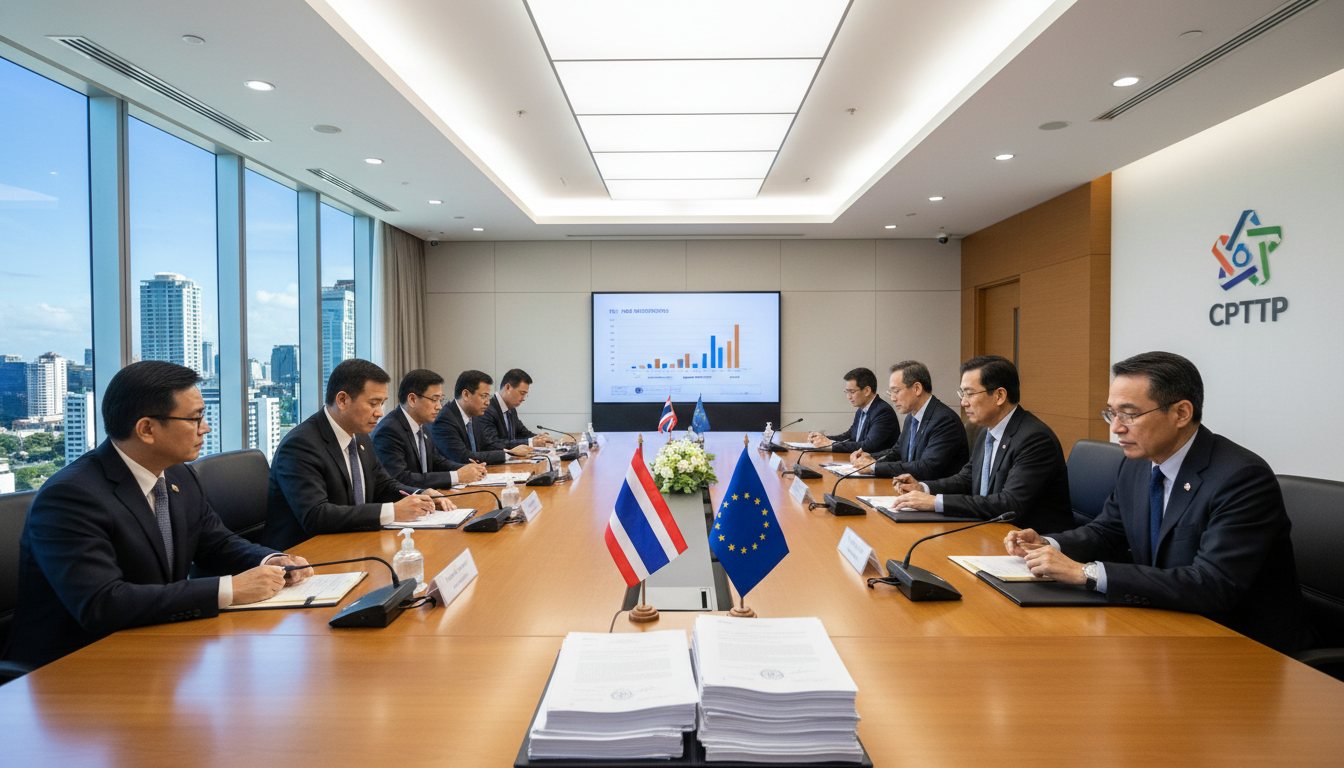
Thailand signals renewed push for CPTPP membership while pursuing EU trade pact
Thailand signals renewed interest in CPTPP membership and seeks an EU trade pact to protect exporters and diversify trade as global protectionism rises.
Thailand’s foreign minister and deputy prime minister said Bangkok is again considering membership of the Comprehensive and Progressive Agreement for Trans‑Pacific Partnership (CPTPP) while pursuing a separate trade agreement with the European Union, underscoring a strategic shift toward deeper regional and global integration. The remarks were made by Sihasak Phuangketkeow during an interview at Nikkei’s Future of Asia forum in Tokyo on June 10, as he framed the moves as responses to growing protectionist pressures affecting global trade.
Renewed CPTPP consideration announced
Sihasak identified the CPTPP as a key multilateral option for Thailand to anchor its export‑led economy within rules‑based trade architecture. He said the government is “again” considering the pact, indicating a revival of earlier efforts to join the Pacific trade agreement that lowers tariffs and sets common standards among members.
Thai officials have portrayed CPTPP membership as a means to enhance market access for manufacturers and agricultural exporters while aligning regulatory practices with major partners. With U.S. trade policy and rising tariff measures disrupting traditional supply chains, Bangkok is positioning the CPTPP as a hedge against unilateral protectionist actions.
EU trade pact negotiations targeted
At the same time, Sihasak said Thailand aims to “conclude” a trade deal with the European Union, signalling parallel negotiations with a major market for Thai goods and services. An EU agreement would potentially address tariff barriers, investment rules and regulatory cooperation, offering exporters a valuable alternative to markets affected by escalating trade barriers.
EU trade talks have long been of interest to Bangkok for their potential to attract investment and boost standards in areas such as food safety and intellectual property. By pursuing both CPTPP entry and an EU pact, Thailand is seeking to diversify its trade partnerships rather than rely on any single market or trading relationship.
Economic rationale amid protectionism
Officials in Bangkok argue that deeper trade ties can help protect Thai industries from volatility caused by unilateral tariffs and trade restrictions. Sihasak explicitly linked the strategy to the “rise of protectionism,” framing multilateral and plurilateral agreements as stabilising frameworks for exporters.
Analysts say joining the CPTPP and securing an EU pact could lower costs for Thai manufacturers that depend on imported inputs and integrated regional supply chains. Broader rule‑making may also reduce non‑tariff barriers that increasingly shape competitiveness in global markets.
Potential gains for exporters and investors
For exporters, CPTPP accession and an EU trade agreement could expand preferential access to high‑value markets, particularly for processed food, electronics and automotive parts where Thailand already has a strong foothold. Investors may be attracted by clearer rules and stronger protections for cross‑border investment that come with such agreements.
However, experts caution that benefits are not automatic. Accession to the CPTPP would require domestic reforms and regulatory alignment across sectors, while an EU pact could include provisions on labour standards, environmental rules and public procurement that necessitate policy adjustments in Bangkok.
Political and regional implications
Sihasak’s remarks also carry geopolitical overtones in a region where trade alliances increasingly intersect with strategic considerations. By pursuing both CPTPP membership and an EU agreement, Thailand signals a desire to maintain economic openness and strategic flexibility amid shifting great‑power dynamics and trade policy uncertainty.
Domestic politics will influence the pace and scope of any commitments, as lawmakers and stakeholders weigh potential gains against pressures to protect vulnerable industries. The government’s ability to navigate disputed provisions and secure parliamentary approval will be critical to any final accession or treaty ratification.
Bangkok’s dual push comes at a moment when many Asian economies are re‑evaluating trade strategies to reduce exposure to sudden policy changes beyond their control. Thailand’s approach reflects a pragmatic pursuit of multiple insurance mechanisms—regional, trans‑Pacific and trans‑Atlantic—to support long‑term growth.
The foreign minister framed these efforts as part of a broader diplomatic and economic strategy designed to defend Thailand’s trade interests. He emphasised that regional pacts and reciprocal agreements can create predictability for businesses and help preserve the integration that underpins supply chains.
Sihasak spoke at Nikkei’s Future of Asia forum in Tokyo on June 10, where regional leaders are debating how to respond to protectionist trends and reconfigure partnerships. His comments underline Bangkok’s intent to actively shape its trade agenda rather than passively adapt to external shocks.
As Thailand moves toward potential CPTPP accession and seeks an EU deal, the coming months will reveal how quickly negotiations can advance and what domestic reforms will be required. Both processes are complex and could extend over multiple rounds of talks, but they represent a concerted effort by the Thai government to secure market access and regulatory certainty in an uncertain global trading landscape.
Thailand’s choices in the near term will matter for exporters, investors and regional economic integration, offering a test of whether strategic diversification can cushion the country from rising protectionist pressures while fostering deeper ties across Asia and Europe.

