
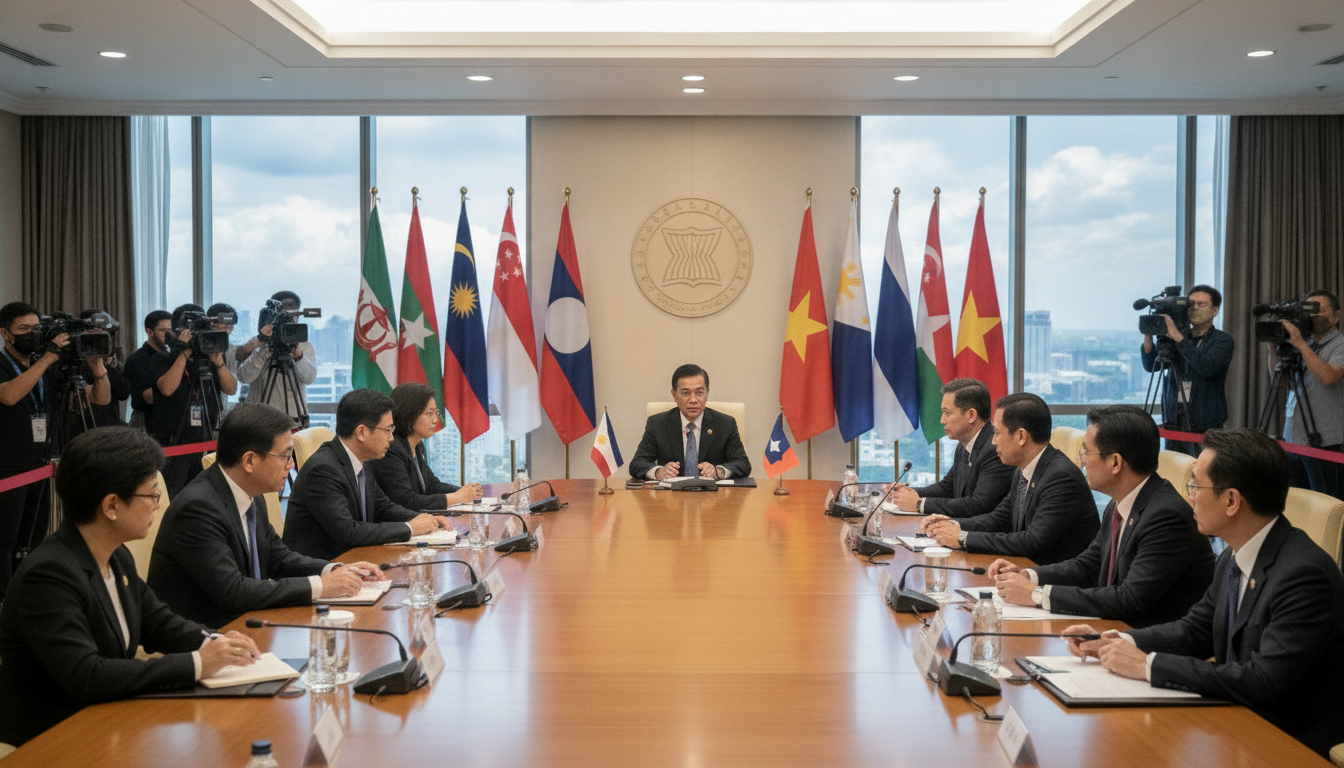
ASEAN foreign ministers meeting in Manila spotlights South China Sea clashes, Myanmar and wider security crises
ASEAN foreign ministers meeting in Manila (July 22–24) drew global counterparts as the Philippines-led summit grappled with South China Sea confrontations, Myanmar and Middle East spillover. (reutersconnect.com)
Manila hosts the 59th ASEAN foreign ministers meeting
The three-day ASEAN foreign ministers meeting, convened in Pasay City at the Philippine International Convention Center, was chaired by Philippine Foreign Secretary Maria Theresa P. Lazaro. The Philippines is serving as ASEAN chair for 2026, and Manila used the forum to elevate regional maritime and security concerns to a multilateral audience. (asean.org)
The meeting brought together foreign ministers from the 10 ASEAN member states alongside dialogue partners and observers, with a packed programme that included the ASEAN Regional Forum and East Asia Summit foreign ministers’ sessions. Delegates held bilateral talks on the sidelines, reflecting the forum’s role as a hub for both formal diplomacy and back-channel engagement. (publicnow.com)
South China Sea incidents dominate discussions
Tensions in the South China Sea, including repeated encounters between Chinese coast guard vessels and Philippine government ships, topped the agenda as ministers met. Philippine officials reported multiple water-cannon incidents against Manila’s vessels during the week, underlining the urgency of preventing maritime incidents from escalating. (apnews.com)
Ministers used a combination of closed-door exchanges and public statements to press for de-escalation and renewed progress on a Code of Conduct with China aimed at preventing incidents at sea. ASEAN diplomats described the negotiations as critical not only for regional stability but also for maintaining freedom of navigation on vital international sea lanes. (reutersconnect.com)
High-level meetings with China and the United States
The Manila meetings featured direct contacts between top diplomats from major powers and ASEAN leaders, including a session with China’s top diplomat and a full slate of engagements involving the United States. China’s foreign minister held discussions with ASEAN counterparts on the proposed non-aggression pact for the South China Sea. (publicnow.com)
U.S. Secretary of State Marco Rubio attended the ASEAN Regional Forum and used the platform to warn against any attempt to impose control over critical straits, while also seeking to deepen practical cooperation with ASEAN partners. His presence underscored the meeting’s role as one of the highest-level contacts between U.S. and Asian counterparts this month. (reutersconnect.com)
EU and Philippines sign Enhanced Partnership on the sidelines
On July 24, European Commission Vice-President and High Representative Kaja Kallas joined Philippine officials to announce and sign an Enhanced Partnership between the European Union and the Philippines. The deal, delivered on the sidelines of the ASEAN foreign ministers meeting, focused on areas including trade, development and security cooperation. (reutersconnect.com)
EU representatives said the partnership was intended to deepen practical engagement with ASEAN members and help deliver infrastructure, climate resilience and governance projects in the region. Manila framed the agreement as complementary to ASEAN priorities and as a sign of growing European interest in Southeast Asia’s security and economic architecture. (reutersconnect.com)
Middle East hostilities and the Strait of Hormuz concern ASEAN ministers
Delegates also discussed the international repercussions of renewed fighting in the Middle East, with ministers expressing alarm at disruptions to energy security and global trade. Several ASEAN statements and partner delegations called for the full reopening and safe passage of the Strait of Hormuz to ensure uninterrupted maritime commerce. (apnews.com)
The presence of Western and Asian dialogue partners at the forum allowed ministers to link regional stability to broader global flashpoints, reflecting ASEAN’s longstanding aim to act as a convenor for crisis diplomacy beyond its immediate neighborhood. (csis.org)
Myanmar’s status remains contentious within ASEAN
Myanmar’s prolonged crisis and the bloc’s 2021 five-point consensus continued to present a diplomatic impasse, with many ASEAN members urging adherence to the plan and others seeking cautious engagement. Manila and the ASEAN special envoy have pressed for humanitarian access and dialogue, but substantive progress on restoring civilian rule remained limited. (apnews.com)
Some ministers described recent informal contacts with Myanmar officials as tentative steps rather than a full return to normalised participation. ASEAN faces pressure from both domestic constituencies and external partners to find a path that addresses human suffering while preserving the bloc’s unity. (apnews.com)
Treaty of Amity and Cooperation 50th anniversary and regional architecture
The Philippines, as ASEAN chair, hosted a commemoration of the 50th anniversary of the Treaty of Amity and Cooperation on July 24, using the milestone to urge renewed commitment to non-aggression and peaceful dispute resolution. ASEAN officials framed the anniversary as a moment to reinforce rules-based engagement amid rising geopolitical friction. (asean.org)
Delegates also discussed the Manila Plan of Action and other initiatives intended to strengthen maritime cooperation, crisis management and economic resilience across Southeast Asia. ASEAN diplomats said the aim was to translate diplomatic language into practical measures that reduce the risk of confrontation and sustain supply chains. (asean.org)
The meetings in Manila illustrated ASEAN’s increasingly central role as a diplomatic platform where regional tensions and global flashpoints converge and are managed through sustained, if cautious, dialogue. Ministers left with reiterated calls for de-escalation, concrete cooperation on maritime safety and new bilateral commitments signed on the sidelines.

