
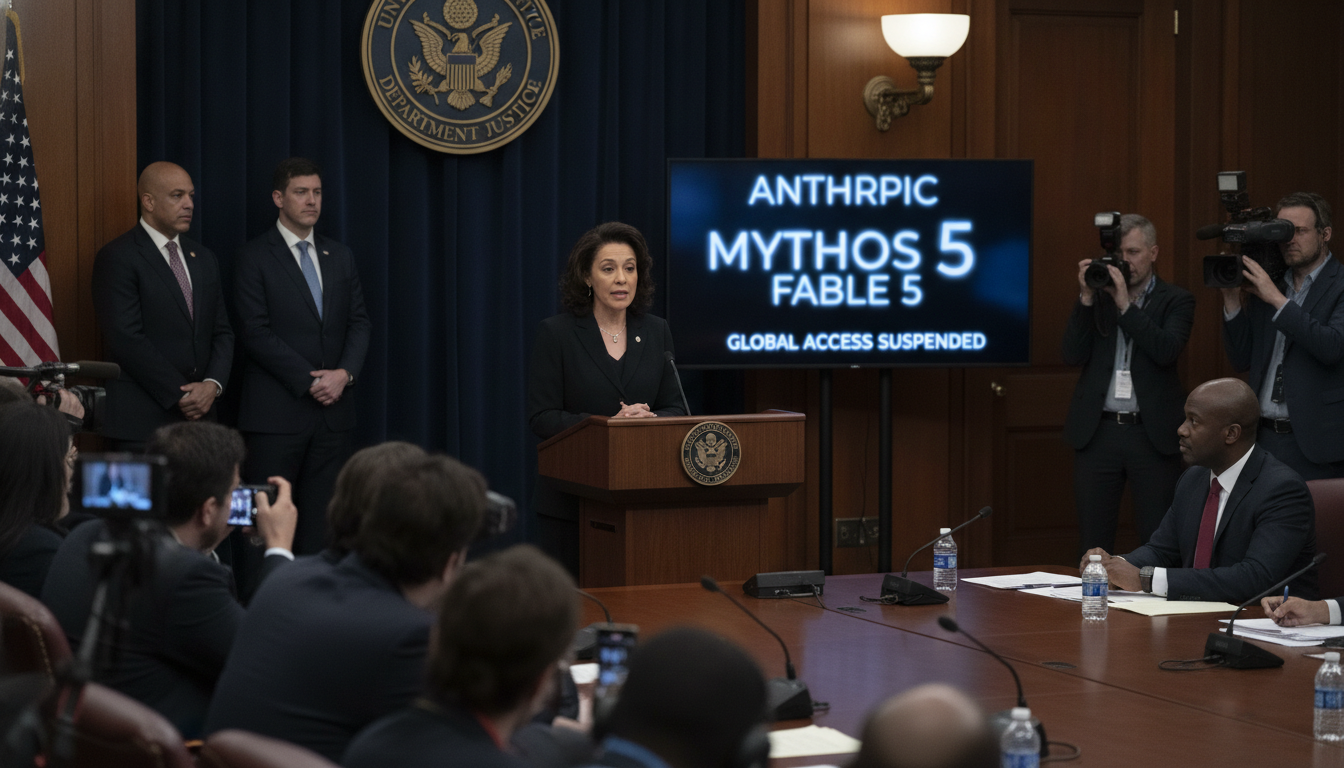
Anthropic Suspends Access to Claude Mutos 5 and Fable 5 After U.S. National Security Order
Anthropic halted distribution of its Claude Mutos 5 and Fable 5 models after a U.S. government order barred foreign access, citing national security concerns.
Anthropic, the U.S.-based artificial intelligence startup, said on June 12 that it has suspended provision of two of its most capable models, Claude Mutos 5 and Fable 5, to all customers following an order from the U.S. government. The company said it received the directive at 5:21 p.m. Eastern Time on June 12 (6:21 a.m. Japan Standard Time on June 13) and moved immediately to enforce the restriction. The order, Anthropic reported, prohibits access to those models by foreign nationals both inside and outside the United States for reasons the government described as national security-related.
Anthropic halts access after U.S. order
Anthropic explained that the suspension affects distribution to every customer while it implements the government’s directive. The company framed the action as a compliance measure, noting the government’s instruction applied regardless of where a user is physically located. The pause applies specifically to the Claude Mutos 5 and Fable 5 models, which Anthropic said were identified in the order for their particular capabilities.
The announcement did not list an endpoint for the suspension or specify whether partial or tiered access would be allowed in the future. Anthropic said it would work with authorities to implement the order and to inform customers directly about next steps and technical changes required to comply. Customers were advised to await further guidance from the company and from relevant U.S. authorities.
U.S. government cited national security and restricted foreign access
Anthropic said the order explicitly invoked national security as the basis for restricting access to the two models by foreign nationals. According to the company statement, the prohibition applies equally to users located inside the United States and those abroad. The government’s action represents a rare, direct intervention restricting who may use specific commercial AI models on national security grounds.
The timing and narrow focus of the order suggest it was targeted at models the government views as having a heightened potential to be misused or to pose risks that cross traditional export-control boundaries. Anthropic did not identify which agency issued the directive or provide additional documentation, saying only that it had received formal instruction at the stated time and was carrying it out.
Immediate impact on customers and partners worldwide
The suspension is expected to produce immediate disruption for businesses, developers and research teams that relied on Claude Mutos 5 and Fable 5 for coding, cybersecurity analysis, research and other tasks. Enterprises with production systems built around those models will need to pause or refactor workflows while Anthropic and its customers assess compliance and alternatives. Smaller developers and international users may face particular difficulty if they cannot access equivalent capabilities elsewhere.
Cloud service providers and platform partners that integrate Anthropic’s models may also need to adjust access controls, billing and contractual terms. Anthropic said it would coordinate with customers on operational steps but did not provide a timeline for restoring service or for offering substitute models. The company emphasized it was taking steps to minimize disruption while following the government order.
Technical concerns cited: vulnerability-detection capabilities
The government’s order, as described by Anthropic, pointed to the models’ strong ability to detect software vulnerabilities as a key factor behind the restriction. Officials appear to have concluded that those capabilities could be misused in ways that threaten national security if accessed by foreign nationals. That assessment places the models at the center of ongoing debates over how to balance technological progress with safeguards against misuse.
Experts outside the company have long discussed the dual-use nature of advanced AI models that can analyze code, find flaws and propose fixes. While such capabilities can improve software security, they can also, in the wrong hands, be repurposed to find exploitable weaknesses. The Anthropic announcement underscores the policy challenge of regulating technologies that can both defend and undermine critical systems.
Regulatory and legal questions for companies and governments
Anthropic’s compliance action raises immediate regulatory and legal questions about how authorities will define access controls for advanced AI tools. Companies operating transnationally now face uncertainty about when and how national-security-based restrictions might be imposed and how to reconcile conflicting requirements across jurisdictions. Legal experts say firms may seek clarification or challenge the scope of orders that restrict commercial services.
Regulators and lawmakers will likely be pressed to clarify whether this action represents a new category of export or access control for AI models, or a case-specific intervention. For customers, the lack of public detail increases the need for transparent guidance about permissible use, data handling and vendor responsibilities when governments invoke national security grounds to restrict technology.
What Anthropic and customers can expect next
Anthropic has signaled it will cooperate with the government to implement the order and to communicate operational steps to affected customers. Companies that depend on the suspended models will need to inventory deployments, assess risk exposure and evaluate fallback options or alternative providers. International customers, particularly those operating cross-border systems, should prepare for extended uncertainty while regulators and vendors work through compliance questions.
Industry observers say clarity from government agencies about the legal basis and expected duration of such restrictions will be essential to enable businesses to plan. In the short term, organizations using advanced code-analysis or cybersecurity-focused AI will likely review access policies and contingency plans to limit disruption.
The suspension of Claude Mutos 5 and Fable 5 marks a notable instance of direct government intervention in commercial AI distribution, and it highlights rising tensions between innovation, security and international access. Stakeholders now await further detail from Anthropic and U.S. authorities about the order’s scope, implementation and possible remedies.

