
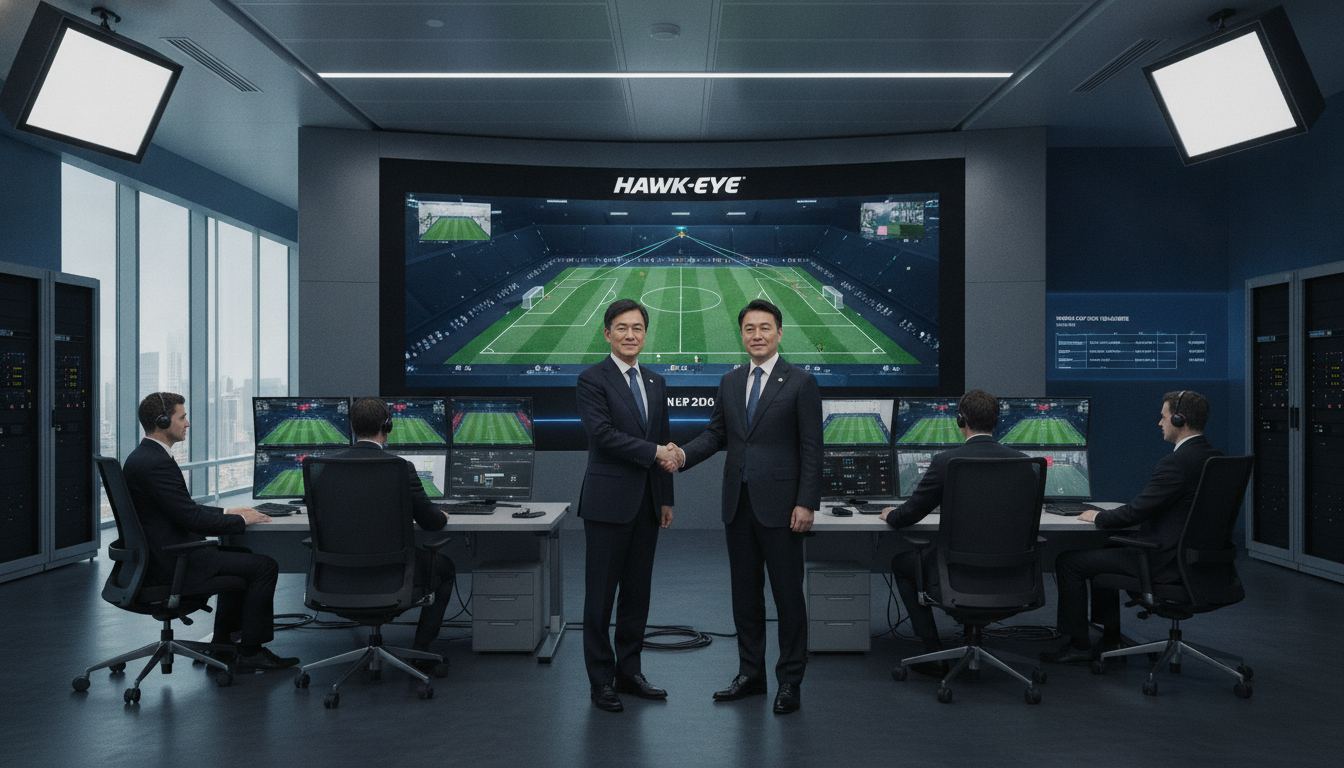
World Cup 2026: Sony’s Hawk-Eye Upgrades Aim to Speed VAR Decisions and Cut Delays
World Cup 2026: Sony’s Hawk-Eye upgrade aims to speed VAR reviews and reduce on-field delays, promising quicker, more reliable video-assisted rulings for referees and fans.
Sony has rolled out an upgraded version of its Hawk-Eye video officiating system ahead of World Cup 2026, saying the enhancements will shorten review times and reduce the long waits that can interrupt matches. The company frames the update as a response to criticism over slow video assistant referee (VAR) decisions and aims to deliver faster, more consistent outcomes on the field. The announcement positions Hawk-Eye as a key technology expected to shape matchday operations and broadcast coverage during the tournament.
Sony deploys updated Hawk-Eye for World Cup 2026
Sony has applied refinements to its ball- and player-tracking algorithms and the overall replay workflow as part of the Hawk-Eye upgrade slated for use at World Cup 2026. The company states the system now processes frames and communicates results to match officials more quickly than previous iterations. Sony’s emphasis is on shaving seconds off adjudication times to preserve the flow of play.
The deployment follows years of incremental improvements in optical tracking and automated detection across professional leagues. Organizers and technology vendors have increasingly focused on reducing the human and technical latency that turns routine reviews into lengthy stoppages. Sony’s work is presented as the latest step in that global effort.
How the Hawk-Eye upgrade speeds up VAR reviews
The new Hawk-Eye build combines higher frame-rate video capture with improved synchronisation between multiple camera feeds, allowing the system to present replays and line-detection overlays faster. On-screen visualisations are optimized to highlight decisive events—such as offside lines, ball crossing the goal line, or potential handball contact—so match officials can make rulings without sifting through extraneous angles.
In practice, the system is designed to prioritize the clearest evidence first and to surface corroborating views only if ambiguity remains. That staged presentation reduces the time referees spend reviewing clips and lowers the chances of repeat reviews that extend stoppages.
On-field integration and referee workflow
Under the revised workflow, on-field referees receive initial findings from the VAR team more quickly and with clearer visual cues, enabling faster confirmations or on-field reviews. The company also improved the user interface used by VAR operators to tag and annotate critical frames, which officials then view on the pitch-side monitor when a review is requested.
Sony says these refinements are intended to preserve referees’ authority while cutting down the back-and-forth between the pitch and the video room. Faster, more transparent communication could help reduce player and fan frustration and keep the momentum of matches intact.
Testing, validation and past examples
The Hawk-Eye system has been progressively validated in domestic leagues and international fixtures, with vendors and competition organizers running controlled trials prior to major tournaments. Sony points to past uses—such as determining the legality of a high-profile assist in an earlier World Cup cycle—as examples of the technology’s ability to resolve tight calls reliably.
Independent match tests have focused on real-time performance, accuracy of spatial overlays and consistency across lighting and weather conditions. Organizers typically require multiple validation runs and redundancy measures before green-lighting a system for use at a major event like World Cup 2026.
Responses from referees, federations and broadcasters
Refereeing bodies and competition officials have welcomed approaches that promise to reduce interruption without compromising accuracy, though some stakeholders remain cautious about overreliance on automated visuals. Broadcasters are also attentive to the technology’s potential to speed reruns and maintain viewer engagement, as shorter reviews can support more continuous live coverage.
Sony’s upgrade arrives amid ongoing debate over the balance between human judgement and technological assistance. Officials say rapid, clear evidence can support more decisive calls, but several national associations have indicated they will monitor implementation closely during pre-tournament friendlies and final preparations.
Potential impact on match tempo and fan experience
If the system delivers reliably faster outcomes, match tempo could benefit from fewer and shorter stoppages, improving the spectacle for stadium audiences and viewers worldwide. Players and coaches have increasingly cited prolonged VAR interventions as disruptive; a reduction in review times would address a central complaint and could alter strategic behaviour around stoppages and substitutions.
Faster decisions may also influence broadcast flows and sponsorship activations, since networks can predict shorter windows for replays and analysis. However, the ultimate test will be how the system performs under the intense scrutiny and operational pressure of World Cup matches.
Sony’s latest Hawk-Eye iteration is presented as a technical response to a longstanding criticism of VAR: that accurate rulings sometimes come too late to preserve the rhythm of play. Organizers and officials will monitor the system during pre-tournament fixtures and early group-stage matches to assess whether the promised reductions in review time materialize. The coming tournament will offer a high-profile proving ground for whether faster, clearer video assistance can reconcile accuracy with the game’s need for continuity.

