
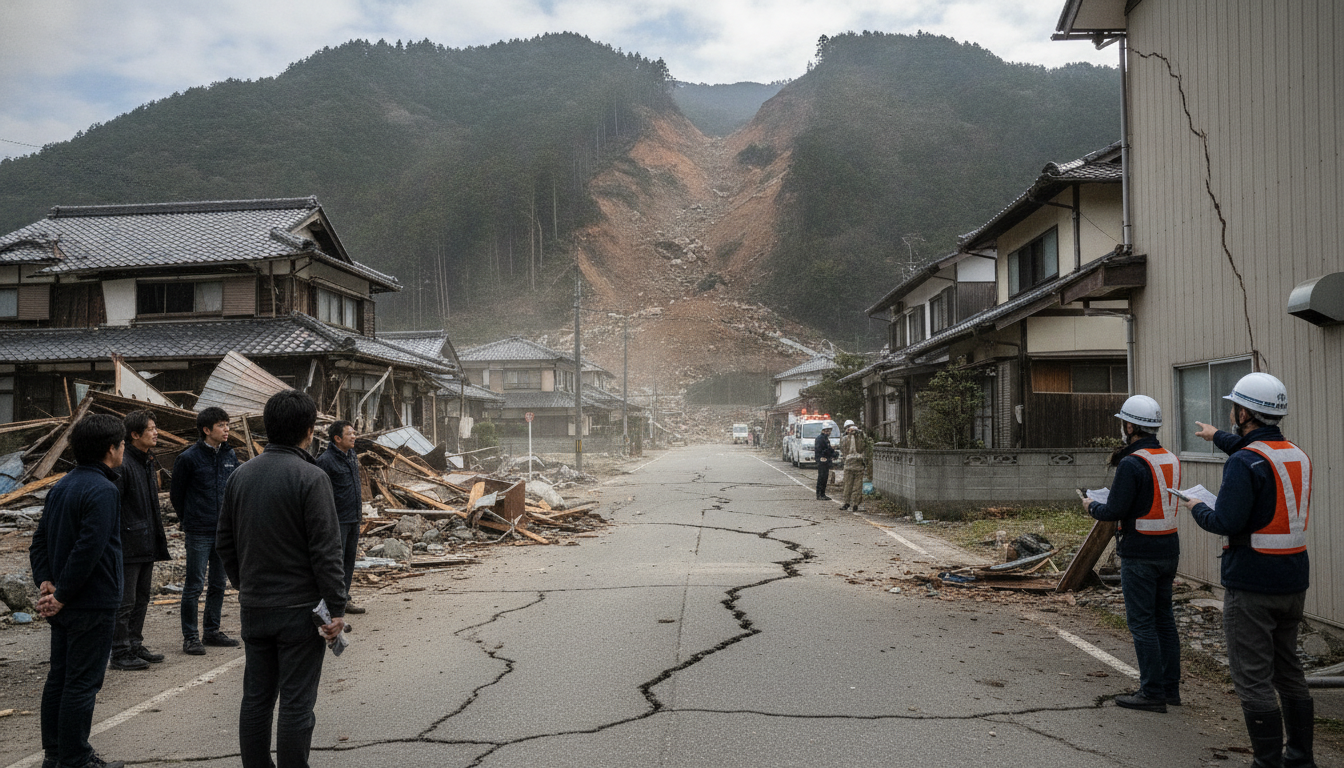
M5-class earthquake shakes Gunma and Saitama; expert warns of landslide and road damage risks
M5-class earthquake struck Gunma and Saitama, with Shindo 5- shaking reported; a University of Tokyo seismologist warned the complex subduction zone raises landslide and road damage risks and urged nighttime safety.
A moderate but widely felt earthquake, estimated at M5-class, shook parts of Gunma and Saitama, prompting local advisories and on-the-ground checks of infrastructure and slopes. The Japan Meteorological Agency and local authorities reported strong shaking of seismic intensity Shindo 5 lower in several municipalities, and residents were urged to take precautions while moving through dark hours. University of Tokyo Earthquake Research Institute Professor Shinichi Sakai characterized the area as a tectonically complex subduction zone where two plates converge and slip beneath the region. He said that this setting has generated frequent moderate earthquakes historically, and that similar events often see activity subside relatively quickly after the initial quake.
Seismic expert cites complex plate boundary beneath the region
Professor Sakai of the University of Tokyo emphasized that the affected area lies where two tectonic plates are subducting, creating a complicated underground structure that influences seismic behavior. He noted that such geometry can concentrate stress and produce frequent moderate earthquakes, including events of magnitude around five. According to Sakai, the complexity of the subsurface means fault interactions and local geological features can change how shaking is distributed at the surface. That complexity also complicates rapid assessments of secondary hazards immediately following an event.
Strong shaking recorded in multiple municipalities (Shindo 5-)
Local seismic intensity measurements showed Shindo 5 lower in parts of Gunma and Saitama, indicating strong shaking capable of causing unsecured items to fall and indoor damage in poorly fixed structures. Emergency services and municipal offices reported power checks and road patrols as part of initial responses, while some schools and public facilities temporarily evaluated building safety. The Japan Meteorological Agency continued to monitor seismic activity and issued information for residents to follow, especially in areas where shaking was most pronounced. Officials reiterated that intensity reports help prioritize inspections of critical infrastructure.
Landslide and road damage risks raised by researchers
Professor Sakai warned that the level of shaking observed could plausibly trigger landslides, cliff collapses, and road surface cracking in susceptible locations. He explained that steep slopes, weathered geology, and existing instability increase the likelihood of slope failures after strong tremors, particularly where heavy rainfall or prior ground disturbance has weakened material. Roads cut into hillsides and older retaining structures were singled out as vulnerable to cracking or collapse, potentially disrupting transport and emergency access. Local governments were advised to inspect known hazard sites and to restrict access where signs of instability appeared.
Nighttime guidance: choose safe, well-lit routes and confirm official updates
Because the earthquake occurred during dark hours, Professor Sakai and authorities urged residents to exercise extra caution when travelling home or checking on neighbors. They recommended verifying updates from the Japan Meteorological Agency and municipal disaster management offices, avoiding steep or exposed paths, and choosing routes that are illuminated and structurally sound. Emergency responders asked people to report visible landslides, fallen rocks, large cracks in roadways, and blocked evacuation routes so crews can prioritize clearing and repair. Residents were also reminded to carry a flashlight, wear sturdy footwear, and avoid unnecessary travel until local authorities confirm safety.
Aftershock expectations and historical patterns of activity
Sakai said that in this particular tectonic setting, clusters of moderate quakes are not uncommon and that, historically, activity of this scale tends to decline relatively quickly after the main event. He cautioned, however, that aftershocks can still occur and sometimes produce strong local shaking that affects already weakened slopes and structures. Monitoring agencies will track seismicity and issue advisories if larger or sustained aftershocks are detected. Municipal disaster offices are preparing patrols and inspection schedules aimed at identifying newly exposed hazards and securing damaged infrastructure.
Residents and commuters in the affected areas are advised to follow official guidance, exercise caution on potentially damaged roads and slopes, and check for updated information from the Japan Meteorological Agency and local governments before travelling.

