
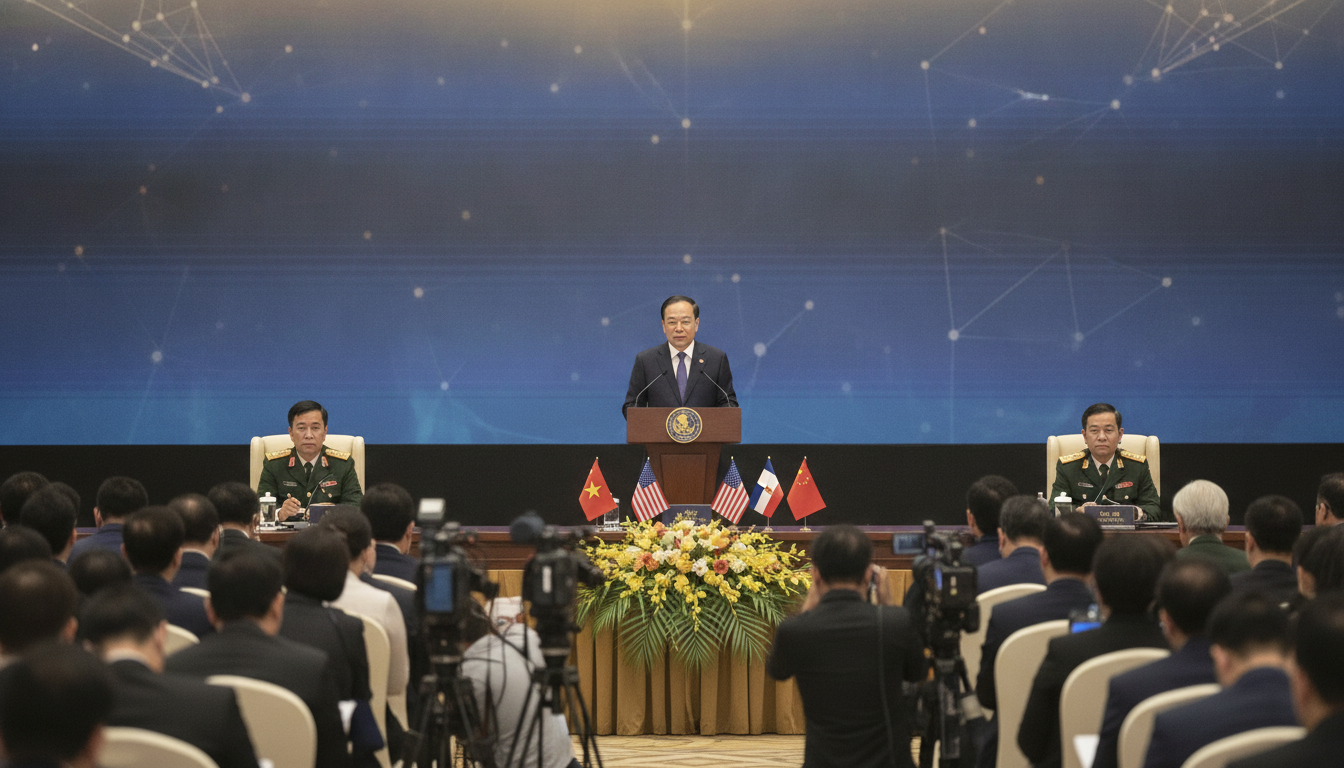
To Lam Signals Strategic Pivot at Shangri‑La Dialogue Amid US‑China Rivalry
To Lam signals a diplomatic shift at the Shangri‑La Dialogue, positioning Vietnam to balance ties with the US and China amid rising geopolitical rivalry.
Vietnamese President and Communist Party chief To Lam used a surprise keynote at the Shangri‑La Dialogue in Singapore to outline a recalibrated approach to foreign policy, underscoring Hanoi’s intent to navigate intensifying US‑China competition. The address, delivered at the region’s leading security forum, positioned Vietnam as an increasingly assertive actor seeking security assurances without forcing a binary alignment. To Lam’s presence at the summit, and the tone of his remarks, were widely read by diplomats and analysts as a deliberate signal to both capitals.
To Lam’s Surprise Appearance at Shangri‑La Dialogue
To Lam’s appearance at the Shangri‑La Dialogue drew attention because presidents and party chiefs seldom lead public defense diplomacy in this venue. He spoke directly to an audience of defense ministers, military leaders and foreign officials, elevating Hanoi’s diplomatic profile on security matters.
The decision to send Vietnam’s top leader to the forum reflected a conscious effort to put Hanoi’s strategic priorities on the record. It also allowed To Lam to frame Vietnam’s posture as pragmatic, stressing sovereignty and stability while seeking cooperative ties.
Message to Washington and Beijing
In his remarks, To Lam sought to strike a balance between reassuring the United States of Vietnam’s security interests and signaling to Beijing that Hanoi will defend its maritime claims. The tone combined calls for principle‑based engagement with requests for predictable, non‑coercive behavior in the region.
That dual message demonstrates Hanoi’s long‑standing strategy of hedging: deepening ties with external partners, including defense cooperation with Western states, while maintaining managed relations with China. To Lam emphasized that Vietnam’s foreign policy will prioritize national development and territorial integrity above bloc politics.
South China Sea and Defense Posture
Maritime security and the South China Sea were central subtexts of To Lam’s speech, reflecting Hanoi’s concerns about freedom of navigation and resource rights. He reiterated the need for rules‑based conduct at sea, an appeal aimed both at deterring unilateral moves and at attracting international support for dispute management.
Concurrently, Vietnam has accelerated modernization of its naval and coast guard capabilities over recent years. To Lam framed those upgrades not as aggressive militarization but as necessary measures to protect economic lifelines and enforce sovereignty in contested waters.
Domestic Political Signal in Hanoi
Sending To Lam to the security forum also carried a domestic political signal: the consolidation of leadership control and an emphasis on stability amid external pressures. As both head of state and party chief, his diplomatic activism underlines a unified strategy linking domestic legitimacy to foreign policy performance.
The speech allowed Hanoi to present a disciplined narrative to domestic audiences that national resilience and pragmatic diplomacy go hand in hand. This internal messaging is important as Vietnam balances growth imperatives with an increasingly fraught regional environment.
Responses from ASEAN and Neighbors
Regional governments and ASEAN institutions watched To Lam’s interventions closely, gauging Hanoi’s willingness to push for stronger Southeast Asian coherence on security. Many ASEAN capitals welcomed the emphasis on dialogue and multilateral mechanisms, while privately noting the limits of bloc consensus on the most sensitive maritime disputes.
Neighbouring states will likely continue to hedge in their own ways, recalibrating ties with major powers while preserving bilateral channels with Vietnam. To Lam’s speech may prompt fresh diplomatic outreach within ASEAN to translate calls for rules‑based behavior into concrete mechanisms for de‑escalation.
Implications for Japan and Regional Security Cooperation
For Japan, To Lam’s performance reinforced the utility of deeper defense and economic cooperation with Vietnam as Tokyo seeks partners to maintain a stable regional order. Shared concerns over maritime security and supply‑chain resilience make Hanoi a natural partner for joint capacity building and infrastructure investment initiatives.
Japanese policymakers will watch whether Vietnam’s outreach yields more predictable behavior at sea and opens avenues for greater trilateral cooperation with like‑minded democracies. To Lam’s emphasis on balancing ties signals opportunities for Tokyo to expand practical security cooperation without forcing Hanoi into a formal alliance posture.
To Lam’s keynote at the Shangri‑La Dialogue marked a notable moment in Vietnam’s foreign policy, blending assertive defense priorities with calls for negotiation and rules‑based order. Observers will watch whether Hanoi can translate rhetoric into durable arrangements that protect its interests while avoiding escalation between the United States and China.

