
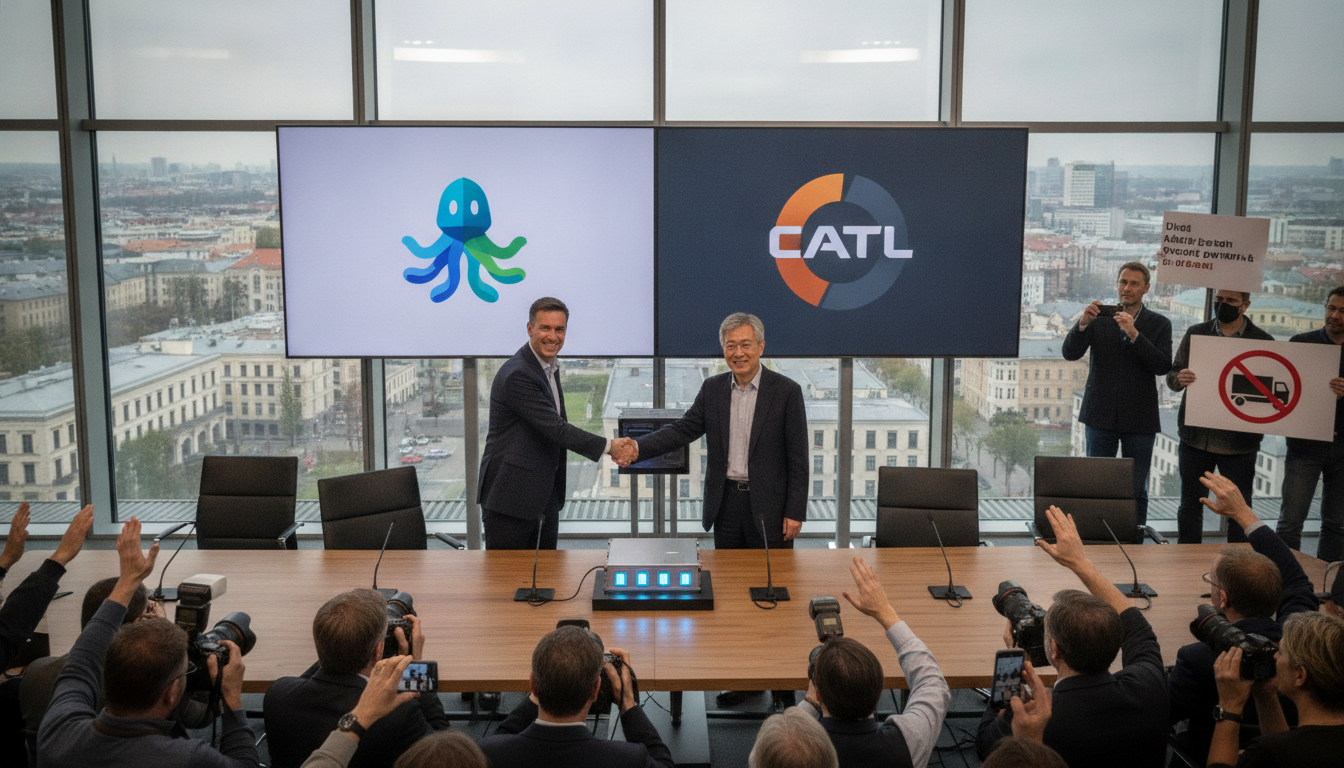
Octopus Energy and CATL to build battery-swapping network for electric trucks across Europe
Octopus Energy and CATL will develop a battery-swapping network for electric trucks across Europe, sparking debate over vehicle compatibility, costs and industrial pushback.
Britain’s Octopus Energy and China’s Contemporary Amperex Technology Co. (CATL) on Tuesday announced a joint venture to deploy a battery-swapping network for electric trucks across Europe, aiming to speed charging and cut downtime for long-haul fleets. The plan has already generated strong responses from truckmakers, logistics firms and regulators, with critics warning that technical compatibility and strategic concerns could complicate rollout. Proponents say the model could transform operations for heavy-duty electric vehicles by shortening refuelling times and enabling standardised battery logistics.
Octopus Energy and CATL form European joint venture
Octopus Energy, best known in Britain as a household energy supplier, is partnering with CATL, the world’s largest battery producer, to create a continent-wide swap infrastructure. The companies say the joint venture will install swapping hubs on major freight corridors and at logistics parks to serve operators switching to electric trucks.
The announcement positions a private-energy player and a battery manufacturer at the centre of a potential reshaping of commercial vehicle refuelling, moving away from the exclusive reliance on plug-in fast chargers to a model that exchanges depleted battery packs for charged units.
Network design targets electric truck fleet operations
The proposed battery-swapping network is aimed principally at large fleet operators whose uptime demands make long charging intervals commercially challenging. Swapping hubs would hold pools of charged battery modules, allowing trucks to exchange packs in minutes rather than wait hours at chargers.
Project planners say the system reduces the need for heavy on-site electrical upgrades at depots and highway stations, and could smooth peaks in grid demand by centralising charging. The companies are presenting the network as a complement to existing charging infrastructure rather than a wholesale replacement.
Truckmakers voice concerns over compatibility and sovereignty
Major European truck manufacturers including Volvo and Scania have voiced reservations about a widespread swapping model, citing compatibility and control over battery technology. Industry sources warn that aligning battery designs, mounts and electronic control systems across competing brands would be highly complex and could require intrusive standardisation.
Beyond technical issues, there are geopolitical and industrial-policy sensitivities as a China-based firm expands influence over critical battery assets in Europe. Some policymakers and trade associations fear over-dependence on a single supplier could create supply-chain vulnerabilities or limit manufacturers’ ability to drive future battery development.
Operators and logistics firms highlight operational gains
Logistics operators that already trial swapping or fast-turn refuelling point to clear commercial advantages for long-distance routes and time-sensitive deliveries. For firms with high daily mileage and tight schedules, the minutes saved by swapping versus hours charging at depots can translate directly into lower fleet costs and higher asset utilisation.
Several European haulage companies are said to be in early talks about pilot projects, attracted by the prospect of predictable charging cycles, centrally managed battery pools and off-balance-sheet battery ownership models that transfer capital and maintenance burdens to the operator of the swapping network.
Technical and commercial roadblocks remain
Technical hurdles include designing modular batteries that meet differing range, weight and power requirements while allowing safe, rapid mechanical and electrical connection. Thermal management, software integration and battery ageing profiles must also be managed across a mixed fleet to avoid mismatches that could erode performance or safety.
Commercial questions are equally difficult: who owns the batteries, how are lifecycle costs allocated, and how will pricing be set to reflect energy, depreciation and infrastructure investment? Analysts caution that without clear commercial models and industry buy-in, a patchwork of incompatible swapping systems could emerge that fails to achieve the economies of scale proponents expect.
Regulators and standards bodies under pressure
European regulators and standards organisations are likely to face early pressure to assess safety protocols, interoperability standards and market competition issues tied to a swapping network. Rules covering battery certification, cross-border transport of charged batteries and grid connection permitting for large charging pools will affect rollout speed and costs.
Competition watchdogs may scrutinise any market structure that gives a dominant supplier undue influence over battery supply or access for competing truckmakers. At the same time, climate and transport regulators will weigh operational benefits against risks to domestic industrial strategy.
Industry analysts say pilots and transparent standards will be crucial to resolve technical and commercial frictions, and that co-operation between manufacturers, utilities and infrastructure providers could determine whether swapping scales beyond isolated trials.
The success of the battery-swapping network will hinge on balancing rapid operational gains for fleets against the need for broad technical standards, clear commercial arrangements and regulatory oversight. If those elements come together, supporters argue the model could accelerate decarbonisation of heavy transport while preserving fleet economics. If not, swapping may remain a niche solution alongside increasingly capable fast-charging networks.

