
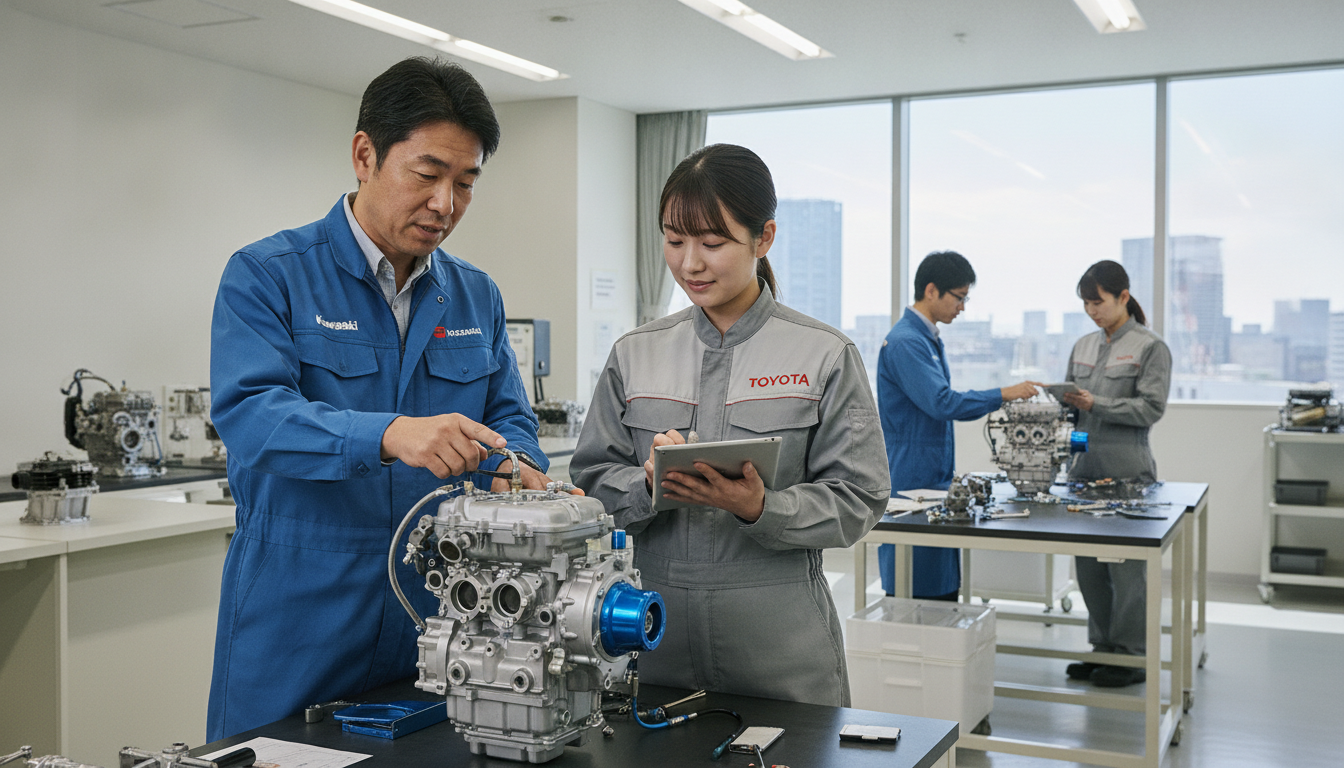
Kawasaki, Toyota Advance Hydrogen-Fueled Combustion Engines for Generators and Sports Cars
Kawasaki and Toyota push hydrogen engines for small generators and sports cars as a lower-cost alternative to fuel cells to boost hydrogen use beyond cars.
Hydrogen-fueled combustion engines are gaining renewed attention in Japan as Kawasaki Heavy Industries and Toyota pursue smaller, market-ready units for applications from portable generators to high-performance sports cars. Industry insiders say combustion engines running on hydrogen could offer a lower-cost pathway to wider hydrogen use than fuel cells, especially where existing engine platforms can be adapted. The developments signal a strategic shift that could accelerate demand for hydrogen across multiple mobility and industrial sectors.
Kawasaki targets compact hydrogen engines
Kawasaki Heavy Industries, which has already demonstrated larger hydrogen-capable engines, is concentrating its development efforts on smaller units that can be more easily deployed. Company engineers are prioritizing compact designs meant for light-duty vehicles, auxiliary power units and small marine craft. By scaling down from six-cylinder demonstrators toward single- and two-cylinder formats, Kawasaki aims to reduce manufacturing complexity and shorten development timelines.
Kawasaki executives have framed the move as a pragmatic approach to build market momentum for hydrogen technologies. Smaller engines can be manufactured in higher volumes and integrated into existing supply chains, which could lower per-unit costs and improve commercial viability in the near term.
Toyota tests generators and sports-car applications
Toyota Motor Corporation has expanded its hydrogen program beyond fuel-cell vehicles to include hydrogen combustion platforms for both stationary and performance uses. The company is reported to be exploring compact generators that run on hydrogen for backup power and remote operations, alongside research into adapting hydrogen combustion for sports-car powertrains. These experiments reflect Toyota’s interest in portfolio diversification rather than an exclusive focus on fuel cells.
Applying hydrogen combustion in sports cars is attractive because it preserves the audible and driving characteristics appreciated by enthusiasts while offering near-zero carbon operation at the tailpipe. Toyota’s dual-track exploration—stationary power and performance vehicles—could help demonstrate the technology’s flexibility to regulators and consumers.
Cost advantages over fuel cells
One of the strongest arguments in favor of hydrogen-fueled combustion engines is cost. Combustion engines use a mature manufacturing base and simpler stack- and catalyst-free architectures compared with fuel-cell systems, which require expensive membrane and catalyst materials. Adapting existing engine platforms to burn hydrogen can therefore reduce research-and-development outlays and lower capital expenditure for manufacturers.
For fleet operators and industrial users, lower upfront costs may make hydrogen adoption more attractive than waiting for fuel-cell prices to decline substantially. That economic calculus could be decisive in sectors where total cost of ownership and rapid deployment matter more than absolute efficiency.
Potential markets across mobility and industry
The potential applications for scaled hydrogen combustion engines are broad. Small generators can serve construction sites, disaster-response operations and off-grid facilities where lower emissions are desired. Light commercial vehicles, motorcycles, and small marine vessels are other obvious candidates because they require less storage capacity and can tolerate existing engine architectures with modest modification.
Moreover, niche high-value markets such as classic and performance cars could provide an early revenue stream, allowing manufacturers to refine combustion-based hydrogen technologies in controlled, visible applications. Success in these segments could create a “halo” effect that supports broader commercialization.
Technical and regulatory hurdles remain
Despite the promise, technical and regulatory challenges persist. Burning hydrogen in internal-combustion engines can raise concerns about nitrogen-oxide (NOx) emissions, which require aftertreatment systems and optimized combustion strategies. Hydrogen’s different flame characteristics also demand reworked fuel-delivery systems and engine calibration to maintain durability and drivability.
Regulatory frameworks and safety codes for hydrogen storage and refueling remain uneven across jurisdictions, adding complexity for companies seeking to scale production. Investment in refueling infrastructure and standards for component certification will be essential to unlock mainstream adoption beyond demonstration projects.
Industry reaction and strategic implications
Automakers and heavy-industry players are watching developments closely, weighing hydrogen combustion as one element of broader decarbonization strategies. For Japan, where industrial policy favors hydrogen as a clean-energy vector, advances by Kawasaki and Toyota could influence supply-chain decisions and government support mechanisms. Private-sector momentum may also prompt accelerated public investment in hydrogen refueling networks, particularly for localized uses such as emergency power and port operations.
Business analysts say the dual approach—pursuing both fuel cells and combustion—reduces technological risk and preserves optionality for manufacturers. Market outcomes will likely hinge on how quickly companies can resolve emissions control issues and how governments align incentives with infrastructure development.
Momentum is building around hydrogen-fueled combustion engines not as a single silver-bullet solution but as a pragmatic, complementary route to broaden hydrogen demand. If Kawasaki’s compact units and Toyota’s generator and sports-car trials prove commercially viable, they could help bridge the gap between pilot projects and larger-scale hydrogen markets, shaping the next phase of Japan’s energy and mobility transition.

