
Malaysia faces durian supply glut as exports and harvests collide with slowing demand
Record harvests and waning overseas appetite have created a durian supply glut in Malaysia, forcing price cuts and new policy debates across the industry.
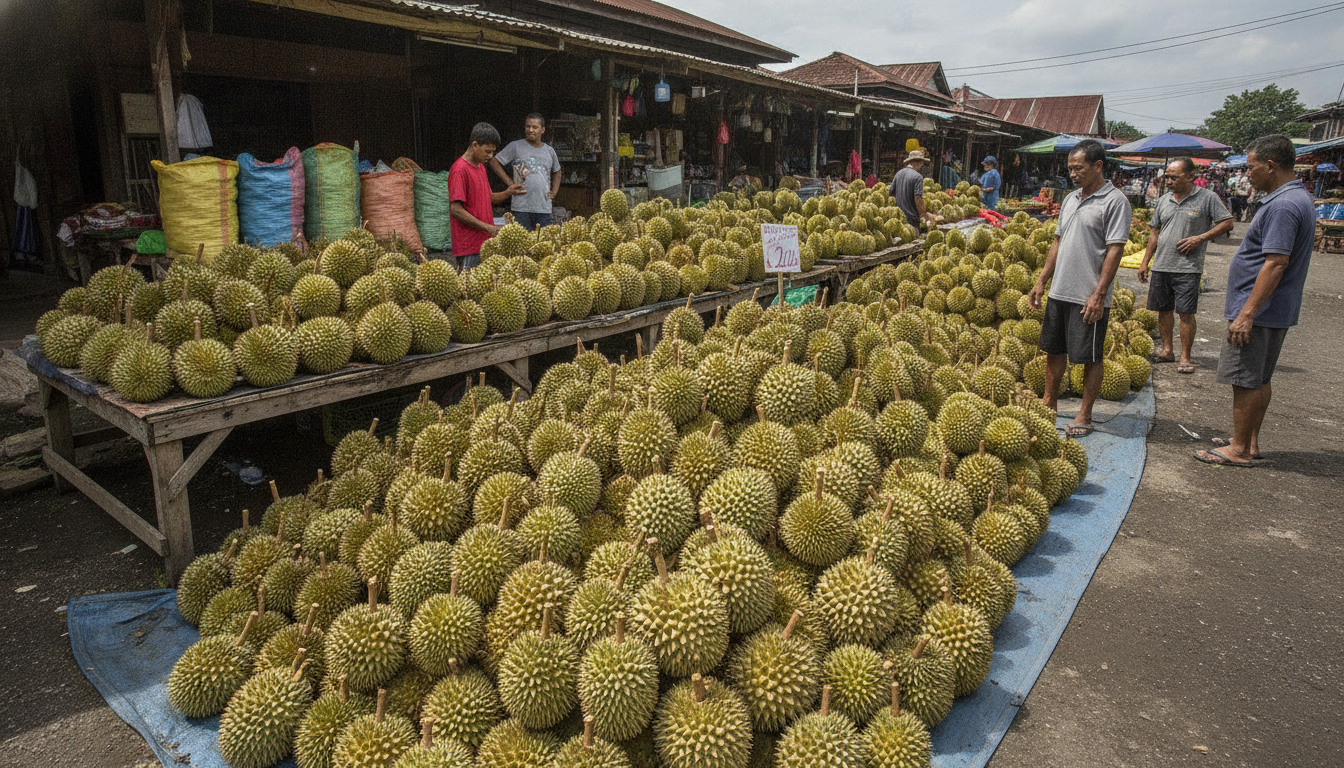
KUALA LUMPUR — Malaysia’s rapid push to expand durian production and exports has collided with a durian supply glut, leaving orchards, traders and exporters scrambling to find buyers and stave off losses. The imbalance between abundant harvests of premium varieties such as Musang King and softer demand from key overseas markets has driven discounting at festivals and weighed on farmgate prices. Industry participants say the situation exposes broader challenges in coordinating production, storage and international sales for a fruit once hailed as a golden export opportunity.
Export expansion and Chinese demand
Malaysia tailored its durian industry for export growth over the past decade, with investment in acreage and branding focused on the Musang King variety. China emerged as the dominant market for premium Malaysian durians, attracting middle-class consumers willing to pay high prices for fresh, branded fruit. That export-driven strategy prompted rapid expansion of planting, processing and cold-chain logistics across peninsular and East Malaysia.
When overseas demand rose quickly, growers accelerated production to capture market share and higher prices. The result was a concentrated supply response that now faces cyclical and policy-driven fluctuations in buyer appetite abroad. Farmers and exporters are learning that export markets can be volatile and require flexible production and marketing systems.
Discounting at Putrajaya Durian Fest
Late June saw visible signs of the supply strain, with sellers offering steep discounts at events such as the Putrajaya Durian Fest just south of Kuala Lumpur. Visitors at the festival found reduced prices on many varieties as vendors sought quick sales to clear inventory ahead of spoilage. Organizers and sellers described the promotions as an emergency measure to move fruit that could not be shipped immediately.
Retail and festival discounting illustrates how localized surplus quickly translates into lower prices for consumers and lower returns for growers. While shoppers welcomed cheaper durians, many smallholders reported the cuts translated into revenue shortfalls that threaten profitability during the weak-season months that follow the harvest surge.
Harvest cycle and logistical bottlenecks
The durian supply glut has roots in crop cycles and a concentration of plantings that matured at roughly the same time. Large-scale planting initiatives several years ago are now bearing fruit concurrently, producing a larger-than-expected harvest window. At the same time, shipping capacity, cold storage and processing facilities have not expanded uniformly, creating logistical bottlenecks that prevent surplus fruit from being preserved for later sale.
Perishable produce like fresh durian is especially vulnerable when harvest volumes outpace the capacity to freeze, pack and transport exports. Without sufficient facilities, exporters must resort to rapid domestic sales or lower-priced routes, undermining the premium positioning Malaysia cultivated for varieties such as Musang King.
Growers and traders feel financial strain
Smallholders and traders interviewed by industry observers say the glut has translated into immediate cashflow pressure. Many farmers faced higher input costs during the years of expansion and expected export revenue to cover debts; the current price slump puts those calculations at risk. Middlemen who arranged shipments and processing now face diminished margins or unsold inventory.
Some growers report holding back investment in new trees and re-evaluating their planting choices for future cycles. Others are exploring cooperative storage, staggered harvesting techniques and contract arrangements with processors to reduce exposure to sudden market swings. The financial strain has prompted calls within the sector for more robust risk-sharing mechanisms.
Government and industry responses
Faced with mounting losses, industry groups and government agencies have started discussing a range of measures to rebalance supply and demand. Proposals circulating include incentives for value-added processing, support for frozen-durian supply chains, and programs to encourage staggered replanting schedules to avoid synchronized surges. Officials are also exploring temporary measures to boost domestic consumption through marketing and promotional campaigns.
Authorities stress that any intervention must avoid distorting market signals while helping smallholders build resilience. The challenge for policymakers is to design responses that expand long-term storage and processing capacity without incentivizing further overplanting that could repeat the cycle in future seasons.
Outlook for prices and market management
Analysts and industry participants expect volatility to persist until production and logistics realign with demand patterns. If exporters can scale up frozen-durian exports and find new markets beyond traditional buyers, some of the current glut can be absorbed. However, that transition requires investment in cold-chain infrastructure and coordinated marketing efforts that take months or years to implement.
For now, many market actors are focused on short-term measures to limit losses while planning structural adjustments. The durian supply glut has underscored a central lesson: rapid growth driven by a single external market can leave the domestic industry exposed when that market softens or when logistical gaps appear.
The current episode will likely reshape how Malaysia balances ambitions for export growth with the practical limits of storage, shipping and international demand.

