
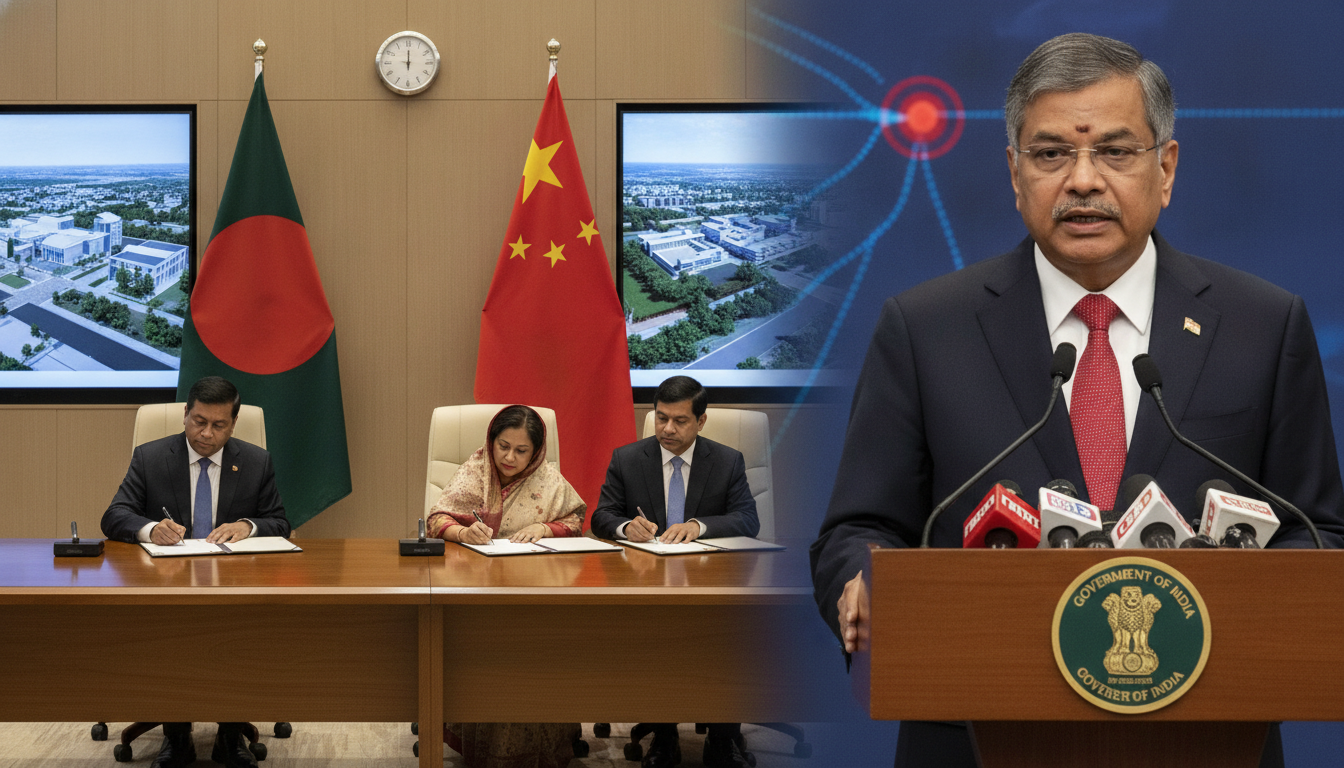
Bangladesh-China Pact to Develop Mongla Port Economic Zone Stokes Security Concerns in India
Bangladesh’s agreement with a Chinese engineering firm to develop the Mongla Port economic zone has prompted alarm in New Delhi, with Indian analysts warning the project could allow Beijing to monitor Indian naval and army movements. The deal, signed recently, revives a site that had been earmarked for development by India a decade ago and shifts a strategically placed project into China’s sphere of influence. Officials in Dhaka present the initiative as an economic opportunity, while analysts in India frame it as a potential security risk in the Bay of Bengal littoral.
Details of the pact and parties involved
Bangladesh has offered the Mongla Port economic zone to a major Chinese engineering company under a development agreement that was finalized in recent weeks. The project transforms a previously contested development plan into a new commercial venture led by Chinese engineering and construction expertise. Bangladeshi authorities emphasize investment, job creation and industrial growth as primary drivers behind the decision.
Indian security analysts note that the land and maritime infrastructure linked to the economic zone carry dimensions beyond pure commerce. Observers point to the involvement of a large state-affiliated Chinese company as elevating the project’s strategic profile in a sensitive maritime corridor. The transfer of a site once considered by India to Chinese development partners is seen as particularly significant by regional specialists.
Strategic geography of Mongla Port and environs
Mongla Port sits on the northern head of the Bay of Bengal, an area that lies close to India’s eastern coastline and important maritime routes. The proximity of the proposed economic zone to naval access points and coastal approaches makes its development relevant to military planners in the region. Analysts argue that facilities near Mongla could be used for logistical activities that have both civilian and military value.
Maritime experts stress that ports and adjacent economic zones often support a range of functions, from customs and ship repair to warehousing and transport hubs. When foreign firms with links to state interests lead such projects, the dual-use potential—where civilian infrastructure can be leveraged for surveillance, logistics or support—becomes a central point of concern for neighboring countries. In the case of Mongla, that sensitivity is amplified by its position relative to Indian naval assets.
Indian security community voices monitoring concerns
Security analysts in India have publicly expressed worry that the Mongla Port economic zone could enable enhanced monitoring of Indian naval and army movements along the eastern seaboard. Their assessments focus on the possibility that data collection, communications infrastructure and on-site logistics could be used, directly or indirectly, to observe or track troop and ship movements. These concerns echo wider regional anxieties about infrastructure projects with potential intelligence or surveillance components.
Indian commentators also highlight the symbolic element of the deal: land once offered to India now being developed by a Chinese firm, which they say reflects shifting influence in Bangladesh’s economic and strategic choices. While New Delhi’s formal diplomatic response has been measured, security analysts continue to advocate for closer coordination and surveillance of developments in the Bay of Bengal.
Bangladesh’s economic and political rationale
Dhaka frames the Mongla Port economic zone as a driver of industrialization, foreign direct investment and employment in the country’s southwestern region. Government officials argue that opening the zone to large international contractors will accelerate construction, improve port connectivity and attract manufacturing tenants. For a low-income country pursuing rapid growth, such projects carry strong domestic political and economic appeal.
Bangladeshi decision-makers also emphasize sovereign control over project terms and stress that host-nation safeguards can limit foreign influence. Authorities are likely to point to contractual clauses, regulatory oversight and benefits-sharing arrangements as evidence that national interests remain central to the development plan. Nonetheless, the selection of a foreign partner with close ties to Beijing complicates perceptions abroad.
Diplomatic ripples across the region
The agreement has already produced diplomatic ripples among regional capitals that monitor China’s expanding footprint across South and Southeast Asia. New Delhi is engaged in outreach to ensure maritime security and maintain existing ties with Dhaka, while Beijing accentuates its role as an infrastructure partner delivering investment and technical capacity. Each capital frames the project within its broader strategic narrative: India highlighting security, China emphasizing development cooperation, and Bangladesh stressing economic gains.
Analysts expect discreet diplomacy to continue alongside public commentary, with India likely to press for transparency around operational details and Bangladesh to defend its sovereign right to choose development partners. Multilateral stakeholders and regional institutions may also be drawn into discussions about port development norms, third-party involvement and safeguards against potential dual-use applications.
Broader effects on Indo-Pacific infrastructure and commerce
The Mongla Port economic zone question sits within a wider pattern of contested infrastructure projects across the Indo-Pacific, where commercial investment intersects with strategic competition. Ports, logistics hubs and special economic zones are increasingly viewed through a dual lens: engines of trade and potential nodes in geopolitical rivalries. The project underscores how infrastructure diplomacy can produce economic benefits while raising strategic anxieties among neighboring states.
Commercial operators, insurers and shipping companies will watch the development for its effect on regional trade routes and port capacity in the Bay of Bengal. At the same time, defence planners will evaluate how new facilities alter surveillance, logistics and force-projection dynamics. The outcome of the Mongla initiative may influence future decisions by other littoral states balancing investment appetites with strategic calculations.
The coming months will be pivotal as construction plans proceed and operational arrangements are finalized, and regional capitals monitor how Bangladesh manages security, commercial and diplomatic trade-offs tied to the Mongla Port economic zone.

