
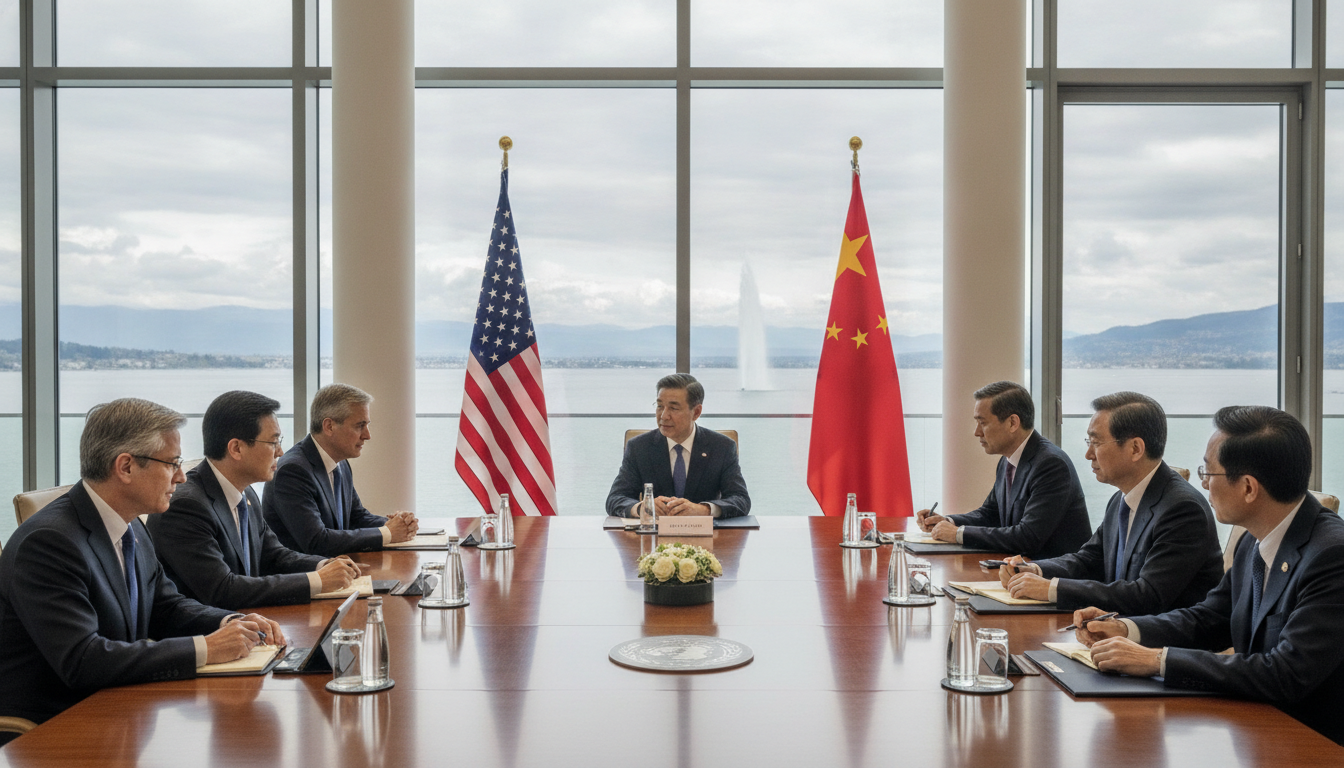
U.S. and China Search for Common Ground on AI Governance at Geneva Conference
U.S. and China meet in Geneva to seek agreement on AI governance amid different domestic rules, aiming for shared safety and transparency standards for trade.
Delegations from the United States and China convened in Geneva in the week of July 6, 2026, to pursue talks on international AI governance. The meetings brought together senior officials and technical advisers to explore whether common rules can be agreed upon despite sharply different national regulatory approaches. Organizers framed the sessions as an initial attempt to identify limited, practical areas of cooperation while acknowledging the broader political tensions between the two countries.
U.S. and Chinese Delegations Meet in Geneva
Both delegations attended sessions hosted at a UN-affiliated venue, according to material circulated by the conference secretariat. U.S. representatives described the talks as a fact-finding and confidence-building exercise, while Chinese officials emphasized the need to protect national development priorities and social stability. The encounter was staged as a diplomatic effort to translate high-level concern about advanced AI systems into negotiable, international practices.
Participants included policy officials, technical experts and observers from multilateral organizations and industry groups. The event purposely combined plenary sessions with smaller technical working groups to test whether operational rules could be drafted and implemented across jurisdictions. Observers said the mix of actors was intended to balance security concerns with innovation and commercial realities.
Stark Differences on Domestic Regulation
Delegations acknowledged that domestic approaches to AI regulation remain markedly different and that those differences shape national red lines in negotiations. The United States has emphasized private-sector oversight, voluntary safety standards and export controls for sensitive technologies, while China has prioritized state-led governance and comprehensive oversight mechanisms within its domestic market. Those contrasts create framing challenges for any global standard that aims to be both effective and acceptable to all.
Officials on both sides said they were mindful that any international agreement must not clash with existing national laws and enforcement models. That constraint narrows the field for immediate consensus and increases the likelihood that early cooperative moves will focus on narrow technical issues rather than sweeping legal obligations. Delegates repeatedly stressed the importance of realistic, implementable measures.
Potential Areas for Early Cooperation
Despite the differences, negotiators identified potential areas where incremental agreement might be feasible, including safety testing protocols, incident reporting frameworks and shared definitions for high-risk systems. Technical harmonization in these narrow domains could reduce cross-border uncertainty and create a foundation for broader trust-building. Participants also noted the practical value of agreeing on metrics and terminologies that would make later regulatory comparisons easier.
Experts at the meeting highlighted that practical steps—such as mutual recognition of conformity testing or common data formats for incident reports—could lower barriers for multinational companies and regulators. Such measures would not resolve strategic competition, but they could mitigate immediate operational risks associated with rapidly deployed advanced models. Delegates suggested that focusing on transparency and traceability would be politically easier than addressing contentious questions like data sovereignty.
Industry and Global Market Pressures
Technology companies and financial markets have been urging some form of international alignment to avoid a patchwork of conflicting rules that could fragment supply chains and limit innovation. Industry representatives at the Geneva sessions argued that predictable cross-border standards would reduce compliance costs and accelerate responsible deployment of AI products. They also warned that a failure to reach even minimal common ground could prompt firms to restrict certain technologies or relocate operations.
Multinational firms face a complex calculus as they navigate differing export controls, data restrictions and certification regimes. Stakeholders attending the conference emphasized that regulatory predictability is particularly critical for cloud services, model training across borders and the international sale of high-capacity compute resources. Those commercial realities were presented as part of the impetus for governments to prioritize certain negotiable areas.
Next Steps, Timetable and Obstacles
Conference organizers signaled that the Geneva talks are intended as the start of a longer, iterative process rather than a one-off negotiation. Delegates agreed to reconvene working groups to translate discussion points into draft technical documents that could be reviewed by capitals. The timetable for further formal agreements was left deliberately open, reflecting the need for domestic consultations and legal reviews in both countries.
Analysts cautioned that progress will be incremental and that geopolitical frictions could slow or derail negotiations. Key obstacles include differing interpretations of national security, varying thresholds for what constitutes unacceptable risk, and broader strategic distrust. Even so, officials framed the talks as a pragmatic channel to reduce the chance of accidents or miscalculations in the near term.
The Geneva discussions underscored a familiar diplomatic reality: shared risks can drive limited cooperation even amid rivalry. While the path to a comprehensive international regime for AI governance remains uncertain, the meeting produced modest progress on technical topics and established a template for continued engagement. Observers said the coming months will test whether those modest gains can be translated into durable mechanisms that both protect public safety and allow technological development to proceed.

