
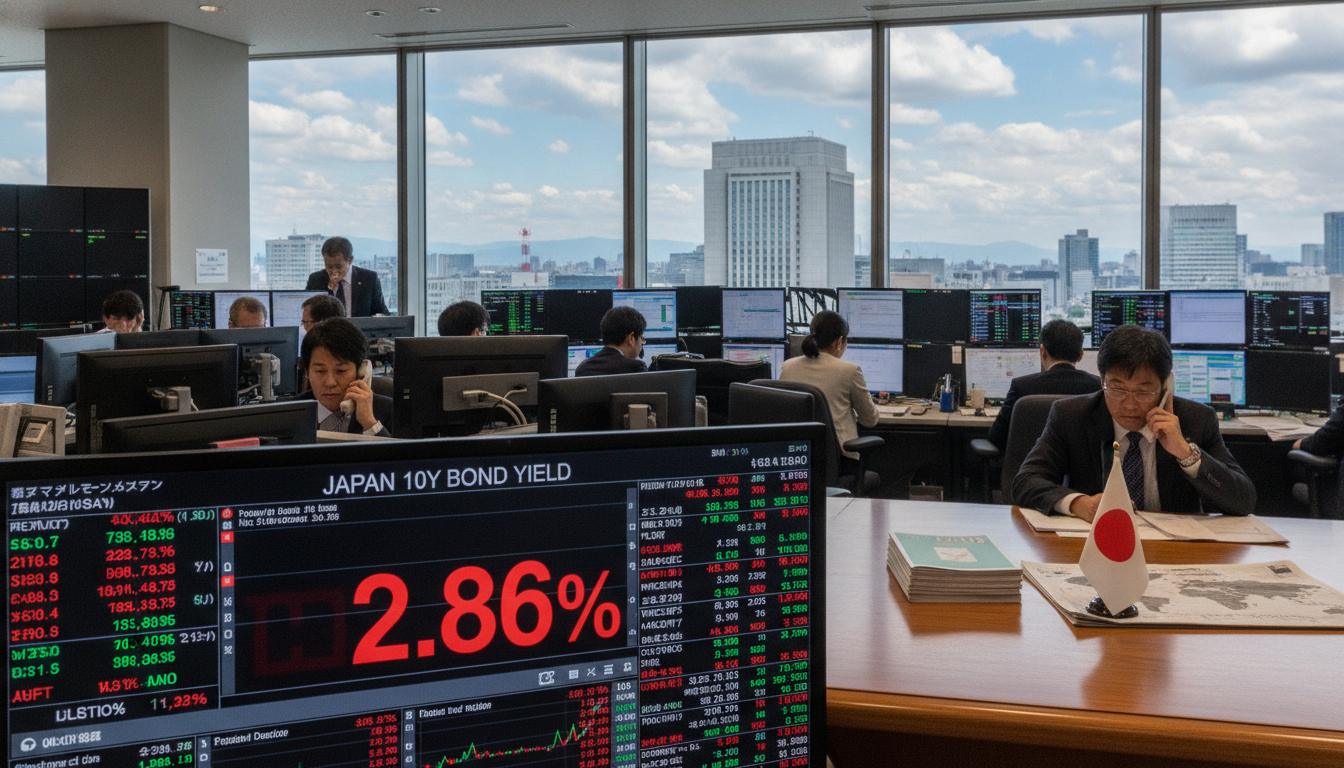
Japan 10-year government bond yield rises to 2.86%, highest since May 1997
Japan’s 10-year government bond yield rose to 2.86% on July 8, highest since May 1997, as fiscal worries and U.S.-Iran tensions push oil prices and inflation.
Market summary on July 8
The 10-year government bond yield climbed to 2.86 percent on July 8, marking the highest level for the benchmark in nearly three decades.
Nihon Sogo Securities reported that this is the strongest reading for the yield since May 1997, reflecting a notable shift in domestic debt market dynamics.
Trading showed sustained selling of Japanese government bonds (JGBs) through the session, with benchmark yields rising across the curve.
Market participants cited a mix of domestic fiscal concern and renewed international risk factors that together pushed investors away from long-duration sovereign debt.
Domestic fiscal concerns prompt bond sales
Investors have grown increasingly wary about Japan’s fiscal trajectory, and that unease has translated into selling pressure on government securities.
Analysts point to long-term budget deficits, an aging population, and continuing public borrowing needs as underlying reasons for reduced appetite among domestic and foreign holders of JGBs.
Higher expected future issuance to finance public spending has raised the perceived supply risk, prompting portfolio adjustments.
As a result, demand for safe but low-yielding JGBs has softened, contributing to the upward move in the 10-year government bond yield.
Geopolitical tensions push oil futures and inflation expectations
Renewed tensions between the United States and Iran have pushed crude oil futures higher in recent sessions, a factor that markets say is lifting inflation expectations.
Rising energy prices increase the risk that headline inflation could accelerate, altering the outlook for real yields and monetary policy.
The combination of higher commodity prices and already-elevated inflation forecasts has made bonds less attractive at current nominal yields.
Traders cited the geopolitical pickup as a catalyst that, alongside domestic worries, amplified selling pressure on long-term government debt.
Investor flows and market mechanics
Selling of bonds has been driven by a mix of institutional rebalancing and hedge fund positioning, according to market accounts.
Some pension funds and insurers have been trimming duration to protect portfolios against further yield increases, while leveraged strategies have magnified intraday moves.
Liquidity in certain JGB maturities tightened during the surge, with bid-ask spreads widening at times as participants adjusted risk exposure.
That dynamic can exacerbate yield volatility, feeding back into selling pressure as market makers demand larger premiums to hold long positions.
Implications for monetary policy and yield curve control
The rise in long-term yields presents a test for the Bank of Japan’s yield curve control framework and broader policy stance.
If elevated yields persist, the central bank may face increased pressure to reassess its approach to anchoring the long end of the curve.
Policymakers must weigh the dual risks of imported inflation from higher oil prices and domestic financial stability considerations.
Any shift in communication or intervention could aim to calm markets, but would also signal a significant change in policy calibration that investors would scrutinize closely.
Government response and fiscal outlook
Tokyo’s fiscal authorities are likely to monitor market developments closely as bond yields climb, with potential implications for debt-servicing costs.
Higher long-term rates increase the cost of new issuance and could complicate budget planning, particularly if rises are sustained.
Officials may seek to reassure investors by outlining plans for fiscal consolidation or by clarifying issuance schedules to reduce uncertainty.
However, meaningful fiscal adjustments in the short term are politically and economically complex, leaving markets sensitive to any signals from the government.
The 10-year government bond yield’s move to 2.86 percent on July 8 reflects a convergence of domestic fiscal questions and international risk factors that have reshaped investor expectations in a single session.
How long yields remain at these levels will depend on the trajectory of oil prices, the evolution of geopolitical tensions, investor risk appetite, and any policy responses from Tokyo or the Bank of Japan.

