
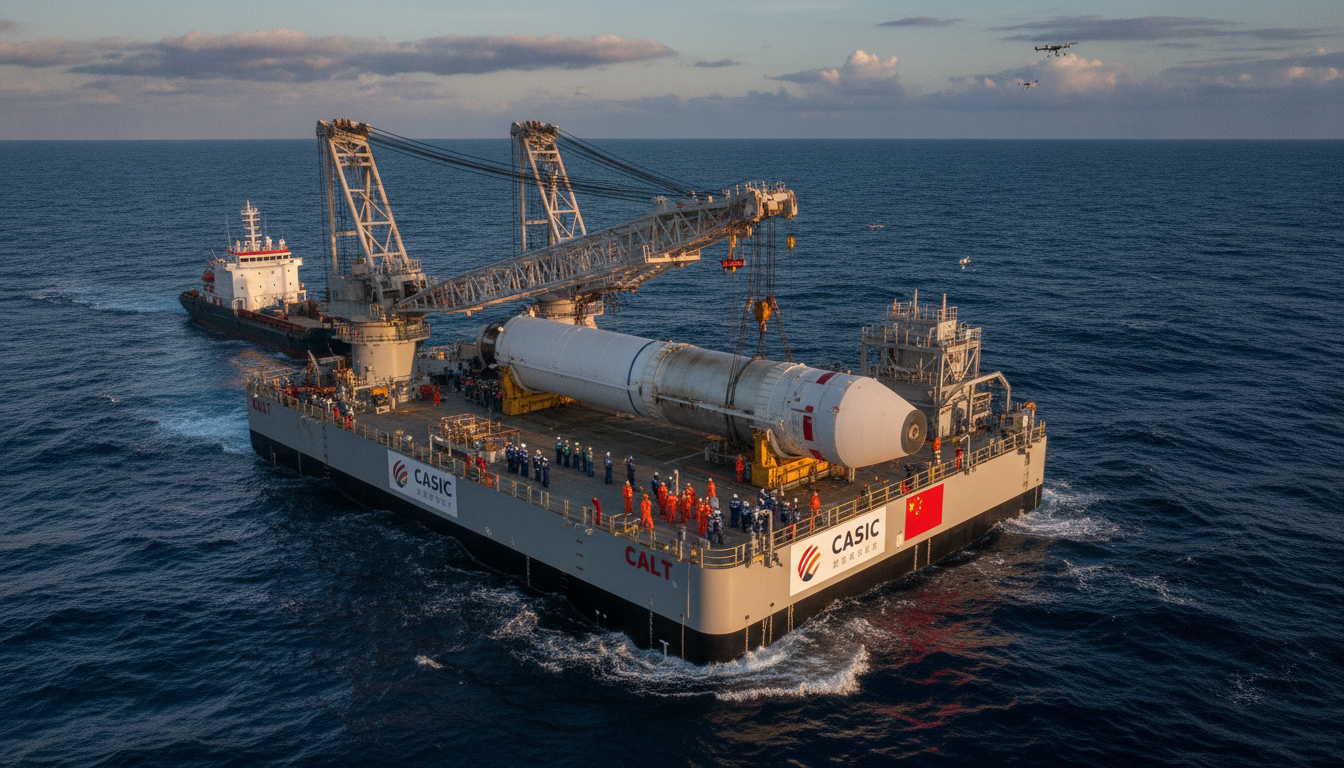
China rocket recovery test succeeds with net-like system off Hainan on July 10, 2026
China rocket recovery test succeeds off Hainan on July 10, 2026, using a net-like system to recover boosters at sea, lower launch costs and attract investment.
China successfully conducted a rocket recovery test at sea on July 10, 2026, marking a significant step in the country’s efforts to develop reusable launch technology. The China rocket recovery test involved an experimental, net-like structure deployed offshore to capture or slow a returning stage, according to photos released by Hainan International Commercial Aerospace Launch. The trial aims to reduce the cost of space missions by enabling partial reuse of launch vehicles and to accelerate commercial space activity within China.
Recovery test off Hainan coast
The test took place in waters off Hainan province and was documented in images posted to the company’s WeChat account on the same day. Photographs show a vessel and what observers described as a mesh or net-like device positioned to intercept a returning stage, indicating a novel approach to maritime recovery. Officials and company representatives have framed the trial as experimental, stressing the need for iterative tests before operational deployment.
The deployment appears designed to capture or decelerate descending rocket hardware, reducing impact forces and sea contamination compared with uncontrolled ocean drop. The choice of a sea-based recovery zone reflects both practical maritime spaceports near Hainan and the desire to conduct recovery away from populated areas.
Design and operation of the net-like recovery system
Available images and company statements suggest the system combines a floating capture structure with support vessels to stabilize and retrieve the stage after descent. The net-like architecture is intended to absorb kinetic energy while preventing structural disintegration, which would simplify refurbishment and reduce turnaround time. Engineers typically balance mesh strength, flexibility and buoyancy when developing such devices, and the experimental setup appears to test those trade-offs under real flight conditions.
Timing and precision are critical for any capture method, and recovery at sea introduces variables such as wind, waves and vessel motion that the system must tolerate. Recovery teams must coordinate telemetry, tracking, and retrieval operations to secure the stage promptly to avoid salt-water corrosion that could complicate refurbishment.
Commercial implications for the Chinese launch industry
If repeatable and reliable, the recovery technique could lower per-launch costs and make small- and medium-class launchers more competitive for commercial satellite deployment. Reduced hardware loss and faster refurbishment cycles would appeal to private satellite operators and could catalyze new investment in domestic space ventures. Chinese commercial launch firms have been expanding in recent years, and recoverable stages would add a cost-optimization tool similar to those used in other markets.
Lower costs could also broaden access to space-based services for Chinese firms and regional partners, stimulating demand for Earth observation, broadband, and small-satellite constellations. Investors evaluating satellite and launch businesses are likely to watch subsequent tests closely for signs of technological maturity.
Strategic competition and international response
The test occurs amid intensified global interest in reusable launch capabilities and follows years of rapid development in both state and commercial space sectors. Chinese authorities and industry executives have framed achievements in recovery technology as part of a broader push to close gaps with leading international players. Observers in other countries are likely to assess whether the approach offers unique technical or cost advantages.
While recovery innovations are largely commercial in intent, they also carry strategic implications for national space capability and resilience. Nations increasingly view affordable access to orbit as a component of both economic competitiveness and national security, which can influence export, collaboration and regulatory priorities.
Regulatory, safety and environmental considerations
Maritime recovery operations must conform to national and international regulations governing navigation, environmental protection and airspace coordination, adding complexity to routine launches. Ensuring safety for nearby shipping and minimizing marine pollution are immediate operational concerns, particularly if hardware contacts seawater. Authorities and operators will need clear protocols for hazard zones, communication with maritime traffic and post-recovery disposal or decontamination.
Environmental monitoring will be important if recovery becomes routine, including assessments of debris, chemical contamination and impacts on marine life. Transparent reporting about recovery procedures and environmental safeguards can help build public and stakeholder confidence as operations scale.
The July 10, 2026 trial represents a measured step toward routine reuse of Chinese launch vehicle components, but technical and regulatory hurdles remain before such systems are deployed at scale. Further tests will be required to demonstrate reliability across different vehicle classes, weather conditions and recovery scenarios. Continued attention from industry and regulators will determine whether the net-like approach developed off Hainan becomes a standard element of China’s commercial space toolbox.

