
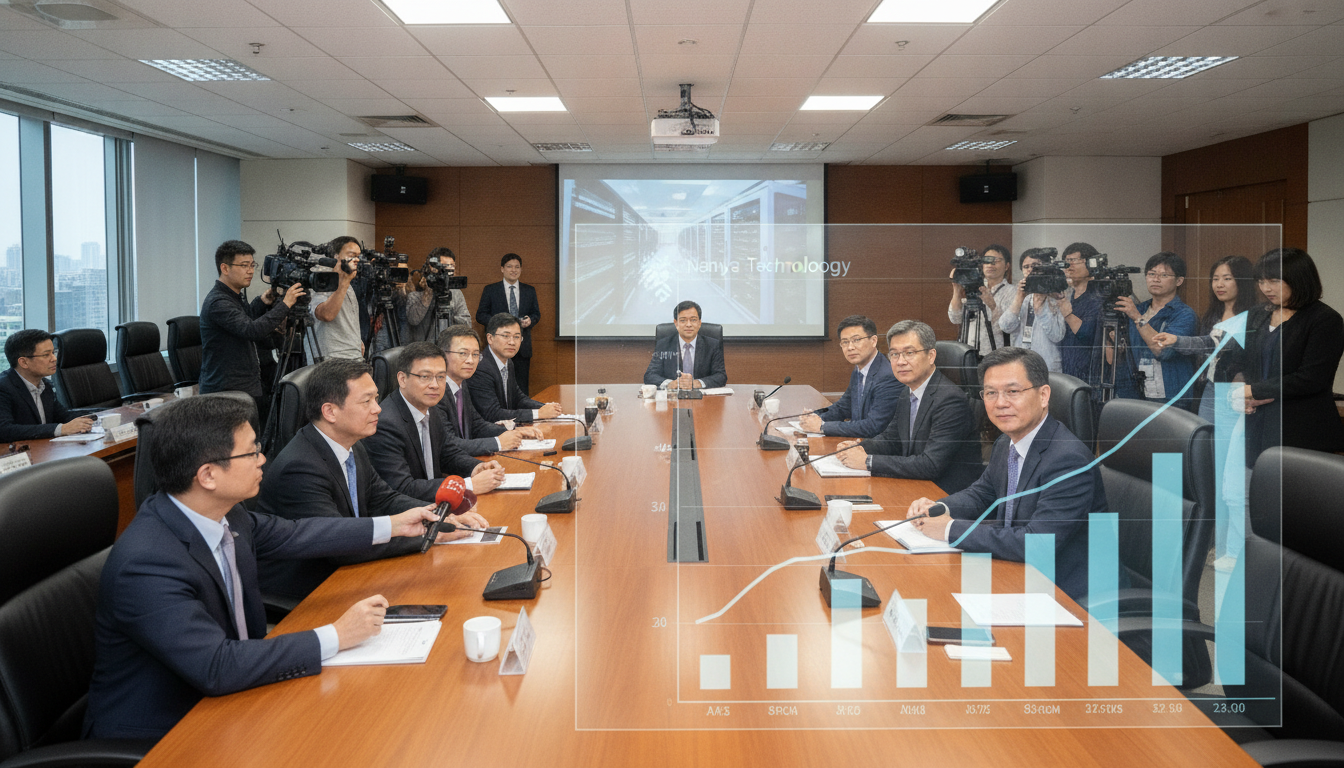
Nanya Technology to Quadruple Capital Spending in 2027 as AI-Fueled DRAM Crunch Tightens Market
Nanya Technology will quadruple capital expenditure in 2027 as the Taiwanese DRAM maker expects memory prices and gross margins to rise through 2026 amid an AI-driven supply squeeze.
Nanya Technology, Taiwan’s largest memory-chip producer and the world’s fifth-largest DRAM maker, told investors it plans a sharp increase in capital spending next year to expand capacity and boost advanced production capabilities. The company cited accelerating demand from artificial intelligence applications and related data-center hardware as the primary driver behind the move. Management said the firm expects memory prices and gross margins to continue improving through 2026, prompting a strategic ramp-up of investment.
Nanya Plans Quadrupled Capital Spending in 2027
Nanya’s board approved a plan to multiply capital expenditure fourfold in 2027 compared with current-year levels to address immediate supply constraints and prepare for longer-term demand. The increased funding will be directed at wafer fabs, process upgrades, and capacity expansion aimed at meeting surging demand for higher-density DRAM.
Company executives framed the decision as proactive rather than reactive, noting that a window of favorable pricing and rising gross margins makes large-scale investment economically viable. The move signals confidence that the current market tightening, driven by AI workloads, is not a short-lived blip but a structural shift that warrants accelerated spending.
AI Demand Drives DRAM Supply Tightness
Memory requirements for AI training and inference, particularly in high-bandwidth graphics processing units and specialized accelerators, have increased the industry’s bit demand dramatically. This AI-led surge has outpaced suppliers’ short-term ability to expand output, producing a tightening in DRAM supply and upward pressure on prices.
Manufacturers across the semiconductor ecosystem have highlighted similar dynamics, with buyers repeatedly flagging shortages for certain memory types used in servers and datacenter accelerators. Nanya’s investment plan reflects an industrywide response to bridge the gap between rapidly growing demand and physical manufacturing lead times.
Financial Outlook and Margin Expectations
Nanya signaled that it expects gross margins to continue improving in 2026 as memory prices recover and inventory normalizes across customers. The company’s position as a mid-ranked DRAM producer allows it to capitalize on favorable price movements while selectively allocating capacity to higher-margin products.
Analysts will be watching quarterly results for signs that the anticipated margin expansion is materializing and sustainable beyond short-term pricing cycles. Management emphasized prudent financial discipline despite the aggressive capex commitment, citing cash flow and balance-sheet metrics that support the planned expansion.
Production Expansion and Investment Focus
The planned capital spending will prioritize both capacity scale and technological upgrades to lift yield and support higher-density products demanded by AI workloads. Investments are expected in wafer fab equipment, backend test and packaging lines, and process control systems to accelerate output without sacrificing quality.
Nanya also intends to deepen collaboration with key equipment suppliers and to optimize production schedules to reduce ramp times. The company aims to balance near-term output increases with longer-term improvements in unit economics that come from advanced node investments.
Competitive Position and Market Implications
As the world’s fifth-largest DRAM vendor, Nanya occupies a position that allows it to influence mid-tier supply dynamics while remaining sensitive to moves by larger rivals. A substantial capacity expansion by Nanya could moderate price volatility over time, but near-term effects will depend on how quickly new capacity comes online across the industry.
Customers, including cloud providers and enterprises deploying AI infrastructure, will be watching allocations and shipment schedules closely. If Nanya succeeds in expanding output efficiently, it could strengthen its bargaining position and capture share in segments where supply has been most constrained.
Risks and Execution Challenges
The scale of the planned spending introduces execution risk given long lead times for semiconductor equipment and potential supply-chain bottlenecks. Delays in tool delivery or yield ramp issues could compress returns and expose Nanya to heightened cyclical swings in memory prices.
Macroeconomic downside, shifts in end-market demand, or faster-than-expected capacity additions from competitors could also erode the pricing environment. Company statements stressed contingency planning and staged investment as means to mitigate those risks while pursuing growth.
This capital-intense bet underscores how the memory industry is responding to rapid shifts in demand driven by AI applications. Nanya Technology’s move to quadruple capex in 2027 is a clear signal that suppliers see a multi-year opportunity to rebuild capacity and capture value as data-center architectures evolve.

