
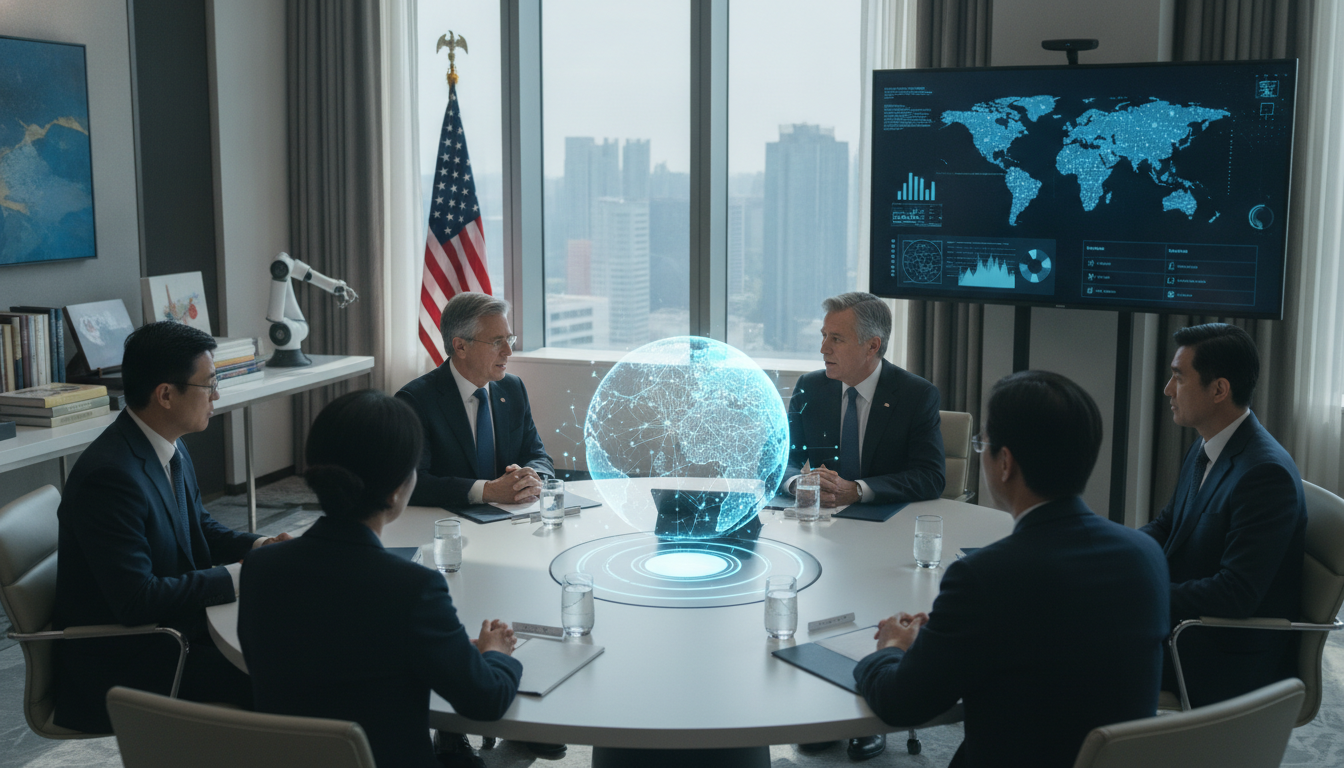
U.S. Global Leadership at Risk: Can AI and Soft Power Keep Washington Ahead of Beijing?
As the United States marks its 250th anniversary, questions over U.S. global leadership are intensifying as policymakers and analysts weigh technological strategy, alliances and influence in the face of a rising China. The debate centers on whether investment in artificial intelligence, renewed soft power initiatives and stronger international partnerships can preserve America’s strategic edge. Washington’s choices in the coming years will determine whether it consolidates advantage or concedes ground.
U.S. Leadership at a Historic Inflection Point
The United States today faces a test of capacity and credibility that combines economic, technological and diplomatic pressures. Domestic political division, fiscal constraints and shifting public expectations have made the practice of global leadership more fraught than in previous decades.
At the same time, the international environment is less forgiving of complacency; rivals have invested heavily in alternate governance models and strategic technologies. That competition has elevated questions about the durability of U.S. influence across Asia, Europe and other regions.
AI Investment and Research as Strategic Tools
Maintaining a technological lead, particularly in artificial intelligence, is widely seen as central to future economic and military power. Private-sector innovation in AI, backed by world-class universities and venture capital, remains a core U.S. advantage that can translate into superior commercial products and defense capabilities.
Sustained public investment, clearer regulatory frameworks and talent policies that attract and retain top researchers are necessary to convert scientific edge into strategic influence. Export controls, standards-setting and international research partnerships will shape whether AI strengthens or merely reshuffles global power.
Economic Foundations and Supply-Chain Resilience
Economic strength underpins any sustained superpower role, and the resilience of critical supply chains has emerged as a priority for policymakers. Semiconductors, rare earths and advanced manufacturing are examples where onshoring, diversification and alliance-driven production have moved to the top of legislative agendas.
Fiscal policy and industrial strategy must balance short-term competitiveness with long-term investment in infrastructure, education and research. Without a robust economic base, technological advances will struggle to translate into lasting geopolitical leverage.
Military Posture and Alliances in the Indo‑Pacific
The United States’ military capabilities and forward presence remain central to deterrence in the Indo‑Pacific, but platforms alone are not sufficient. Deepening interoperability, joint exercises and base access with partners like Japan, Australia and South Korea amplify U.S. influence beyond the size of its own forces.
Diplomatic engagement that aligns defense planning with economic and technological cooperation will strengthen credibility. Allies judge Washington not only by capabilities but by policy continuity and willingness to lead on shared security challenges.
Soft Power Renewal and Global Perception
Soft power—cultural appeal, educational ties, development assistance and values-based diplomacy—continues to be an essential complement to hard power. Universities, media, cultural exports and people-to-people exchanges sustain long-term relationships that shape global alignments in ways military assets cannot.
Renewing soft power requires pragmatic investment: expanding educational visas, increasing exchange programs, and deploying development aid with greater strategic focus. Reasserting commitment to international institutions and cooperative problem-solving can rebuild trust among partners and neutral states alike.
China’s Strategic Competition and Structural Limits
Beijing’s rapid advances in technology, infrastructure finance and military modernization present a sustained challenge to U.S. primacy. China’s scale and state-led approach have delivered impressive gains, especially in areas like 5G, manufacturing and targeted AI applications.
However, structural limits—an aging population, external dependency for key technologies, and growing geopolitical pushback—constrain Beijing’s trajectory. The contest therefore hinges not only on raw capacity but on governance choices, global perception and the ability of other countries to choose relationships that best serve their interests.
Policy Choices That Will Shape the Next Decade
Washington faces a narrow window to align domestic reform with international strategy. Priorities include boosting federal funding for AI and semiconductor R&D, modernizing education and immigration systems to attract talent, and coordinating export controls with allies to shape technology ecosystems.
Equally important are diplomatic investments: revitalizing alliances, expanding multilateral engagement on technology standards and climate, and deploying soft power tools to demonstrate the benefits of partnership. These policy choices will determine whether the United States converts present assets into sustained global leadership.
The question of whether the United States has peaked is not purely academic; it is a strategic dilemma that requires concrete policy responses. By coupling technological leadership with alliance cohesion and a renewed commitment to soft power, Washington can strengthen the foundations of U.S. global leadership for the decades ahead.

