
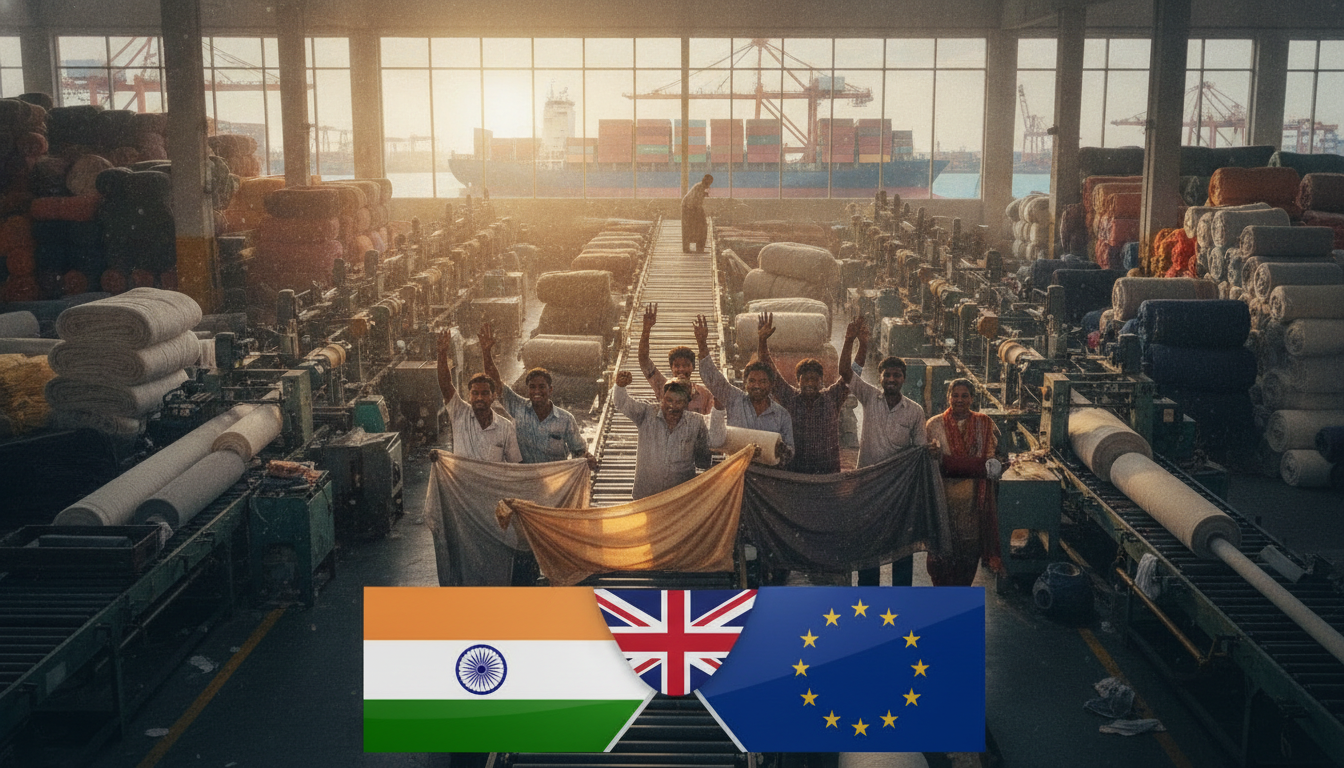
India textile exports rebound as UK and EU trade deals lift orders
India textile exports gain momentum after the U.K. and EU trade agreements removed duties of up to 12%, boosting orders and competitiveness with regional rivals.
India textile exports have begun to recover after months of uncertainty as the start of trade agreements with the United Kingdom and the European Union reduces tariffs on key shipments. Exporters report an uptick in purchase orders following the removal of duties of up to 12%, a change that narrows the tariff gap with duty-free competitors such as Bangladesh and Pakistan. The shift has prompted mills, garment manufacturers and trading houses to recalibrate production and delivery schedules to meet renewed demand.
Trade deals spark immediate order flow
The recent implementation of preferential terms with the U.K. and the EU has produced a tangible short-term uplift in enquiries and confirmed orders from European buyers. Suppliers in major textile hubs said buyers, previously cautious during months of trade friction and logistical disruption, are now returning with clearer sourcing plans. The tariff concessions have made Indian offers more price-competitive at the front end, translating quickly into purchase commitments for staple categories such as knitwear, woven shirts and home textiles.
Industry sources described the response as measured but meaningful, with order windows gradually widening beyond spot shipments. Buyers indicated they are testing Indian suppliers on reliability and lead times before shifting larger volumes, a pattern analysts say is typical after structural trade changes.
Tariff relief narrows the playing field with regional rivals
Removing duties of up to 12% levels the tariff playing field between India and South Asian rivals that have long benefitted from lower or zero duties into Europe. The change addresses a core competitiveness issue for Indian exporters, who had faced a relative disadvantage in price-sensitive product segments. For many buyers, a lower tariff environment reduces the final landed cost enough to reconsider sourcing decisions that previously favoured Bangladesh and Pakistan.
That said, price is only one component of sourcing decisions. Observers note that duty parity increases India’s attractiveness but does not automatically guarantee market share gains unless combined with on-time delivery and compliance with buyer specifications.
Manufacturers and logistics firms adapt to renewed demand
Factories in textile clusters are reportedly ramping up shifts and undertaking incremental hiring to accommodate flow-back orders, while logistics providers scramble to secure container capacity. Several medium-sized suppliers said they were reworking production schedules and sourcing raw material more aggressively to shorten lead times. Companies also highlighted the need to manage working capital carefully as payment terms and inventory cycles readjust.
At the same time, port congestion and inland transport bottlenecks that contributed to earlier disruptions remain concerns for some exporters, underscoring that tariff changes alone will not resolve all operational obstacles.
European retailers and wholesalers respond with cautious buying
Retailers and wholesalers in the U.K. and EU are beginning to place more structured orders for upcoming seasons, influenced by the lower duty regime. Procurement teams cited in-market margin pressures and consumer cost sensitivity as drivers for diversifying sourcing back to India. Several buyers are also placing greater emphasis on compliance, traceability and sustainability credentials, which Indian suppliers must meet to secure larger contracts.
Analysts expect a phased shift in sourcing, with more conservative procurement in the short term and larger reallocations contingent on consistent delivery performance over several quarters.
Non-tariff barriers and rules of origin still pose hurdles
Despite tariff relief, exporters warn that non-tariff measures—such as stringent rules of origin, certification requirements and labelling standards—could dampen the pace of gains. Meeting the documentation and processing demands necessary to claim preferential tariffs requires investment in compliance systems and training. Smaller suppliers, in particular, may find the administrative burden significant, potentially limiting their immediate ability to capitalize on the tariff changes.
Industry bodies are urging clearer guidance and streamlined processes to reduce friction at the claim stage and ensure eligible shipments realise the full benefit of the new agreements.
Policy measures urged to consolidate gains
Trade associations and exporters are calling on policymakers to support the sector through targeted measures that complement the trade deals. Recommendations include credit facilities for working capital, expedited customs procedures, technical assistance for compliance, and incentives for upgrading manufacturing equipment. Stakeholders argue that coordinated policy action will help convert improved tariff access into durable export growth and higher-value product moves.
Many exporters also see an opportunity to push into higher-margin segments such as technical textiles and certified sustainable apparel if combined with supportive finance and training.
The early recovery in orders for India textile exports reflects a pivotal moment for the industry, but the outlook will depend on how quickly suppliers can demonstrate consistent delivery, meet evolving buyer standards, and overcome remaining logistical and compliance challenges.

