
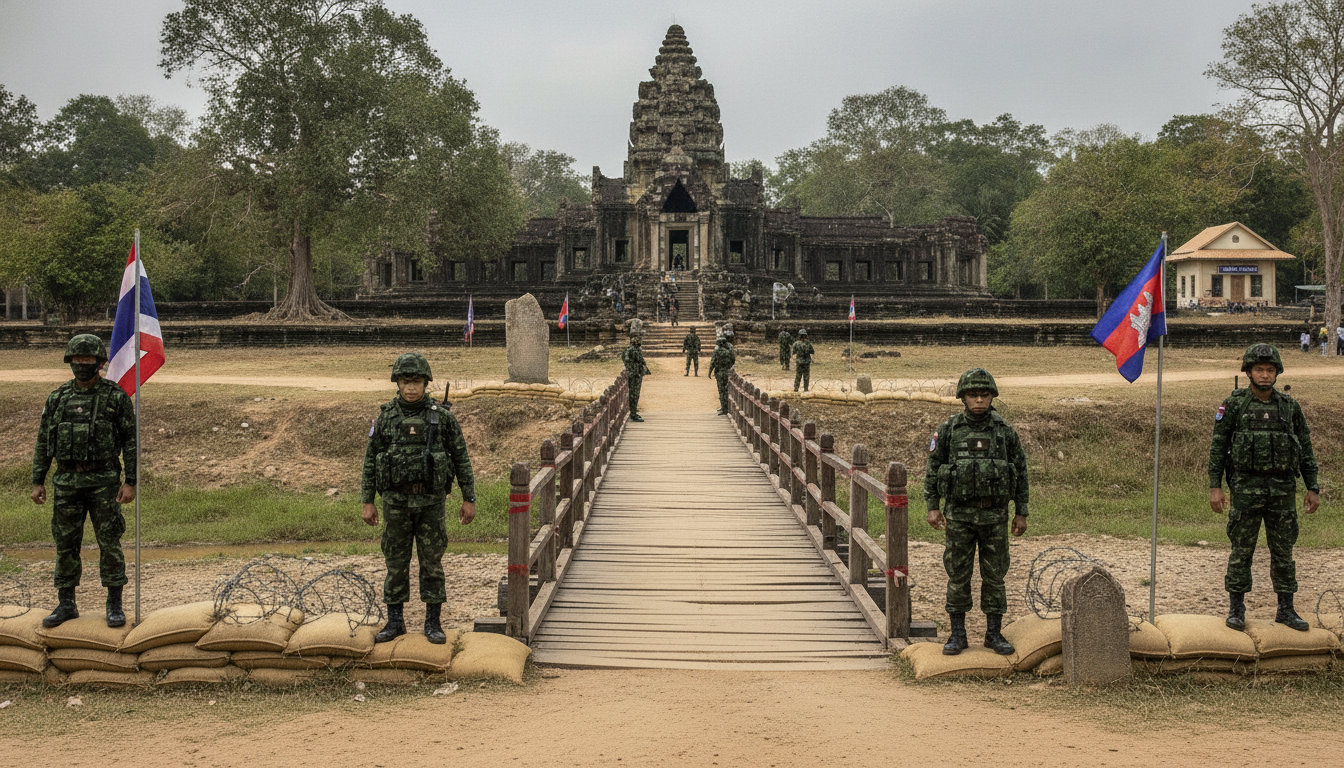
Thailand-Cambodia conflict: Border fence work resumes in Pong Nam Ron as December ceasefire holds
Thailand-Cambodia conflict draws renewed attention as workers erect a border fence in Pong Nam Ron, Chanthaburi, after a December ceasefire brought calm but no durable settlement.
Workers were photographed on July 22, 2026, building a border fence in Pong Nam Ron district of Chanthaburi province, highlighting how the Thailand-Cambodia conflict remains unresolved despite a ceasefire agreed in December. The construction underscores persistent local tensions as military and civilian lines of control remain contested. Officials on both sides say the ceasefire has prevented large-scale fighting but have not yet translated into a political resolution.
Fence construction resumes near Pong Nam Ron
A crew of laborers and equipment was seen erecting a new section of barrier along a stretch of the border on July 22, 2026. Local authorities described the work as part of measures to regulate crossings and prevent smuggling, while some residents view it as a hardening of the frontier. The visible activity has prompted concern among villagers who fear restricted movement and potential clashes over demarcation.
The fence is the most recent in a series of physical measures taken along disputed stretches of the boundary. Military patrols have increased their presence near the works, though there have been no public reports of engagements tied directly to the construction. Observers say the installation is as much political signaling as practical border control.
Ceasefire agreed in December remains intact
Since the ceasefire reached in December, major combat operations along the Thailand-Cambodia border have largely stopped, according to regional monitors and local officials. Both governments have repeatedly affirmed the truce in public statements, and there have been fewer incidents of artillery or mortar exchanges compared with previous flare-ups. The pause in large-scale hostilities has reduced immediate civilian harm but has not resolved disputes over territory.
Despite the calm, the ceasefire appears fragile in everyday terms, with periodic patrol encounters and tensions over new infrastructure such as the recent fence. Analysts warn that without a formal, mutually accepted border demarcation, the status quo could be punctured by miscalculation or local incidents. Diplomats have urged renewed talks but progress has been incremental.
Impact on border communities in Chanthaburi
Residents of Pong Nam Ron and neighboring villages report a mix of resignation and anxiety as construction proceeds. Farmers say access to grazing lands and market routes has become more uncertain, and small traders fear restrictions will hit livelihoods dependent on cross-border activity. Community leaders have called for clear guidance from provincial authorities to prevent unintended disruption.
Humanitarian workers note that displacement risk remains low while open fighting has subsided, but stress that economic hardship and limited services could worsen if barriers impede daily life. Local clinics and schools continue to operate, but parents express concern about safety and future access to work across the frontier. The social toll of a prolonged, unresolved dispute is increasingly evident in everyday conversations.
Military posture and patrols along the frontier
Thai and Cambodian forces have maintained reinforced patrols in key sectors of the border since the December agreement, officials say. Both sides report routine surveillance, checkpoints and occasional stand-offs that are typically resolved through local commanders or liaison channels. The increased visibility of troops aims to deter infiltration as much as to reassure domestic audiences.
Military spokespeople emphasize that current deployments are defensive and tied to maintaining the ceasefire. Yet the construction of fences and checkpoints can alter tactical calculations on the ground, experts warn, potentially increasing friction where lines of control remain ambiguous. Continued confidence-building measures will be critical to prevent accidental escalations.
Diplomatic efforts and regional mediation
Diplomats and regional organizations have pressed for renewed negotiations to translate the ceasefire into a durable settlement, but official talks have yielded limited breakthroughs. Bangkok and Phnom Penh have held intermittent discussions focused on confidence-building, demining and joint border management, yet deep-rooted disagreements over maps and sovereignty claims persist. International mediators have offered technical support but stress that political will is essential.
Observers say progress will likely require a phased approach: codifying the ceasefire terms, establishing clear local mechanisms for incident resolution, and then moving toward formal demarcation. Economic and security incentives could help, but both capitals face domestic pressures that complicate compromise. Any sustained solution will need to balance national pride with pragmatic arrangements on the ground.
Historical claims and the enduring source of dispute
The Thailand-Cambodia conflict has origins in colonial-era treaties, competing historical interpretations, and the strategic value of borderland resources. Specific sites and border alignments remain sensitive symbols of sovereignty for both countries, complicating technical attempts at resolution. Past flare-ups have flared into violence when political momentum favored hardline stances.
Legal and cartographic disagreements persist in district-level boundary descriptions, making translation from national negotiation to local implementation difficult. Specialists say that durable peace requires not only diplomatic accords but detailed, mutually ratified maps and community-level guarantees to prevent future incidents.
As the fence work in Pong Nam Ron illustrates, the ceasefire that took effect in December has bought breathing space but not closure in the Thailand-Cambodia conflict. Communities along the border await clearer decisions from national governments while local actors adapt to tangible changes on the ground.

