
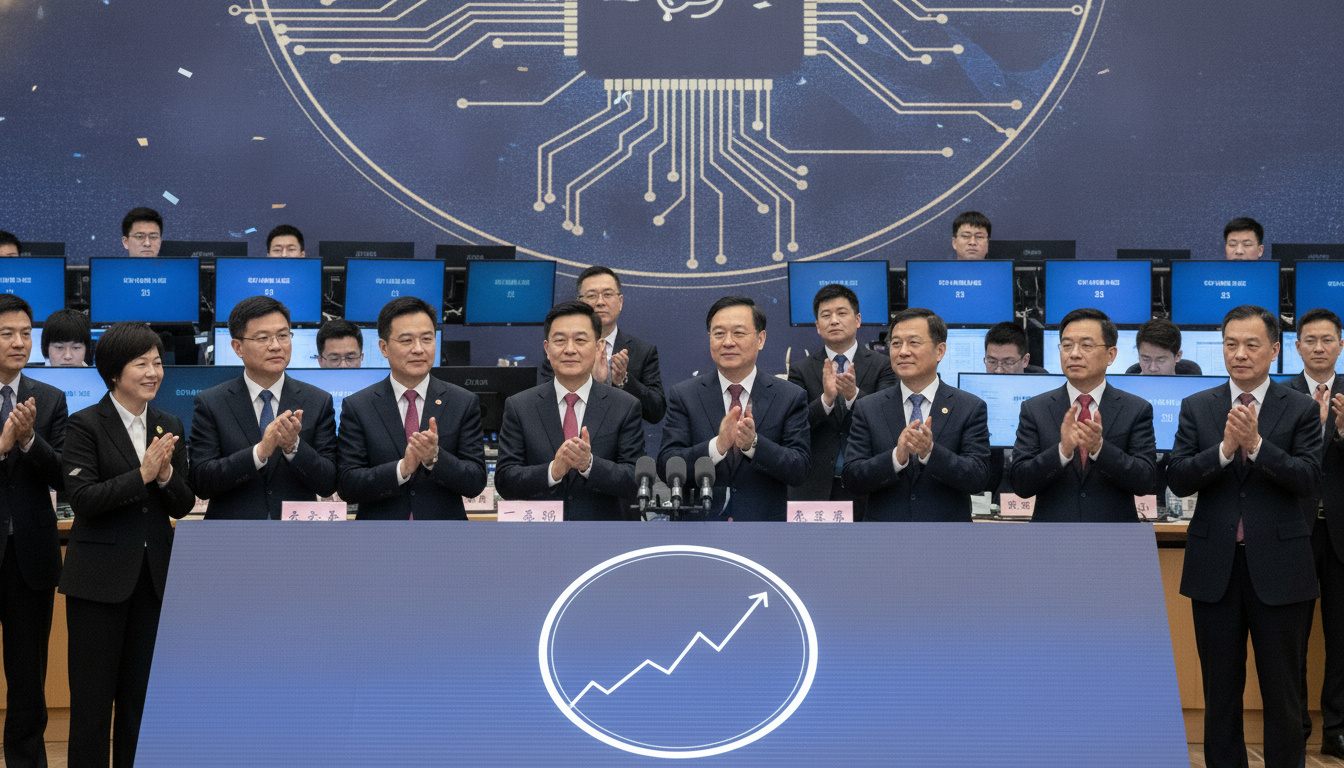
CXMT IPO Raises 57.9 Billion Yuan in Asia’s Biggest Offering This Year
China’s CXMT IPO drew strong investor demand, raising at least 57.9 billion yuan ($8.6 billion) in a landmark listing that debuted on July 27, 2026. The CXMT IPO on the Shanghai STAR Market marked a high-profile moment for China’s memory-chip industry as demand for DRAM tied to AI applications surged.
Strong opening move in trading debut
Shares of CXMT climbed sharply when trading began on the Shanghai STAR Market, reflecting heavy demand from institutional and retail investors. The debut capped a selling period that set the share price and produced proceeds that industry watchers say will accelerate the company’s capacity build-out. Market participants described the rise as affirmation of investor appetite for semiconductor names linked to artificial intelligence and data-center growth.
Proceeds top 57.9 billion yuan and support expansion plans
The offering raised at least 57.9 billion yuan, roughly $8.6 billion, making it the largest initial public offering in Asia so far in 2026. Company statements indicate proceeds will be directed toward increasing DRAM production, upgrading process technology and strengthening research and development. CXMT has framed the capital raise as central to its strategy to scale output and reduce reliance on foreign suppliers amid intensifying global competition.
State backing and strategic importance to China’s chip ambitions
CXMT is widely regarded as state-supported, and its listing has been framed by officials and analysts as a strategic step for China’s semiconductor self-reliance. The firm’s role as a domestic DRAM supplier places it at the center of Beijing’s efforts to build local supply chains for memory chips critical to AI, cloud computing and advanced electronics. Observers note that government support for investment and industrial policy has been a material factor in the company’s rapid rise.
Investor concerns over valuation and long-term profitability
Despite the strong debut, some investors and analysts warned that the CXMT IPO carried valuation risks given the capital intensity of DRAM manufacturing. Memory markets are cyclical, and sustaining profit margins typically requires consistent demand and disciplined capacity expansion. Questions remain about how quickly CXMT can translate higher revenue into durable profits, especially while investing heavily in fabs and wafer production.
Market dynamics: AI demand versus cyclical risk
The surge in demand for DRAM driven by generative AI and data-center upgrades has underpinned investor enthusiasm for memory suppliers worldwide. CXMT has positioned itself to capture that growth by expanding capacity and adapting designs for high-performance AI workloads. At the same time, the memory sector’s history of sharp price swings and overcapacity episodes warns that favorable near-term fundamentals can change rapidly if supply and demand fall out of balance.
Implications for China’s chip ecosystem and global supply chains
The successful listing of CXMT is likely to spur further capital flows into China’s domestic semiconductor firms, from materials and equipment suppliers to chip designers. For policymakers, the IPO is a visible demonstration of progress toward a more localized memory industry, though experts caution that technological gaps and export controls remain significant constraints. International players will be watching whether CXMT’s scale-up reduces reliance on overseas suppliers or prompts renewed strategic responses.
China’s broader semiconductor strategy may shift incrementally as companies like CXMT move from state-backed startups to publicly listed manufacturers with access to global capital. That transition creates new governance expectations and places commercial performance under closer scrutiny from both investors and regulators.
Looking ahead, the CXMT IPO will be measured not only by the size of the funds raised and the initial market reaction but by the company’s ability to deploy capital effectively, manage cyclical DRAM dynamics and deliver technology improvements. The listing underscores how AI-driven memory demand is reshaping investment priorities, while also highlighting the commercial and technical hurdles that lie ahead for domestic chipmakers.

