
Alibaba’s Qwen3.8 Max Debut Draws Scrutiny as Benchmarks Place It Behind Rivals
Alibaba’s Qwen3.8 Max previewed at a Shanghai conference, but independent tests show it lags behind some domestic and international rivals in real-world benchmarks.
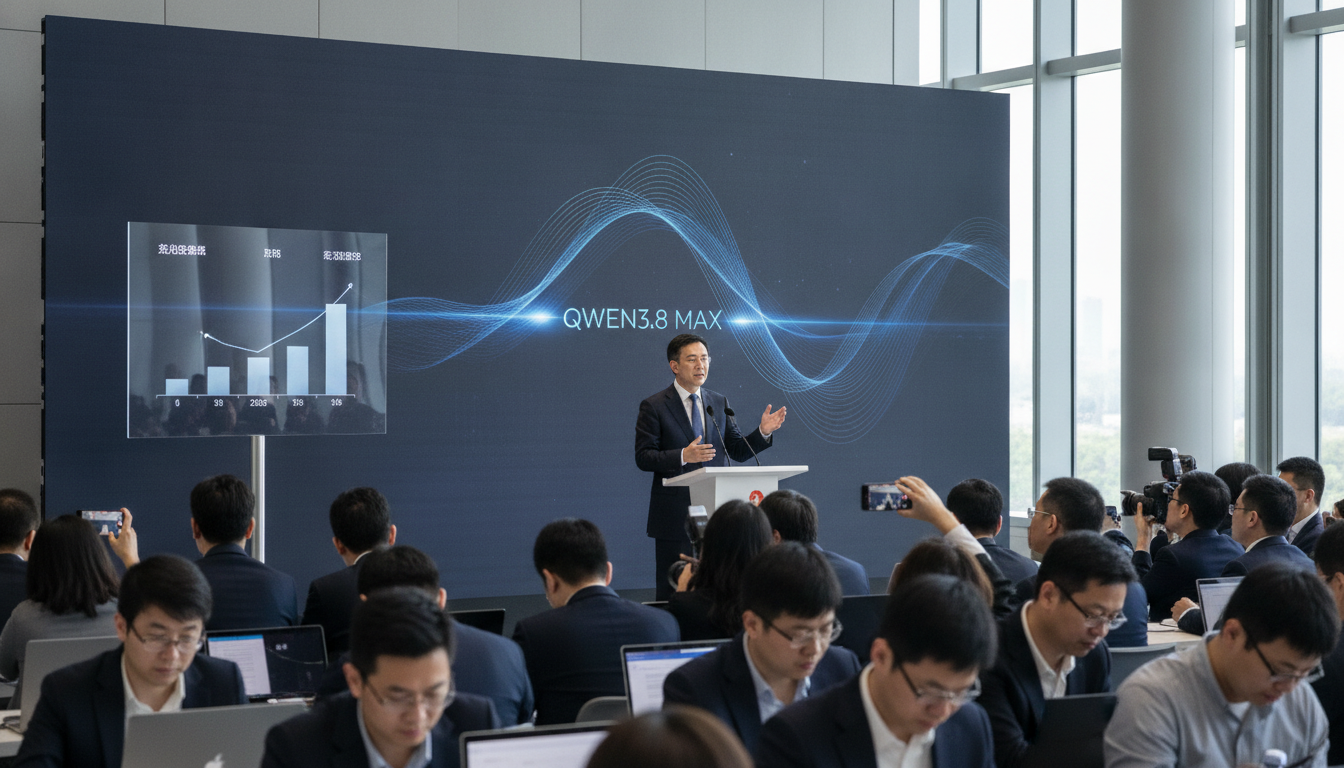
Alibaba Group on July 19 unveiled a preview of Qwen3.8 Max, touting the model as a 2.4‑trillion‑parameter flagship and saying it was “one of the most powerful models available today, second only to Fable 5.” The company made the preview available through its token plan and enterprise tools, positioning Qwen3.8 Max as a multimodal, mixture‑of‑experts system for developers and customers. (geotoolbox.ai)
Early public preview at World AI Conference
Alibaba presented the Qwen3.8 Max demonstration at the World AI Conference in Shanghai, calling the model a significant advance for its Qwen family. The preview release was distributed across Alibaba’s token pricing plan and its Qoder product lines rather than through a full public model card or a standalone API announcement. Several industry observers noted the absence of a formal benchmark table or detailed model card accompanying the preview. (geotoolbox.ai)
Independent benchmark results show mixed performance
Independent benchmark testing and community reviews in the days following the preview produced mixed results, with several testers finding Qwen3.8 Max behind the performance signals Alibaba claimed. Analysts and third‑party labs have published early comparisons that suggest the model does not unambiguously outperform existing frontier models across a range of coding and reasoning tasks. Those tests have prompted debate about whether vendor claims should be treated as demonstrations until peer‑reviewed benchmarks are available. (yottalabs.ai)
Moonshot’s Kimi K3 emerges as a strong competitor
Compounding Qwen3.8 Max’s challenge is the near‑simultaneous rise of Moonshot AI’s Kimi K3, which independent trackers and platform rankings have placed at or near the top on several coding and reasoning leaderboards. Kimi K3’s public rollout prompted heavy demand and temporary limits on new subscriptions as the startup scaled capacity to meet interest. The Kimi release has become the primary reference point in recent model comparisons. (apnews.com)
Pricing and market positioning differ sharply
Pricing dynamics are shaping early adoption decisions. Third‑party trackers list Kimi K3’s API at roughly $3 per 1M input tokens and about $15 per 1M output tokens in early July pricing documents, placing it in a premium frontier tier. Alibaba’s Qwen preview was framed as more cost‑competitive in the materials released and in subsequent market summaries, and analysts say Chinese hosted and self‑hostable models are generally being offered at lower marginal inference costs than many Western closed‑weights alternatives. That gap is a central argument for enterprises weighing accuracy against operational cost. (tokenrate.dev)
Questions over transparency and technical detail
Critics and researchers have emphasized that the Qwen3.8 Max rollout was a preview rather than a full technical release: there was no comprehensive model card, no activated‑parameter disclosure and no detailed task‑level benchmark table published alongside the announcement. That lack of disclosure has fueled caution among independent evaluators and some enterprise customers who prefer reproducible benchmark tables and model cards before committing to migration or deployment plans. Some observers also documented that earlier public scores tied to prior Qwen releases were later adjusted or removed, adding to concerns. (siliconangle.com)
What corporations and developers should watch next
For corporate users, the immediate calculus will likely hinge on three factors: independent, task‑level benchmark results; pricing and caching economics for large agent or long‑context workloads; and the pace at which Alibaba publishes a model card and fuller technical documentation. Developers experimenting with Qwen3.8 Max in the token plan report a range of early experiences, from promising multimodal outputs to occasional latency and consistency issues in preview settings. Market watchers expect head‑to‑head Arena and coding leaderboard updates in the coming weeks to clarify comparative strengths. (eesel.ai)
As Alibaba and other Chinese labs iterate rapidly, the sector’s short horizon is becoming clearer: new, large‑scale models are appearing at a rapid cadence, but differences in transparency, pricing and real‑world robustness continue to determine which systems gain traction in production. Industry customers say they will prioritize verified performance on their workloads and predictable inference costs over vendor marketing until independent results converge.

