
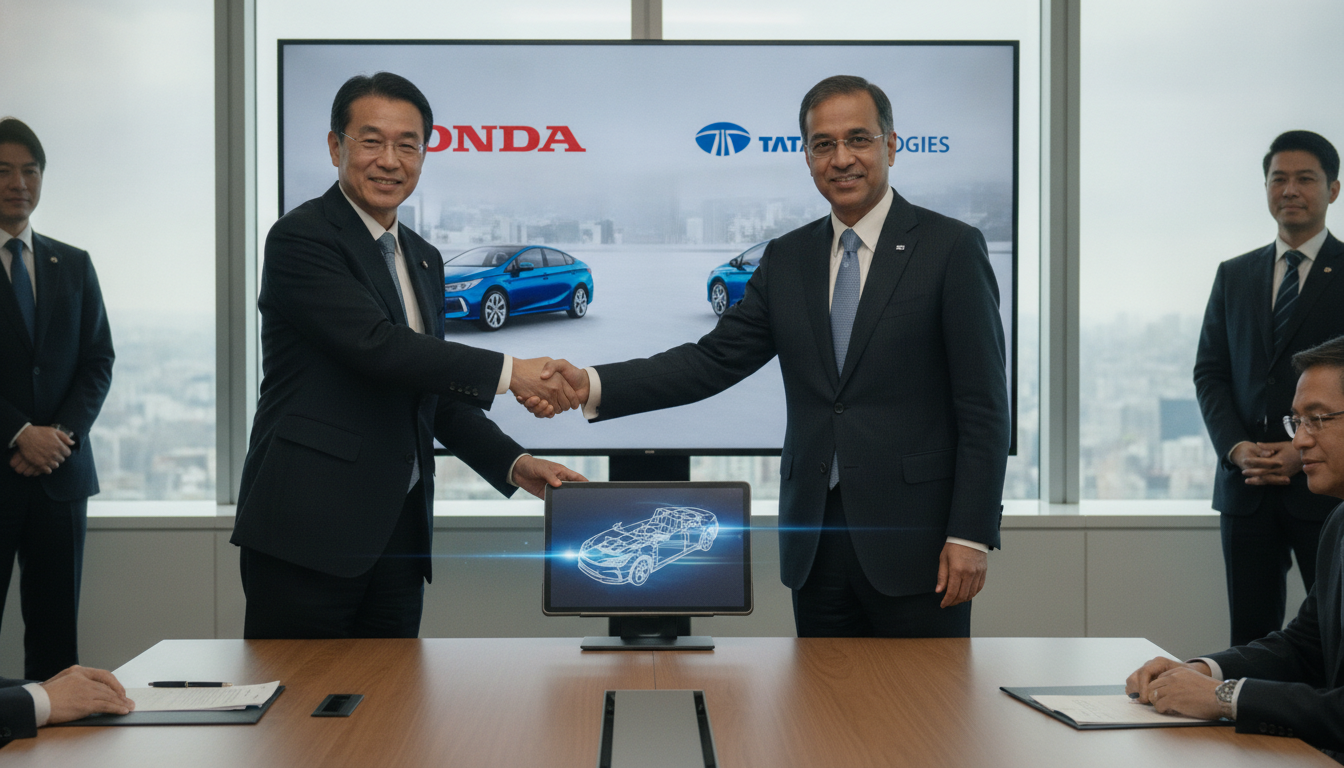
Honda delegates vehicle platform development to Tata Technologies unit
Honda assigns vehicle platform development to Tata Technologies’ subsidiary to cut costs; the platform will serve hybrids and other electrified models globally.
Honda has delegated parts of its vehicle platform development to a subsidiary of India’s Tata Group, marking a significant shift in the automaker’s engineering strategy. The Honda-Tata Technologies platform arrangement is intended to reduce development costs while supporting hybrids and other electrified vehicles. The move reflects broader industry pressure to contain rising engineering expenses as automakers transition to electrified powertrains.
Details of the delegation
Honda transferred responsibility for certain platform engineering tasks to a Tata Group subsidiary that operates in vehicle design and digital engineering. The arrangement covers work on the structural and software elements that underpin new models. Company representatives described the change as part of a targeted effort to streamline development without relinquishing final design authority.
The platform scope includes architectures adaptable to internal combustion hybrids and battery-electric variants. That flexibility is intended to allow Honda to apply a single underlying structure across multiple powertrain options. Such common platforms are increasingly used across the industry to lower per-unit costs and shorten time to market.
Scope for hybrids and electrified models
The codevelopment will explicitly support hybrid drivetrains and other electrified architectures, signaling Honda’s intention to maintain a multi-technology product mix. Engineers will focus on integrating electrified components — such as battery packaging, electric motors and power electronics — within the shared platform envelope. The goal is to ensure the platform can accommodate differing energy storage and cooling needs across model variants.
For customers, this could mean new Honda-branded models that share basic underpinnings across petrol-hybrid and fully electric versions. For Honda, the shared architecture offers both manufacturing efficiencies and flexibility in responding to regional market demand for electrified vehicles.
Cost reduction and strategic rationale
Senior executives at Honda have framed the move as part of a broader cost-reduction strategy amid steep investments in electrification and software development. Outsourcing certain platform tasks to a Tata Technologies unit is expected to trim engineering costs by leveraging the supplier’s specialized design and digital engineering capabilities. The partnership allows Honda to retain control over final product specifications while reducing in-house resource commitments.
Industry analysts say the global auto sector is under growing pressure to slash development costs as margins tighten and capital needs for battery, software and charging investments increase. Sharing engineering platforms with a partner can yield significant economies of scale, especially for modular architectures that serve multiple vehicle segments.
Engineering responsibilities and quality safeguards
Under the arrangement, Tata Technologies’ subsidiary will perform defined engineering and digital-development roles, while Honda retains responsibility for vehicle validation, safety certification and manufacturing integration. Honda engineers will continue to set performance targets and oversee testing protocols to ensure models meet the company’s quality and safety standards. The precise split of responsibilities is structured to preserve Honda’s brand standards while tapping external engineering capacity.
Quality control and intellectual property protections are likely to be key components of the agreement, industry sources say. Automakers that delegate engineering functions typically build detailed contractual safeguards and joint governance to manage technical risks and protect proprietary vehicle systems.
Implications for global production and suppliers
A shared platform developed with Tata Technologies could affect Honda’s global sourcing and assembly footprint by standardizing parts and subassemblies across regions. Common platforms typically simplify supplier relationships and reduce the number of unique parts, which can lower procurement costs and streamline logistics. Honda may also be able to accelerate production of electrified variants in markets where demand is growing fastest.
However, consolidation of engineering tasks with an external unit can shift value away from incumbent suppliers, prompting some partners to renegotiate terms or focus on aftermarket components. The broader supply chain impact will depend on how Honda sequences model introductions and where final assembly is staged.
Timeline, models and market outlook
Honda has not published a detailed public timetable or listed specific models that will employ the Tata-developed sections of the platform. Observers expect initial applications to appear on mid-cycle refreshes or new compact-to-mid-size models where platform commonality yields the greatest cost benefits. Market reception will hinge on how well the vehicles meet Honda’s established benchmarks for driving dynamics, reliability and fuel- or energy-efficiency.
If the initiative reduces costs without compromising product quality, it could accelerate Honda’s rollout of hybrid and electric vehicles while preserving margins. Conversely, any missteps in engineering coordination or validation could delay launches and erode consumer confidence, underscoring the importance of tightly managed collaboration.
Industry analysts say the move is emblematic of a wider trend: major automakers increasingly blend in-house design with partner-led engineering to manage the massive capital demands of the EV transition. The Honda-Tata Technologies platform approach will be watched closely as a test case for combining legacy automaker standards with external engineering scale.
The partnership represents a pragmatic recalibration by Honda as it balances investment in electrification with the need to control development costs, and it will shape the company’s product rollout and supplier relations in the years ahead.

