
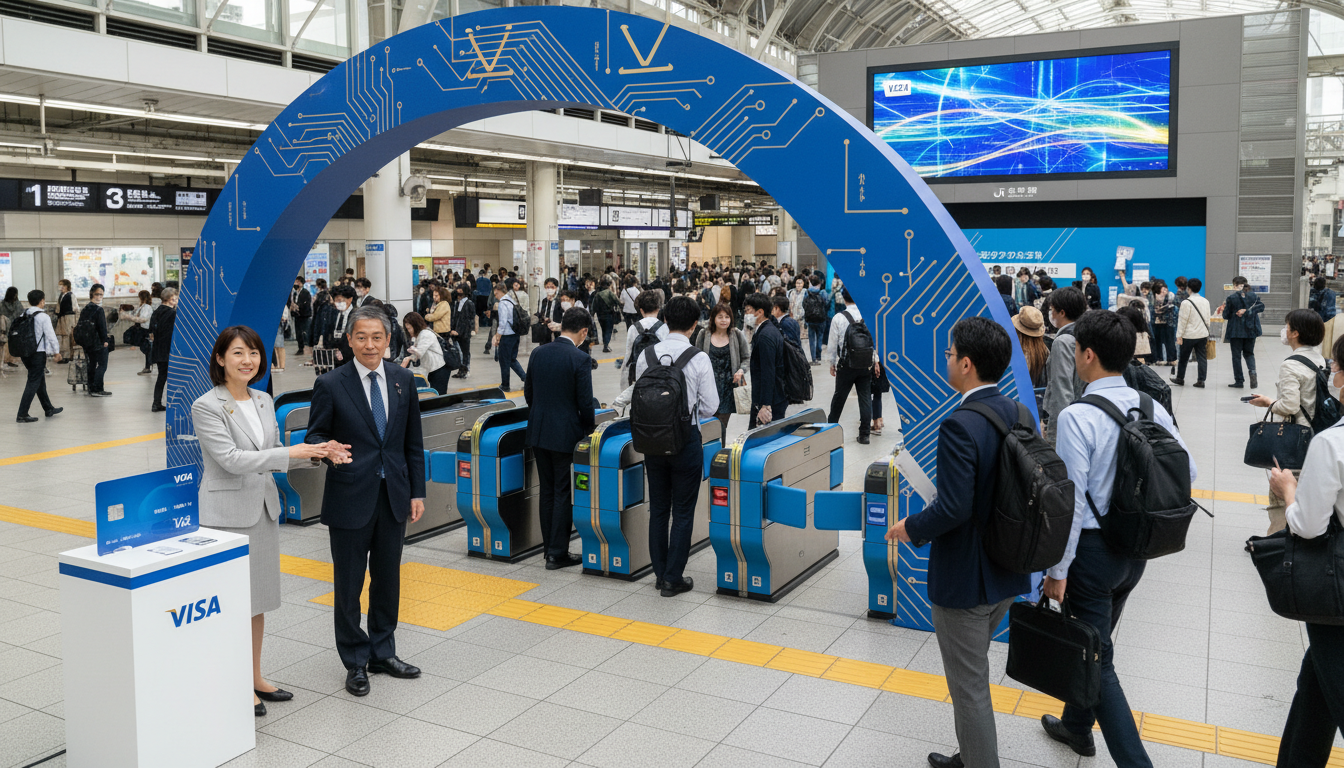
Visa Touch Discount Campaign Launches Nationwide Train Cashback in Japan
Visa Touch Discount Campaign in Japan offers up to 30% cashback on train fares from May 1–31, 2026 for registered Visa contactless cards, domestic holders only.
Visa launches Take the Train! Visa Touch Discount Campaign nationwide
Visa Worldwide Japan has launched the Take the Train! Visa Touch Discount Campaign to promote contactless payment on public transport. The campaign runs from May 1 to May 31, 2026 and is limited to domestic Visa cardholders who register a contactless card. Visa says the initiative covers 46 railway operators across Japan and offers up to 30% cashback when users touch in and out with a registered Visa contactless card.
Campaign scope and cashback mechanics
The campaign applies to journeys on lines operated by the participating 46 railway operators and requires riders to both register a Visa contactless card and use it to touch in and out at station gates. The advertised benefit is “up to 30%” cashback on qualifying train fares, with the total cashback capped at 600 yen per Visa card for the entire campaign period. That cap means the maximum financial return to an individual card during May 2026 is fixed at 600 yen, regardless of the number of qualifying rides taken.
Consumers should note how the cap affects actual savings: at a 30% rate, a cardholder would reach the 600 yen maximum after spending 2,000 yen in qualifying train fares during the campaign. Smaller fare users will receive proportionally smaller cashback amounts, while heavy commuters may find the cap limits the program’s impact on monthly transport costs. Visa’s terms also specify that only cards issued for domestic use are eligible, so travelers with foreign-issued Visa cards should not expect to qualify.
Registration process and using a registered Visa contactless card
To participate, riders must register a Visa contactless card on the campaign registration page maintained by Visa Worldwide Japan and ensure the card is enabled for contactless payments. After registration is complete, the eligible card must be used to tap in and tap out at the automated ticket gates of participating railway operators for each journey to qualify for the cashback. Cardholders are advised to confirm the card they register is the one they intend to use routinely, since the cashback cap is applied per registered Visa card.
Practical steps for passengers include checking that the Visa card displays the contactless symbol and that station gates accept contactless credit card taps on the transit network in question. Where mobile wallets carry a registered Visa contactless credential, cardholders should check the campaign’s terms to confirm whether mobile wallet transactions are treated the same as a physical card tap. If there is any uncertainty, cardholders should contact their card issuer or Visa’s campaign support to confirm eligibility before relying on the advertised cashback.
JCB’s parallel train cashback program and how it compares
JCB is running a separate cashback campaign for train fares that extends through the end of June 2026 and offers a different mix of benefits. The JCB program provides up to 50% cashback on qualifying train fares, with a per-card cap of ¥1,000 for the campaign period. Compared with Visa’s initiative, JCB’s offer presents a higher maximum percentage rebate and a larger cap, but it also runs over a longer window, ending on June 30, 2026.
For commuters weighing the two offers, the practical differences matter: JCB’s higher rate and cap mean larger potential savings for moderate spending, while Visa’s campaign concentrates its benefit within the month of May 2026. Eligibility rules, registration procedures and participating operators vary between the two campaigns, so passengers should check each issuer’s detailed terms and conditions to determine which program — if either — best matches their travel patterns and card holdings.
How commuters can estimate expected savings
Estimating potential savings under the Visa Touch Discount Campaign is straightforward once cardholders know their typical fare expenditure. Because the Visa campaign caps cashback at 600 yen, a rider receiving the full 30% would need to spend approximately 2,000 yen on qualifying train fares during the campaign to reach the maximum rebate. For a weekday commuter who pays, for example, 200 yen per journey and rides twice per day, five workdays in May would yield modest cashback well below the cap.
Short-term visitors or occasional riders will see proportionally smaller rebates, while someone who makes a series of one-way trips across multiple operators might approach the cap more quickly. Riders who hold multiple eligible cards can register more than one card, but each card’s cashback is capped independently; passengers should therefore consider whether registering multiple cards is practical or necessary for their travel behavior.
Operational and consumer considerations for contactless transit use
Railway operators that accept contactless credit card taps at gates benefit from faster boarding and reduced ticketing friction, and campaigns such as this one aim to accelerate adoption of tap-to-ride by reducing perceived cost barriers. For passengers, contactless payment can remove the need to load value onto a dedicated IC card and simplify occasional journeys on unfamiliar lines. However, differences in gate hardware, fare calculation and merchant processing rules can affect how transactions are recorded and whether a particular tap qualifies for promotional cashback.
Cardholders should keep transaction records and monitor their card statements after participation, since cashback settlements often appear days or weeks after the qualifying transaction. When a tap fails to register correctly at a gate or a transaction posts at a different merchant code, consumers may need to open a query with their card issuer or with the campaign helpdesk to seek an adjustment. Maintaining proof of travel, such as receipts or travel logs, can help resolve discrepancies more quickly.
Eligibility limits, privacy and dispute advice
The campaign is explicitly restricted to domestic Visa cardholders, a detail that affects travelers and residents carrying foreign-issued cards. Visa’s terms also require registration of the eligible card and successful contactless taps at participating gates, and the company has set a per-card cashback ceiling for the duration of the campaign. Cardholders should read the campaign’s terms and conditions carefully to confirm whether a mobile wallet, corporate card or co-branded transit card qualifies and to understand any exclusions for discounted fares or season passes.
On privacy and dispute resolution, passengers should assume that registering a card for promotional purposes will involve sharing limited transaction data with Visa for the purpose of applying cashback. If a cashback payment is not posted as expected, consumers should first confirm the registration status of their card and then check transaction records before contacting the card issuer. If an issue persists, normal cardholder dispute channels are the appropriate route, and passengers should retain any correspondence or travel evidence until the matter is resolved.
Industry context and potential longer-term effects
The Take the Train! Visa Touch Discount Campaign forms part of a broader push by payment networks and issuers to normalize contactless credit card use on public transport in Japan. Operators have incrementally expanded their contactless acceptance in recent years, and promotional incentives from Visa, JCB and others can encourage habitual change among commuters and occasional riders alike. If programs such as this increase tap-to-ride volumes, operators and retailers may accelerate investments in gate infrastructure and fare-system integration.
At a macro level, these campaigns also intersect with policy goals to reduce cash dependency and increase payment efficiency in urban mobility. Short promotional windows and modest caps, however, indicate these are targeted nudges rather than permanent fare changes, and long-term behavior change will depend on convenience, pricing, and ongoing coordination between payment networks and transport providers.
Practical tips for passengers before and during the campaign
Passengers planning to participate should register their Visa contactless card as early as possible, confirm that the card is accepted at station gates on their route, and check whether the card is treated the same way when stored in a mobile wallet. Riders should also be mindful that the cashback is capped at 600 yen per Visa card for May 1–31, 2026 and that only domestic-issue cards qualify, so travelers from overseas should verify eligibility before relying on the rebate. Monitoring card statements and the campaign page for settlement dates will make it easier to verify that the cashback was applied.
If a tap fails to register at a gate, commuters should record the time and location and keep any available proof of the journey, as this can help when contacting their card issuer or campaign support. Passengers should avoid making assumptions about cross-issuer compatibility and treat the Visa offer as separate from other issuer promotions such as JCB’s program, which carries different terms and a different timeframe through June 30, 2026.
The campaign’s short timeframe, limited cap, and domestic-only eligibility make it a focused promotion rather than a broad, permanent change to fare policy. Nonetheless, for eligible cardholders who take multiple short journeys within May, the program can provide straightforward savings and a convenient way to test tap-to-ride contactless payments without changing existing commuter routines.
Participating in the Visa Touch Discount Campaign is simple but bounded: register, use a qualifying Visa contactless card at participating gates, and monitor statements for the capped cashback. Readers should examine the specific terms for exclusions, timing of cashback payments, and any operator-specific constraints before relying on the rebate for budgeting.

