
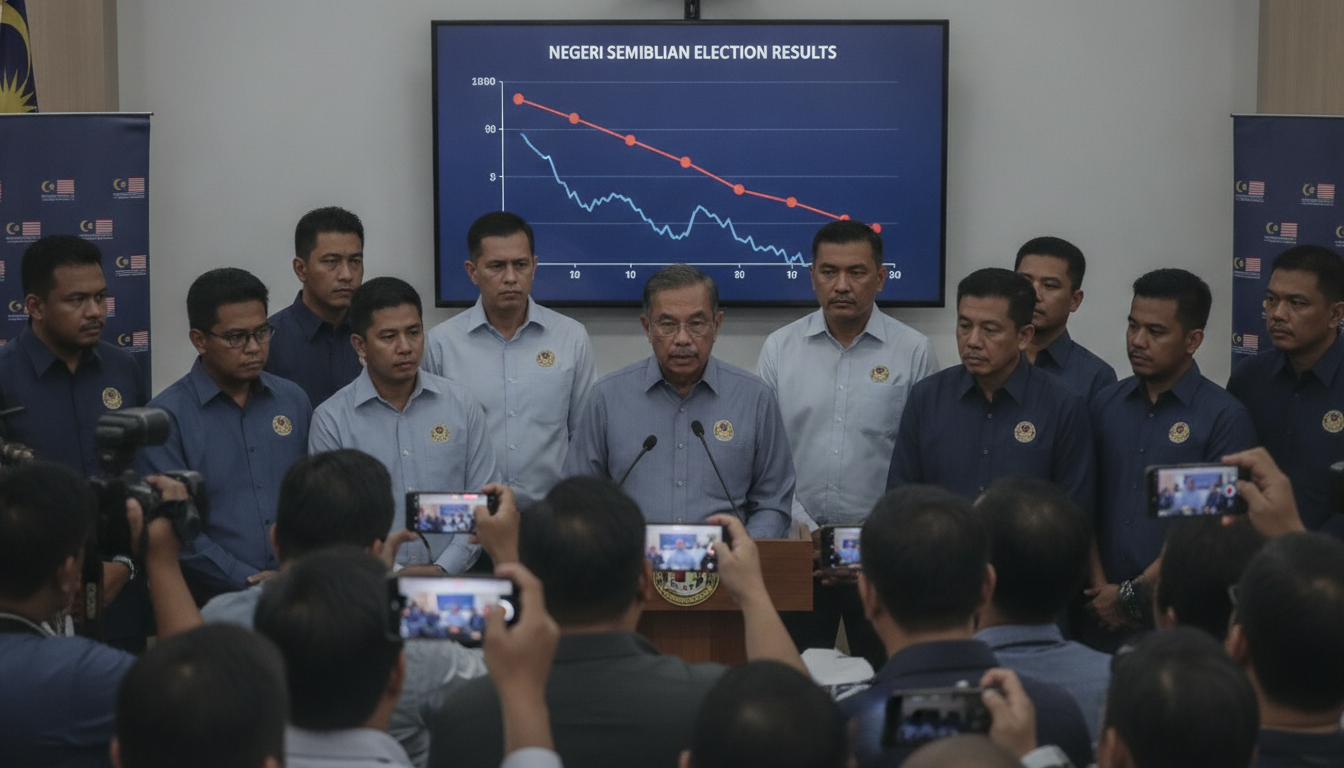
Anwar Ibrahim’s Coalition Loses Ground as Barisan Nasional Claims Victory in Negeri Sembilan
Malaysia’s ruling coalition, led by Prime Minister Anwar Ibrahim, suffered a fresh setback when Barisan Nasional marked a victory in the Negeri Sembilan state election on August 1, exacerbating concerns about the government’s standing ahead of an expected general election in early 2028. (channelnewsasia.com)
BN Claims State Win in Negeri Sembilan
Barisan Nasional leaders celebrated gains in the Negeri Sembilan contest, with party chairman Ahmad Zahid Hamidi appearing alongside other senior figures at post‑poll events. Campaigning by BN focused on promises of experienced governance and the completion of local projects, messages the party said resonated with voters. (malaymail.com)
Observers said the result reflected targeted local campaigning by BN and tactical coordination with Perikatan Nasional in many seats, a strategy that boosted the opposition’s appeal in rural and semi‑urban constituencies. Analysts who followed the campaign noted coordinated messaging on bread‑and‑butter issues and constituency delivery as decisive factors. (freemalaysiatoday.com)
Anwar Coalition Sees Erosion of Support
The defeat is the latest in a sequence of disappointing local outcomes for the ruling coalition, testing the unity and narrative of Prime Minister Anwar Ibrahim’s reform agenda. Party officials acknowledged the result as a wake‑up call, describing it as proof that voters are paying close attention to everyday living costs and service delivery. (channelnewsasia.com)
Political scientists said the loss undermines perceptions that Anwar’s government remained a symbol of hope for economic relief and institutional reform, particularly in areas where living costs and public anxieties have not eased. Some experts argue that the administration’s reform messaging has struggled to reach voters concerned about immediate financial pressures. (iseas.edu.sg)
Local Issues and Voter Priorities
Campaign interviews and local polling suggested that cost‑of‑living pressures, job security and the pace of local infrastructure delivery were prominent voter concerns in many constituencies. Candidates who ran on clear, localised platforms that addressed these issues tended to outperform those that relied solely on national narratives. (iseas.edu.sg)
Party operatives from both sides acknowledged that national policy debates — including fuel prices, subsidies and government payouts — filtered into voters’ decisions, but that ground operations and candidate selection ultimately shaped seat‑by‑seat outcomes. The elections underscored the enduring importance of constituency service in Malaysia’s first‑past‑the‑post system. (freemalaysiatoday.com)
Campaign Dynamics and Coalition Tactics
BN’s campaign was marked by an emphasis on experienced leadership and a promise to restore programmes left unfinished during previous administrations. BN also pursued seat arrangements with Perikatan Nasional in several areas, a tactical alignment that reduced vote splitting and bolstered their competitiveness. (astroawani.com)
Ruling coalition strategists said the snap polls were triggered by political realignments and state‑level ruptures earlier in the year, leaving them limited time to reframe the national agenda into compelling local offers. Prime Minister Anwar had previously said he did not want a snap election but was forced into one by developments at the state level. (channelnewsasia.com)
Implications for National Politics and the 2028 Election
The Negeri Sembilan outcome adds momentum to opposition calls that the federal government has lost touch with voters on immediate economic concerns, a narrative that could shape campaigning ahead of the general election expected by early 2028. Political parties are already recalibrating messages and candidate lists in response to the result. (iseas.edu.sg)
For the ruling coalition, the defeat raises questions about internal cohesion, messaging discipline and the effectiveness of service delivery in mixed constituencies. For the opposition, the result offers a tactical blueprint for stitching together a winning coalition by combining national critique with local promises. (freemalaysiatoday.com)
Parties Prepare for a Longer Campaign
In the aftermath, both the ruling and opposition camps signalled a renewed focus on mobilisation, with BN emphasising deliverables and the government promising to address voter grievances. Campaign directors from multiple parties told reporters they expect the next stretch of contests to centre on economic relief packages and targeted development projects. (astroawani.com)
Analysts said the coming months will test whether Anwar’s coalition can translate policy intentions into visible results on the ground, or whether the opposition’s message of managerial competence will consolidate further gains. The trajectory set by Negeri Sembilan will likely factor into strategic calculations for both national and state-level contests. (iseas.edu.sg)
The Negeri Sembilan result is a stark reminder that Malaysia’s electorate is responsive to both immediate household economics and the perceived capacity of parties to deliver at the constituency level, and it sets a more contested stage as parties prepare for national voting early next year.

