
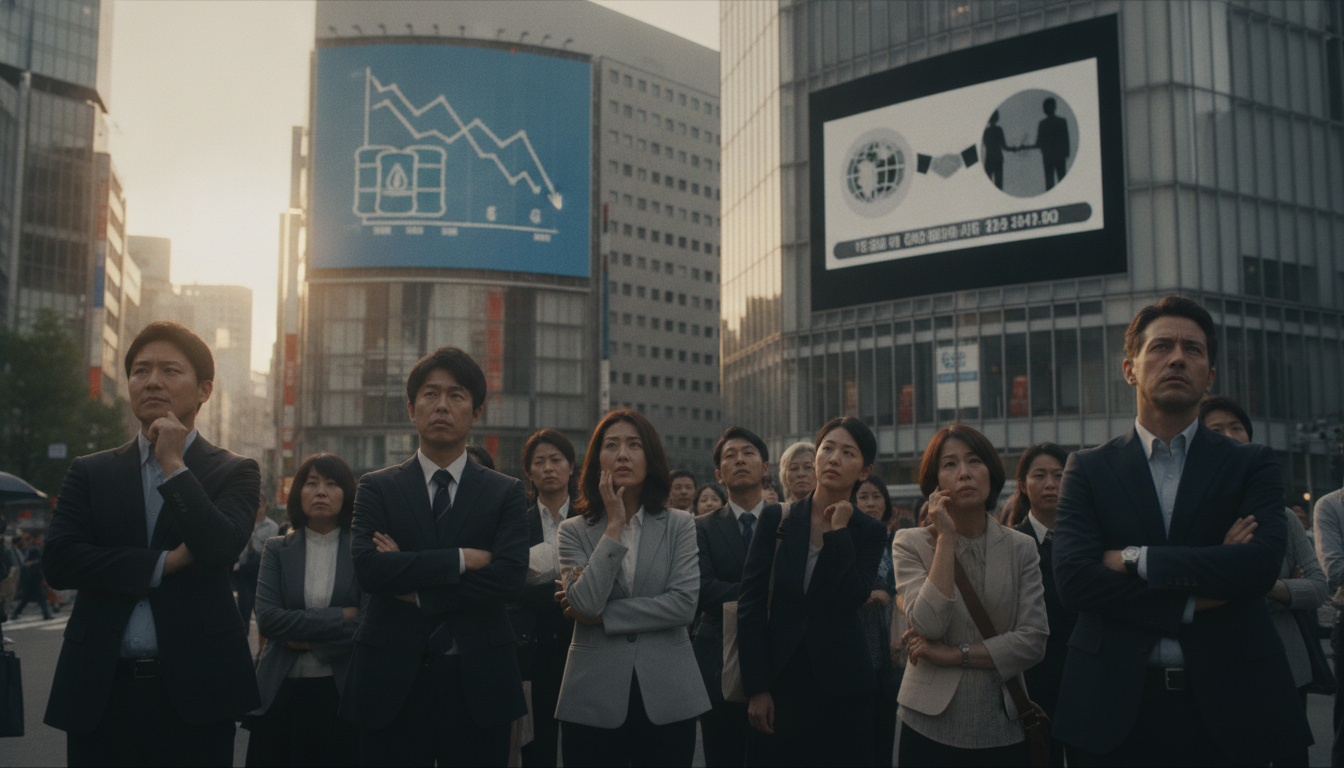
Asahi poll: 57% of Japanese doubt prices will fall after US–Iran accord; public split on SDF deployment
Asahi poll: 57% of respondents say they cannot expect prices to fall after the US–Iran agreement, while opinions remain divided over a proposed Self-Defense Forces mine-clearing mission.
Majority doubt price relief from US–Iran agreement
The Asahi poll, conducted by telephone on June 20–21, found 57% of respondents said they do not expect the recent US–Iran agreement on ending hostilities to bring price relief. By contrast, 36% said they believe the accord could lead to lower prices for households.
Respondents cited skepticism despite the diplomatic development, reflecting persistent concerns about domestic inflation and global energy markets. The result indicates limited public faith that geopolitical progress will quickly translate into lower consumer costs.
Public split on Self-Defense Forces mine-clearing mission to Strait of Hormuz
When asked about dispatching Japan’s Self-Defense Forces to the Strait of Hormuz to clear naval mines after a cessation of hostilities, 48% opposed the move while 42% supported it. The question revealed a narrow but clear tilt toward opposition among the national sample.
Party affiliation and government support shaped responses: cabinet and ruling-party supporters tended to back the deployment in roughly half of their responses, yet a substantial minority within those groups still opposed the idea. The close balance underscores the political sensitivity of overseas SDF missions.
Gender gap sharp on deployment question
The poll exposed a pronounced gender divide over the mine-clearing mission. Male respondents registered strong support at 57% in favor and 36% opposed. Female respondents, however, were markedly less supportive, with only 28% backing the deployment and 58% against it.
These contrasting views suggest that any government decision to send personnel abroad for mine-clearing will face differing levels of public acceptance across demographic groups. The gap also points to broader differences in risk perception and defense policy attitudes between men and women.
Cabinet approval steady despite economic worries
Prime Minister Sanae Takaichi’s cabinet approval stood at 60% in the June poll, unchanged from a similar survey in May. Disapproval registered at 27%, a slight rise from the previous month’s figure of 26%.
Notably, respondents who said they did not expect prices to fall following the US–Iran agreement reported a higher-than-average cabinet disapproval rate of 34%. This association suggests that economic pessimism could erode trust in the government even while overall approval remains stable.
Diplomacy rated favorably but fiscal concerns persist
The Asahi poll showed a strong public appraisal of the prime minister’s diplomatic efforts, with 67% expressing a positive view of her foreign policy performance and 23% offering a negative assessment. This approval may reflect recognition of recent diplomatic moves even as voters remain wary about immediate domestic benefits.
At the same time, the survey touched on domestic fiscal pressures, including public debate over proposals such as food tax reductions and their potential impact on government finances. Voters’ reluctance to expect quick price relief indicates that fiscal and monetary uncertainties remain central to public sentiment.
Potential political and policy implications
The survey’s findings carry implications for both foreign policy and economic messaging from the government. Strong approval of diplomatic efforts gives the administration political cover to engage in international negotiations, but skepticism about economic outcomes may limit enthusiasm for policies presented as quick fixes.
For defense planners and lawmakers, the gender and partisan splits exposed by the poll suggest any decision to deploy SDF personnel for mine-clearing will require careful public explanation and likely parliamentary debate. Balancing security commitments with domestic sensitivities will be crucial if the government moves forward.
The Asahi poll, conducted nationwide by telephone on June 20 and 21, highlights a Japanese public cautiously optimistic about diplomatic engagement yet realistic about the limits of short-term economic gains.

