
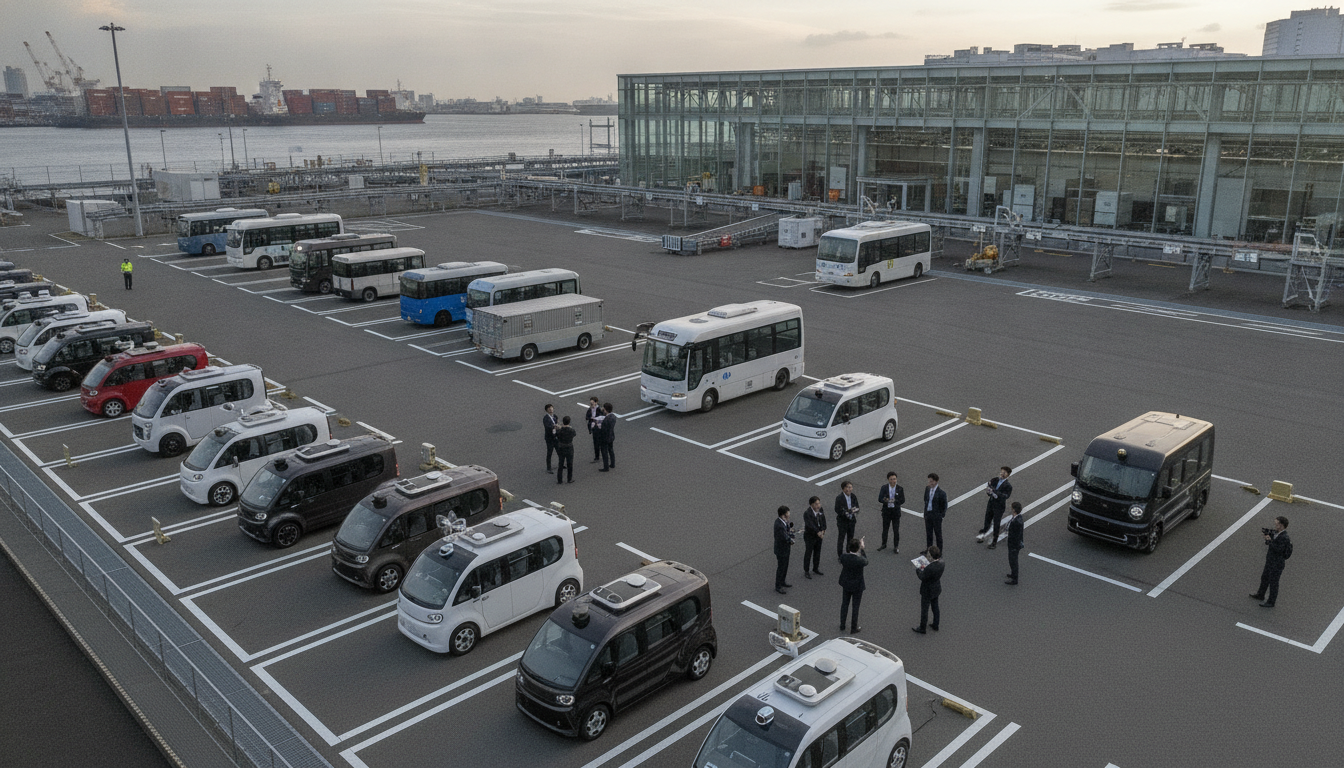
Tokyo logistics facility becomes autonomous driving testing hub for startups
Tokyo waterfront logistics complex repurposed as an autonomous driving testing hub, hosting Turing, newmo and about 10 mobility startups for trials and development.
A former warehouse complex on Tokyo’s waterfront has been repurposed into an autonomous driving testing hub that is drawing a cluster of mobility startups. The facility now hosts Turing, newmo and roughly 10 other firms using controlled indoor and adjacent outdoor spaces to trial hardware, software and integrated logistics applications. Companies say the site offers a rare combination of scale, proximity to central Tokyo and access to real-world logistics operations, making it attractive for early-stage and later-stage autonomous vehicle work. The testing hub language and layout are becoming a blueprint for how urban logistics properties can support next-generation mobility development.
Logistics complex repurposed for autonomous testing
The waterfront warehouse sits within a network of shipping and storage facilities and was reconfigured to create dedicated bays, test loops and technical support zones. Operators partitioned large storage halls into configurable circuits and staged areas so vehicles can perform repeated maneuvers under controlled conditions. Management emphasizes that the conversion reduces the safety and regulatory hurdles companies face when testing on public roads while still exposing systems to realistic cargo-handling scenarios. The repurposing has turned a traditional storage site into a practical stepping stone between lab prototypes and open-road trials.
Startups and operations on site
A mix of startups has taken up space at the complex, ranging from firms building full self-driving stacks to companies focused on perception, mapping and fleet operations. Turing is among the users conducting integrated vehicle tests, while newmo and several other mobility-focused teams are deploying sensor rigs, edge-compute units and trial logistics services. Tenants share testing windows and on-site workshops, allowing engineers to iterate quickly between software updates and hardware changes. Several companies also coordinate live demonstrations that link autonomous platforms with warehouse automation systems.
Facility features and testing environment
The site offers long indoor aisles, modular road-mockups and sheltered outdoor routes that simulate urban delivery conditions and port-adjacent traffic flows. Technical infrastructure includes high-capacity power feeds, secure data rooms and spaces for dismantling and reconfiguring prototype vehicles. The controlled environment enables repeated scenario testing — such as obstacle avoidance, low-light perception and coordinated vehicle-to-infrastructure trials — without the variability of public roads. Support services on site range from mechanical shops to telemetry and cloud-connectivity nodes that accelerate diagnostics and remote monitoring.
Regulatory and industry context in Japan
Operators say the hub helps startups navigate Japan’s evolving testing requirements by concentrating trials in a managed space where safety protocols are strictly enforced. The arrangement limits exposure on public streets and simplifies coordination with local authorities for staged demonstrations. Industry participants describe the approach as complementary to sanctioned public-road trials, allowing teams to mature systems to a point where regulator engagement is more targeted and efficient. Tokyo’s logistics sector also benefits by engaging directly with developers seeking to integrate autonomous vehicles into last-mile and intra-port workflows.
Commercial and local economic impact
The site’s conversion is attracting investment and partnerships from logistics operators, equipment suppliers and venture backers interested in urban mobility solutions. Tenants report savings in development time because they can test and retrofit vehicles without lengthy off-site transport or complicated permit cycles. Local businesses — from parts suppliers to service contractors — have seen increased demand as startups scale their testing programs. City planners and property owners are watching the experiment as a model for reusing underutilized industrial real estate to support technology clusters.
Collaboration and technical exchange
Beyond vehicle trials, the hub is fostering informal collaboration among multiple startups and service providers co-located on the site. Shared technical facilities and recurring cross-team workshops help accelerate problem solving for sensor calibration, data labeling and fleet management challenges. Some firms have begun joint pilots that pair mapping specialists with logistics operators to test route optimization under realistic loading and time-window constraints. The proximity of diverse technical teams is shortening feedback loops and encouraging modular approaches that are easier to commercialize.
The conversion of the Tokyo logistics complex into an autonomous driving testing hub highlights how urban industrial assets can be adapted to meet the needs of fast-moving mobility startups. By offering a controlled, resource-rich environment close to ports and supply chains, the facility is helping companies refine systems more efficiently and bringing technology development closer to real-world logistics needs. Operators and tenants say the model may be replicated at other underused logistics sites as demand for test-ready spaces grows.

