
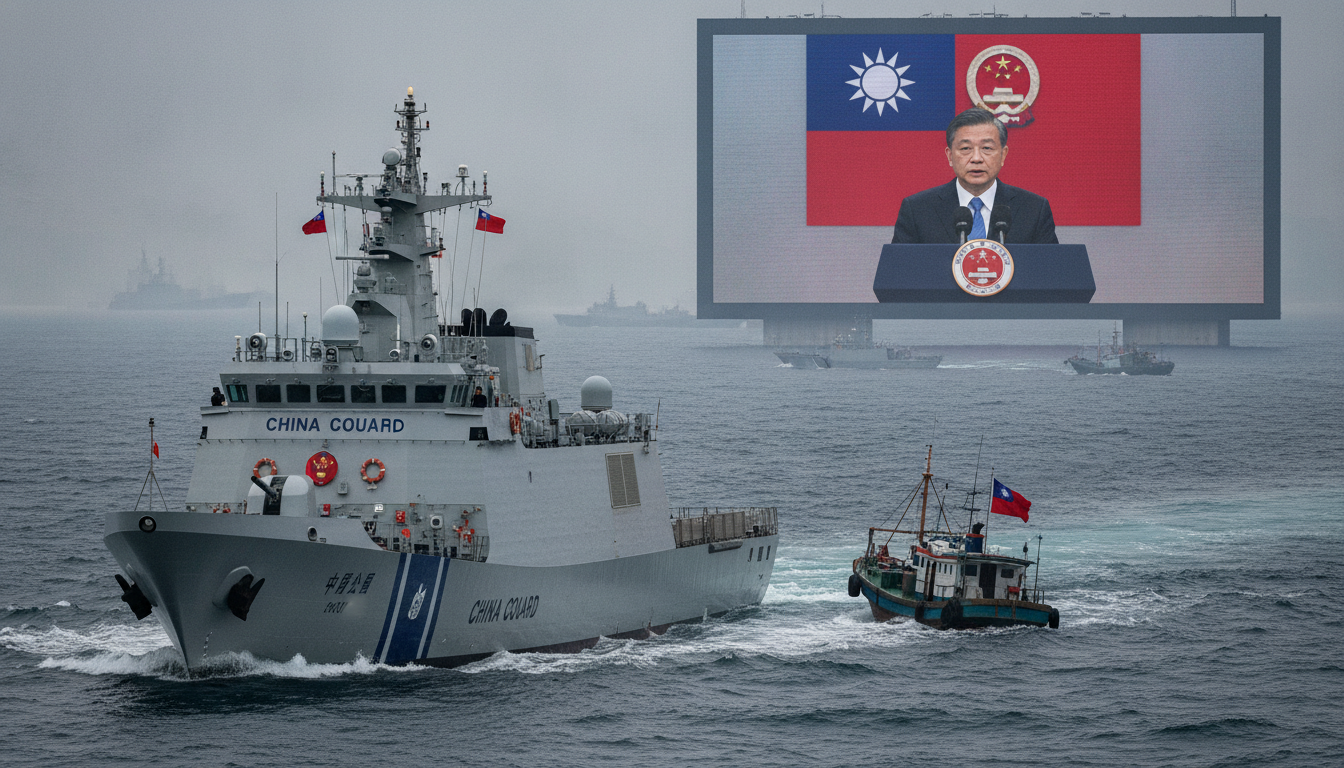
Taiwan tensions escalate as Beijing widens maritime and political pressure
China’s stepped-up maritime, diplomatic and legal measures are squeezing Taipei’s strategic options, observers say, as Taiwan tensions deepen across the strait.
TAICHUNG, Taiwan — Taiwan tensions have intensified as Beijing combines expanded maritime operations with diplomatic and legal pressure, officials and diplomats say, narrowing the space available to President Lai Ching-te’s government. The moves include repeated naval and air activity around Taiwan, actions to the island’s east, and coordinated political measures designed to isolate Taipei internationally. Taiwanese officials describe the campaign as simultaneous and multi-domain, complicating Taipei’s response options while testing regional allies’ resolve.
Beijing broadens maritime posture
Beijing has increased the tempo and geographic reach of its maritime operations around Taiwan, deploying surface ships and aircraft along new vectors, according to regional military observers. Operations to the east of Taiwan mark a departure from the more familiar sorties concentrated across the Taiwan Strait, demonstrating a willingness to project pressure along routes that intersect international waters.
The pattern of activity appears intended to complicate Taiwan’s defense planning and signal that Beijing can operate beyond traditional choke points. Analysts warn that sustained operations in wider areas raise the operational costs for Taipei and for foreign navies seeking to monitor or assist.
Diplomatic and legal pressure intensifies
Alongside military moves, Chinese diplomatic initiatives and legal measures have targeted Taipei’s international space, officials say. Beijing has pursued tighter controls over international organizations, travel and exchanges that influence Taiwan’s ability to maintain formal and informal ties overseas.
These steps include public diplomatic campaigns and administrative measures that seek to limit foreign engagement with Taiwanese officials. The combined diplomatic and legal push aims to erode the practical support Taiwan receives from partners without triggering direct military confrontation.
Pressure east of Taiwan signals strategic shift
Activity to the east of Taiwan has particular strategic resonance because it intersects key maritime routes and surveillance corridors. Observers view operations in that area as an attempt to expand the operational envelope and to demonstrate Beijing’s capacity to exert influence in less-contested seas.
The eastward emphasis adds a new layer of complexity for Taipei, which must now account for contingencies in areas previously regarded as secondary to the central Strait. The change also presents new challenges for neighboring countries monitoring freedom of navigation and regional stability.
Taipei’s strategic options grow narrower
Taipei’s leadership faces a compressed set of choices as the multi-vector pressure continues, government advisers say. Political, legal and maritime constraints make large-scale diplomatic moves riskier, while overt military responses could escalate tensions in ways that narrow external support.
The administration must weigh incremental defensive measures, diplomatic outreach and reliance on international partners, particularly amid concerns that prolonged pressure could erode the practical effectiveness of those partnerships. Officials acknowledge a need to balance deterrence with de-escalation to prevent unintended escalation.
Regional responses and allies’ dilemmas
Allies and partners in the region are watching closely, confronting a dilemma between supporting Taiwan and avoiding actions that might trigger a sharper confrontation with Beijing. Nations in East Asia and beyond are recalibrating naval patrols, diplomatic messaging and contingency planning in response to the changing operational patterns.
For some partners, the shift means more frequent monitoring and closer coordination with likeminded states, while others prefer quiet diplomacy to reduce friction. The result is a patchwork of responses that reflects differing threat perceptions and political constraints.
Economic and information levers under scrutiny
Beyond ships and diplomats, Beijing’s toolbox includes economic pressure and influence operations that can be applied with plausible deniability. Analysts point to targeted economic measures and messaging campaigns that aim to shape public opinion and weaken external political support for Taipei.
Such levers can be effective over time, especially if paired with restrictions on formal engagement. Taiwanese leaders are examining resilience measures, including diversifying supply chains and strengthening domestic communication strategies to counter disinformation and economic coercion.
Cross-strait dynamics are evolving as officials on both sides test the boundaries of statecraft and coercion. Taiwan’s elected government is responding with a mix of diplomatic outreach, military readiness and public messaging aimed at preserving international support and domestic confidence. Observers caution that continued escalation in multiple domains increases the risk of miscalculation, making steady crisis-management channels and clear signaling between Taipei, Beijing and external partners essential.
The persistence of coordinated pressure marks a notable phase in cross-strait relations, one that will shape strategic choices for Taiwan and its friends in the months ahead. The path Taipei chooses will depend on its calculus of risk, the appetite for confrontation among external actors, and Beijing’s willingness to sustain a campaign that blends maritime operations with diplomatic and legal pressure.

