
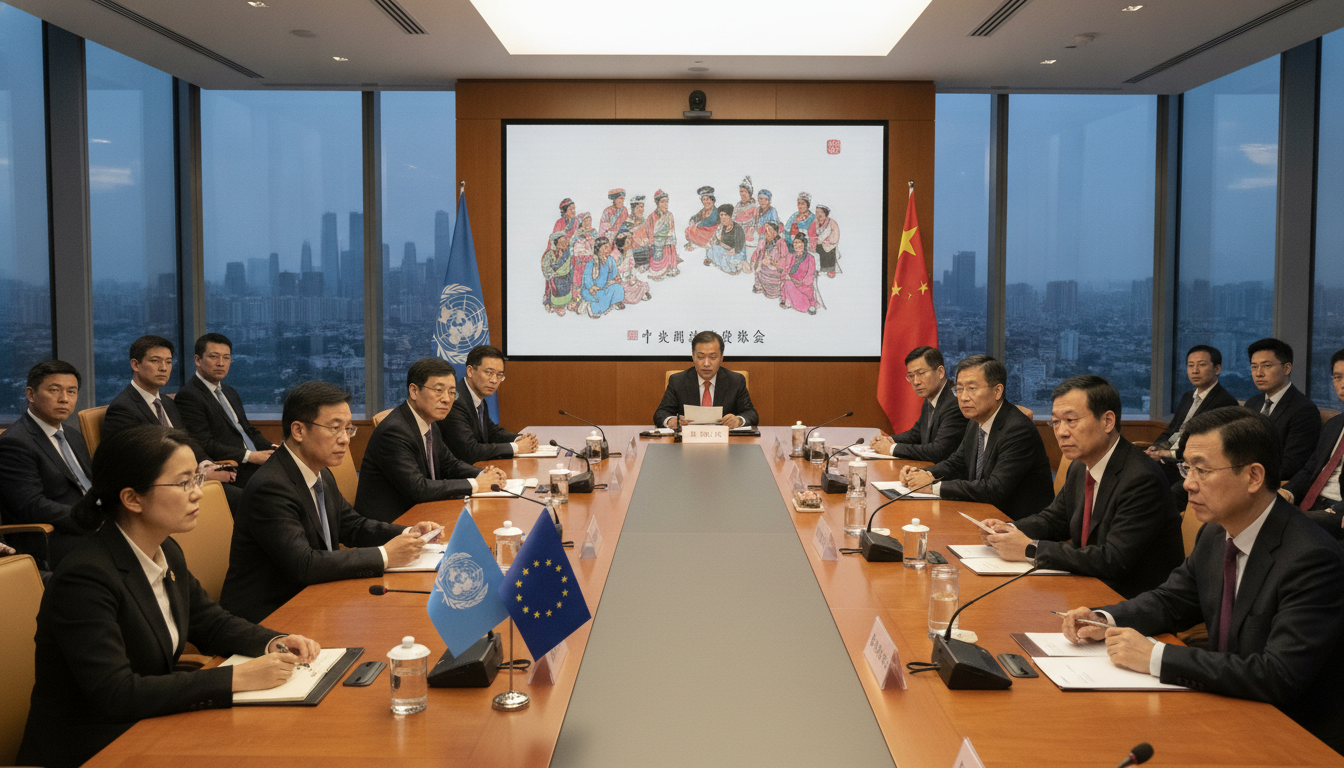
China’s Law on Promoting Ethnic Unity and Progress Takes Effect, Prompting Global Calls for Repeal
China’s Law on Promoting Ethnic Unity and Progress came into force on July 1, 2026, raising immediate concern from the United Nations, the European Parliament and human rights groups over measures they say will intensify pressure on minority communities and reach beyond China’s borders. The law, adopted by the National People’s Congress on March 12, 2026, codifies a series of state-directed requirements for language, education and public behaviour under the banner of “ethnic unity.” (english.news.cn)
New law enters force after March passage
The National People’s Congress formally adopted the Law on Promoting Ethnic Unity and Progress at its closing session on March 12, 2026, and the legislation took effect nationwide on July 1, 2026. Chinese state media and legal translations of the bill describe it as a fundamental statute to strengthen cohesion among the country’s 56 official ethnic groups. (english.news.cn)
The law’s passage follows years of policy shifts toward greater central direction of ethnic and cultural affairs, and officials framed the statute as an instrument to modernize social governance and promote shared development. The text embeds Party slogans and directs a wide range of public and private actors to align with state ethnic policy. (cfr.org)
Key provisions expand state influence over language and family life
Text of the law and expert analyses indicate measures that mandate increased use of Mandarin in early education and public life, require institutions to promote a “shared national identity,” and instruct families and schools about permitted content in family education. Critics warn the provisions blur lines between public policy and private cultural transmission. (cfr.org)
Human rights groups have flagged clauses they say are vague and capable of wide interpretation, enabling local authorities to enforce compliance through administrative, educational and surveillance mechanisms. Legal observers say these elements transform policy preferences into enforceable obligations. (cfr.org)
Text asserts extraterritorial jurisdiction, prompting official defence
One of the most contested aspects of the law is a clause that asserts legal accountability for organisations and individuals outside China who are judged to “undermine ethnic unity and progress” or incite separatism. Beijing officials have publicly defended the provision, saying it aligns with international practice and is necessary to protect national sovereignty and the rights of ethnic groups. (investing.com)
Those assurances have done little to quell overseas alarm, with analysts warning the clause could be used to target diaspora advocacy, foreign civil society actors, journalists and researchers who criticise Beijing’s treatment of minority communities. Legal experts describe the provision as a potential tool for transnational pressure. (lawzana.com)
United Nations, European Union and rights organisations urge repeal
At the United Nations Human Rights Council in Geneva, UN High Commissioner for Human Rights Volker Türk urged China to repeal or amend the legislation, saying it risked deepening restrictions on language, religion, education and cultural expression. The European Parliament has also adopted resolutions condemning the law and calling on Beijing to rescind it. (monitor.civicus.org)
Amnesty International, Fortify Rights and other NGOs have published detailed warnings that the statute will likely entrench assimilationist policies already in place in regions such as Xinjiang and Tibet, and could criminalise ordinary cultural and religious practices. They have called on governments to press China diplomatically and to consider protective measures for at-risk communities. (amnesty.org)
Tokyo reaction and domestic political stance
An aide to Prime Minister Sanae Takaichi characterised the law’s extraterritorial claims as intolerable, saying “no democratic nation could tolerate” a move that asserts legal reach over people abroad. The comment reflects rising tensions in Tokyo over how the statute could affect Japanese residents, civil society groups and cultural exchanges involving ethnic Chinese and other minority communities. (Source material provided to this outlet.)
Japanese officials have signalled close monitoring of potential implications for bilateral ties and for members of diaspora communities who maintain links to Tibet, Xinjiang and other minority regions. Tokyo’s diplomatic channels are reported to be analysing both legal risk and options for coordinated responses. (europarl.europa.eu)
Implications for minorities and diaspora activism
Legal scholars and rights monitors say the law may accelerate existing trends toward the “sinicization” of religion and culture, tightening controls on minority languages and curtailing community-led cultural transmission. The combination of education mandates, reporting obligations and broad definitions of “ethnic division” raises the spectre of criminalising benign expressions of identity. (cfr.org)
For diaspora communities, the most immediate worry is the law’s claimed long-arm jurisdiction. Experts caution that even absent formal extradition measures, the statute could be used to pressure institutions, restrict travel, or justify sanctions against individuals and organisations abroad that engage in advocacy or cultural work deemed hostile to Beijing. States with large Chinese diaspora populations and active civil society networks are already debating legal and protective responses. (lawzana.com)
The long-term political effect inside China is also uncertain. While central authorities present the law as a path to unity and development, critics argue it risks deepening grievances by replacing plural recognition of ethnic difference with a narrower national identity enforced by law. Domestic implementation will depend heavily on local institutions, funding priorities and the parameters set by subsequent regulations. (cfr.org)
The Law on Promoting Ethnic Unity and Progress now sets a legal baseline for Beijing’s ethnic policy that foreign governments, rights organisations and affected communities will be watching closely in the coming months. Observers say the immediate period after July 1 will be critical to see how provisions are interpreted on the ground and whether domestic and international pressure leads to legal amendment or clearer implementing rules.

