
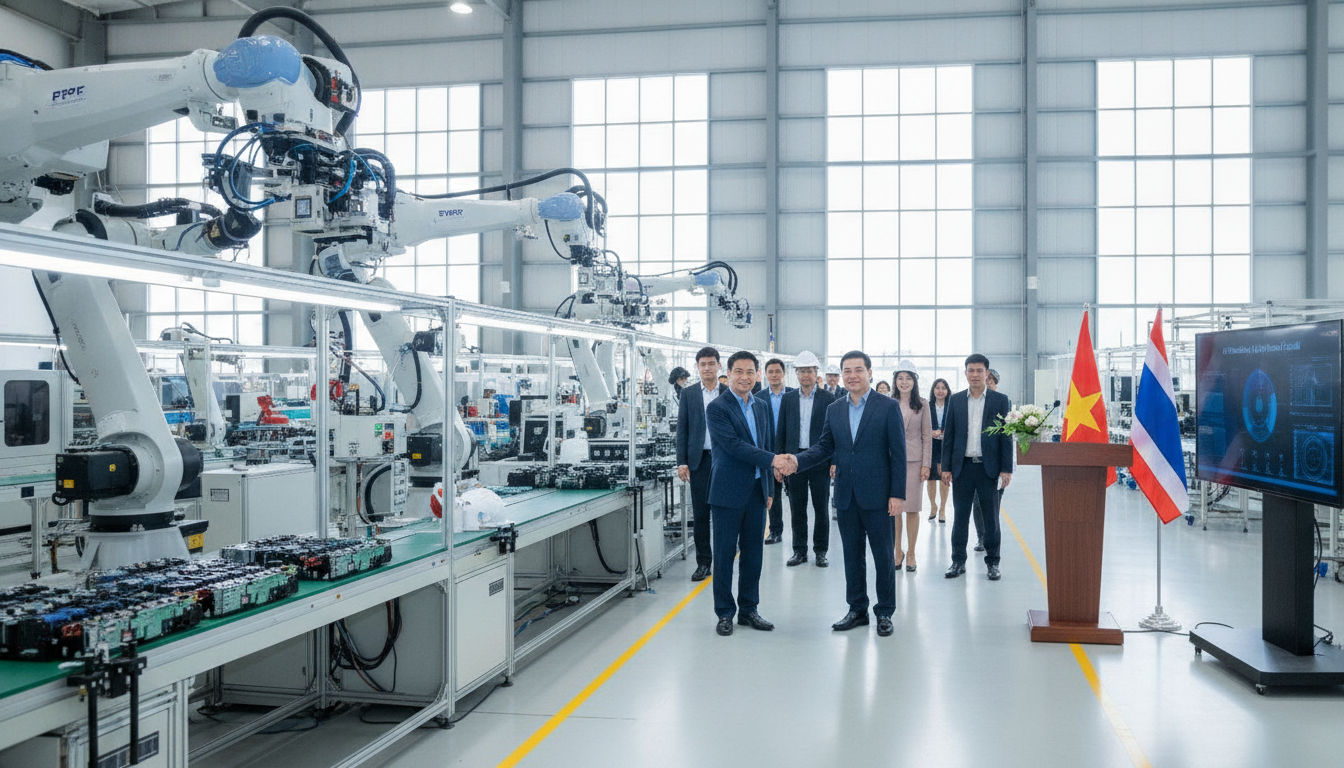
FPT Thailand Expands AI Push to Serve Manufacturers’ Production and Quality Control
FPT Thailand accelerates AI expansion, partnering with manufacturers and universities to provide AI tools for production, quality control and operations.
FPT, Vietnam’s largest technology firm, has launched an accelerated push into Thailand to meet growing corporate demand for artificial intelligence tools that improve production processes and quality control. The company is directing investments and partnerships toward Thai manufacturers, logistics firms and academic institutions as it rolls out machine-learning applications and industrial automation services. Executives say the move aims to localize deployment and integrate AI models into existing factory systems to boost efficiency and reduce defects.
FPT targets Thailand’s industrial customers
FPT Thailand is prioritizing heavy industry and consumer-goods manufacturers, where executives see immediate potential for AI to cut costs and improve yield. Company leaders describe opportunities in predictive maintenance, defect detection on production lines and process optimization using data from sensors and legacy control systems. Several pilot projects already focus on automating visual inspections and real-time anomaly alerts to reduce downtime.
The strategy is built around delivering modular AI tools that can be adapted to specific plant configurations without full infrastructure replacement. That approach appeals to firms wary of large capital expenditures and long integration timelines, industry analysts say. By packaging algorithms with training, support and cloud-edge hybrid deployment, FPT aims to shorten the time from proof of concept to full-scale production use.
Partnerships with major businesses and a university
FPT has formalized partnerships with leading regional companies and at least one Thai university to accelerate deployment and talent development. These agreements cover co-development of AI models, data-sharing frameworks and workforce training programs designed to upskill engineers and technicians. Executives emphasize that local partnerships are central to tailoring solutions to compliance, languages and operational norms in Thailand.
The collaborations include pilots with manufacturers across automotive, electronics and food sectors, where companies are testing FPT’s image-recognition and process-optimization systems. University collaborations focus on applied research and creating pipelines of graduates with practical experience in industrial AI applications. The combined approach seeks to resolve both immediate technology needs and longer-term talent shortages.
Products focused on production process and quality control
FPT’s product line for Thailand emphasizes two near-term use cases: improving production processes and strengthening quality control. Production process tools use machine learning to model and optimize workflows, balance line throughput and predict equipment failures. Quality control solutions leverage computer vision to detect surface defects, assembly errors and packaging issues at speeds beyond human inspectors.
Executives say the systems are designed to integrate with programmable logic controllers and manufacturing execution systems, allowing factories to adopt AI gradually. The offering also includes analytics dashboards and automated reporting to help operations managers make faster decisions. Pricing models vary from subscription services to outcome-based agreements tied to efficiency gains.
Local leadership and regional coordination
Leadership for the expansion is being coordinated by the company’s Thailand and Taiwan chief executive, who has been meeting clients and partners in Bangkok. Management describes a two-pronged approach that combines regional coordination with local teams responsible for sales, deployment and client support. The structure is intended to balance the efficiency of centralized R&D with the responsiveness of on-the-ground engineers.
Local teams are being staffed with a mix of Thai hires and regional specialists to speed knowledge transfer. Executives note that building trust with manufacturing clients requires not only technical capability but also experienced project managers who understand plant operations and safety protocols. The leadership team is positioning FPT as a service-oriented partner rather than a pure software vendor.
Market potential and competitive landscape
Thailand’s sizable manufacturing base and growing digitalization efforts make it an attractive market for industrial AI, industry observers say. The country’s automotive and electronics sectors are particularly receptive to technologies that can raise productivity and reduce warranty costs. FPT faces competition from multinational system integrators and global cloud providers that are also seeking to capture industrial AI opportunities.
To differentiate itself, FPT emphasizes industry-specific solutions, local support and flexible commercial terms. The company’s regional footprint and experience in Southeast Asia are cited as advantages for multinational manufacturers with plants in multiple countries. Observers caution, however, that success will hinge on measurable outcomes and the ability to scale pilots across complex supply chains.
Regulatory and talent challenges remain
Despite demand, challenges persist in talent availability and regulatory clarity around AI use in industrial settings. Companies adopting advanced analytics and edge computing must navigate data governance, cybersecurity and cross-border data transfer rules. FPT and its partners plan to work with customers and regulators to establish safe deployment practices and compliance frameworks suitable for Thailand’s regulatory environment.
Training programs and university partnerships aim to alleviate talent bottlenecks by creating engineers with hands-on experience in deploying and maintaining AI systems on factory floors. Executives acknowledge training will be a multiyear effort but say it is essential for sustained adoption and local ecosystem development.
FPT’s expansion into Thailand underscores a broader regional trend in which Southeast Asian technology firms are attempting to capture industrial AI demand by combining local partnerships, applied research and pragmatic deployment models. The company’s success will depend on converting pilots into repeatable, measurable improvements that meet manufacturers’ strict reliability and cost requirements.

