
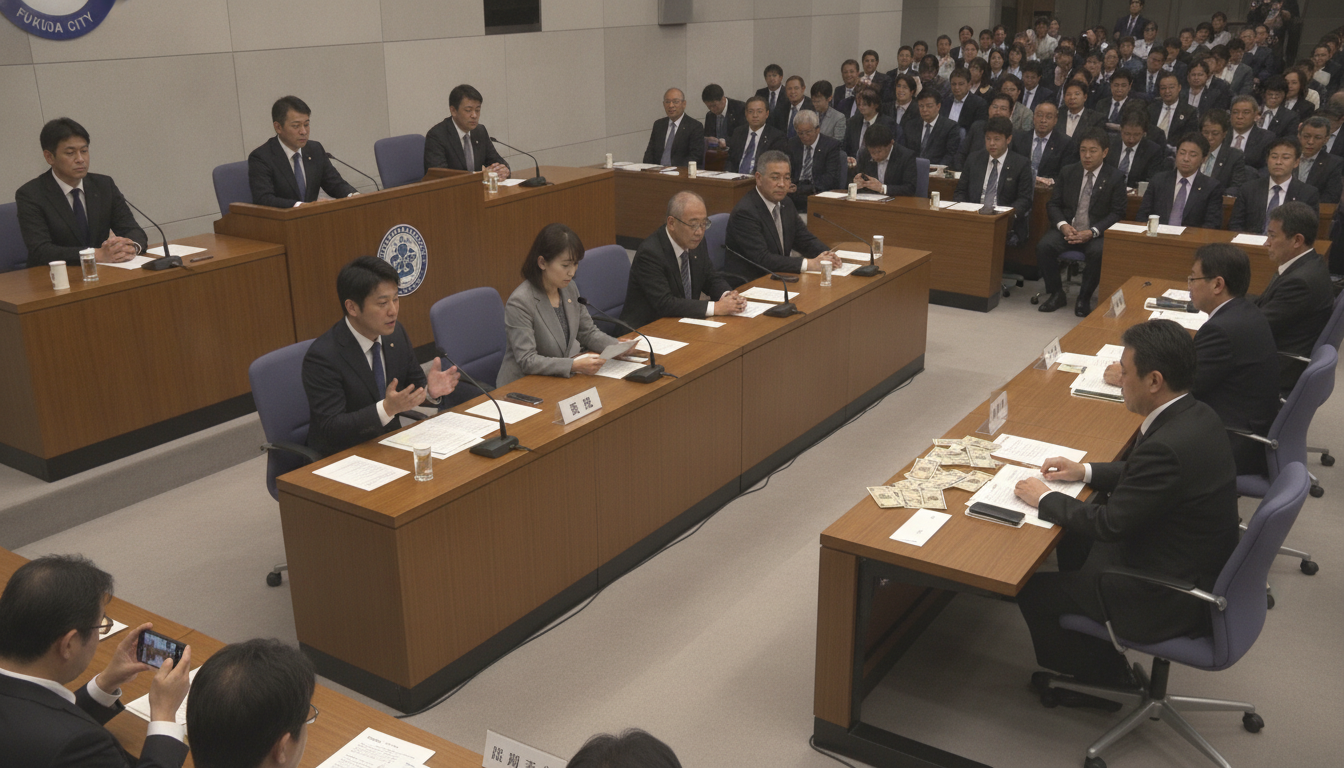
Fukuoka prefectural assembly cash scandal: five former leaders acknowledge payments above ¥1 million
Five former chairs and vice chairs of the Fukuoka prefectural assembly have admitted handing cash or covering costs exceeding ¥1 million to senior caucus figures, exposing a long-standing practice tied to leadership posts. The Fukuoka prefectural assembly cash scandal centers on these admissions and witnesses’ descriptions of a culture in which participating in selection events was regarded as an honor. The revelations have prompted calls for formal inquiries and raised questions about governance and transparency in the 87-seat assembly.
Admissions by Five Former Assembly Leaders
Several former holders of the assembly’s top posts told reporters they made payments of ¥1 million or more, or paid for dinners and related expenses, around the time they assumed or shortly after taking office. Those former leaders said transfers and hospitality were presented as customary obligations linked to the prestige of becoming chair or vice chair.
The witnesses described giving money directly to caucus officials or assuming banquet and entertainment costs at gatherings where leadership matters were discussed. While some framed the gestures as voluntary tokens of appreciation, the repeated pattern across multiple officeholders has led critics to treat them as institutionalized practices rather than isolated lapses.
Custom of “sweat payments” tied to leadership selection
Former officials described the practice using a local term that translates roughly to “sweat payments,” portraying participation in selection-related events as carrying social and political prestige. Several said the rationale offered to participants was that taking part in these rituals was itself an honor and part of the unwritten path to leadership.
That normalization of cash transfers and funded hospitality is central to the controversy, as it blurs the line between customary political courtesy and improper financial influence. Legal experts and ethics observers warn that even if presented as tradition, such payments can distort decision-making and undermine public trust in elected institutions.
Responses and denials from current caucus members
Officials within the dominant local party caucus have issued mixed responses, with some members denying any systematic cash exchange and others acknowledging that informal support for officeholders has occurred. A number of current assembly members have disputed direct allegations of extortion or coercion but have not fully explained why multiple former leaders made similar claims.
Party representatives have emphasized that no formal mechanism exists for soliciting funds tied to posts, while promising cooperation with any official inquiry. The tension between denials and repeated firsthand accounts has increased pressure on the caucus to provide clear documentation or to back up assertions with transparent procedures.
Legal and political ramifications under scrutiny
Legal analysts note that the facts as described — cash payments exceeding ¥1 million and concerted hospitality payments — could trigger criminal or administrative investigations if investigators conclude they were linked to an exchange of influence or improper gain. Public prosecutors would typically examine intent, the recipients, and whether payments were conditioned on official acts.
Politically, the scandal threatens to erode confidence in the assembly’s selection processes and to spark demands for structural reforms, including clearer rules on gifts, reporting, and disciplinary measures. Lawmakers and municipal watchdogs are already discussing whether to tighten internal ethics codes and increase external oversight to prevent recurrence.
Public reaction and media coverage in Fukuoka
Local residents expressed concern and frustration as details emerged, saying that revelations of cash transfers feed perceptions of insider privilege and weaken citizens’ faith in representative institutions. Community groups and civic organizations called for independent investigations and for assembly members to make full financial disclosures.
Media coverage has intensified scrutiny of the assembly’s culture, with editorials and commentaries urging swift corrective action. Public opinion appears to be coalescing around demands for transparency, and several municipal leaders have suggested convening cross-party talks to restore trust.
Investigations, assembly measures and potential reforms
Assembly leadership said it would review the matter internally and consider establishing a special committee to collect testimony and examine records related to transfers and event spending. Observers expect that a combination of internal review and external inquiries, possibly by prefectural ethics panels or prosecutors, could follow depending on what documentation surfaces.
Measures under consideration include mandatory reporting of gifts and payments, caps on entertainment allowances, and clearer sanctions for violations of assembly rules. Some lawmakers have proposed rotating oversight panels and independent audits to ensure the assembly’s procedures meet basic standards of accountability.
As scrutiny continues, the Fukuoka prefectural assembly cash scandal remains a test of local governance and institutional reform. The coming weeks are likely to determine whether the admissions by former leaders lead to legal action, formal ethics rulings, or a package of procedural changes intended to prevent similar conduct and to restore public confidence.

