
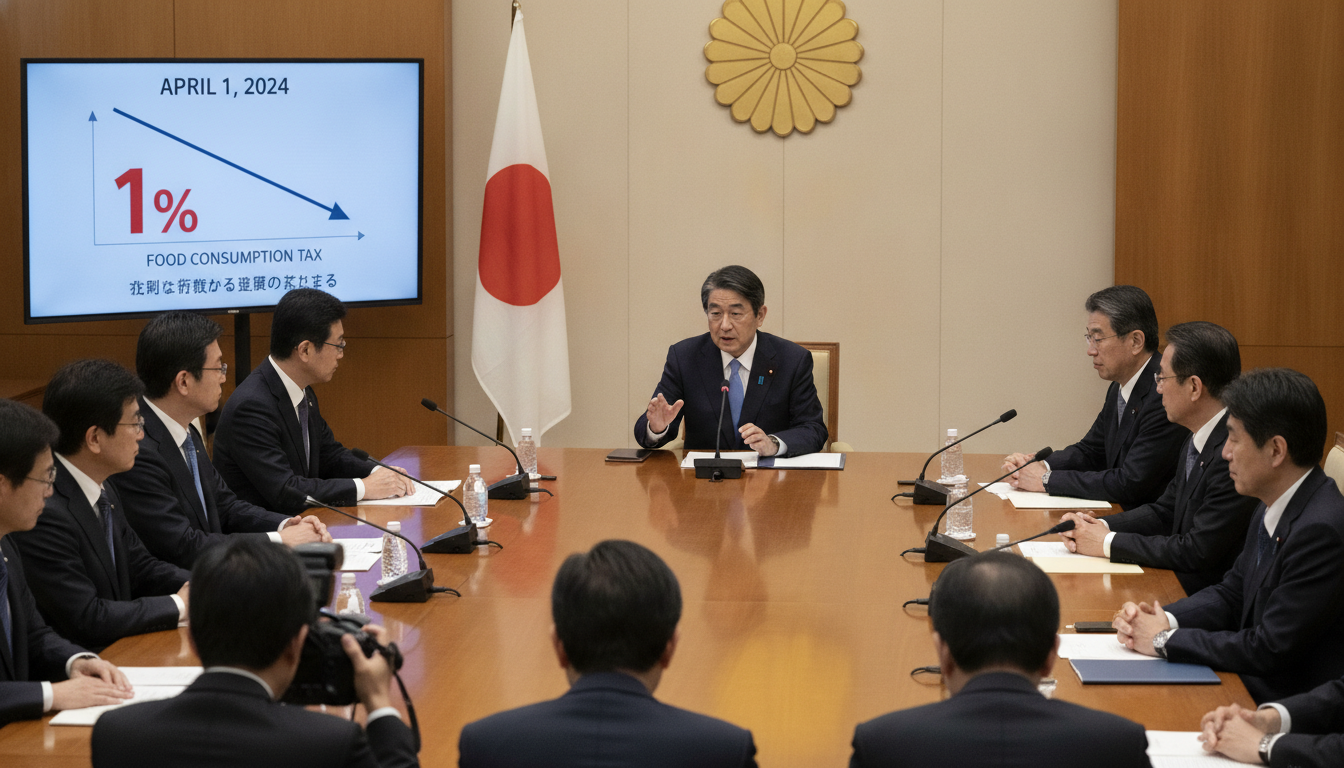
Consumption Tax 1% for Food Set from April 1, 2027, Prime Minister to Instruct LDP on July 30, 2026
Government and ruling LDP agree to cut the food consumption tax to 1% from April 1, 2027. Prime Minister Takaichi is set to instruct party procedures on July 30, 2026.
The government and the ruling Liberal Democratic Party have settled on lowering the consumption tax on food to 1% beginning April 1, 2027, officials said. The move, described by multiple senior cabinet and party sources as a central fiscal measure, follows months of debate within the ruling coalition and the cross-party Social Security National Council. Prime Minister Sanae Takaichi is preparing to direct the LDP to begin intra-party procedures as early as July 30, 2026, a senior official said.
Ruling Coalition’s Decision and Timeline
Ruling party leaders and government officials met this month and reached a policy line to reduce the food consumption tax rate from the current 8% to 1% for a two-year period beginning April 2027. Party sources said the Cabinet and LDP leadership agreed on the broad framework and are moving to formalize it through legislative steps. The prime minister’s planned instruction to the party on July 30, 2026, is intended to trigger internal legal amendment work and pave the way for government submission to the Diet.
Officials framed the cut as temporary, aiming to ease household expenses while keeping an offset mechanism in place for fiscal balance. The measure targets the specific 8% portion applied to food items; the reduced rate will be reflected in the consumption tax schedule enacted for the two-year window. Government ministers and party strategists are coordinating to ensure the change is legislatively ready ahead of the budget cycle next year.
Social Security National Council Reaches No Unified Conclusion
The Social Security National Council, a cross-party body formed to advise on welfare and fiscal measures, failed to reconcile diverging party positions on the tax cut at its working-level meeting on July 27, 2026. Council members decided to compile an interim report that records competing proposals, including the 1% reduction and alternative cash-transfer ideas from opposition and coalition partners. A plenary session of the council is expected to endorse the interim summary at a meeting scheduled shortly, leaving final judgment to the prime minister.
Council officials said the interim document will list each party’s stance rather than force a single consensus recommendation. That approach signals an intent to document political plurality while enabling the executive to advance a concrete policy. Observers note the move reduces the council’s role to advisory compilation rather than decisive arbitration on tax design.
Onodera Proposal and Targeted Compensation Plan
LDP tax affairs chair Gotoku Onodera earlier proposed cutting the food consumption tax portion from 8% to 1% from April and offsetting the remaining 1%—roughly 600 billion yen—through targeted cash payments to low- and middle-income households. The chair’s plan, presented in June, framed the combined measures as effectively nullifying the net burden for vulnerable households while preserving overall fiscal discipline. Government negotiators said they are advancing policy along the lines of that chair’s proposal.
Under the proposed compensation scheme, distribution mechanisms would prioritize households with limited income, using existing benefit and tax data to identify beneficiaries. Officials emphasized that the design aims to minimize administrative delay while limiting leakage to higher-income groups. The detailed eligibility criteria and delivery timetable remain under negotiation across ministries.
Fiscal Cost and Budgetary Implications
Officials estimate the net cost of the immediate cut and compensation measures will require careful budget planning, with the 1% direct reduction on food consumption representing a substantial revenue shortfall over the two-year period. Initial government calculations put the compensation component at about 600 billion yen, but total fiscal effects depend on behavioral responses and the precise scope of items covered. Finance Ministry officials are reviewing projections to reconcile the package with medium-term deficit targets.
Ministers are exploring offsetting measures, including reallocation within existing spending envelopes and temporary use of contingency reserves. Analysts say that while a temporary relief can provide measurable help to household budgets, sustained fiscal pressure would emerge if the measure extends beyond the planned two-year window. The Cabinet Office has signaled it will publish updated fiscal estimates as legislative drafting proceeds.
Political Reactions and Opposition Proposals
Opposition parties offered multiple alternatives during council discussions, ranging from broader cash-transfer schemes to preserving the current rate while expanding targeted subsidies. The cross-party record of differing proposals in the interim report reflects political caution and competing priorities ahead of the fiscal year. Opposition leaders have signaled they will press for more generous direct payments rather than a rate cut, citing distributional fairness and administrative clarity.
Within the LDP, some lawmakers expressed concern about long-term precedent and the message a temporary cut sends on fiscal sustainability, while others argued immediate relief is politically and economically necessary. Municipal leaders and business groups have also weighed in, calling for clear guidance on implementation details and the scope of exempted food items to avoid supply-chain confusion.
Legislative Path and Next Procedural Steps
If Prime Minister Takaichi instructs the LDP to initiate party procedures on July 30, 2026, lawmakers will begin drafting the necessary amendments to the consumption tax law and related statutes. Legal drafters and relevant ministries will be tasked with preparing bill text, impact assessments, and administrative plans for distribution of any compensation payments. The government intends to align the legislative timetable with the autumn Diet session to secure enactment ahead of April 2027.
Observers expect further debate in parliamentary committee hearings, where technical details such as the treatment of prepared foods, dining out, and online grocery sales will be clarified. The pace of enactment will depend on cross-party negotiations and the government’s ability to present clear fiscal offsets.
The policy decision to reduce the food consumption tax to 1% from April 1, 2027, marks a significant fiscal and political move by the government and the ruling party, with implementation details and budget offsets to be hammered out in the weeks ahead.

