
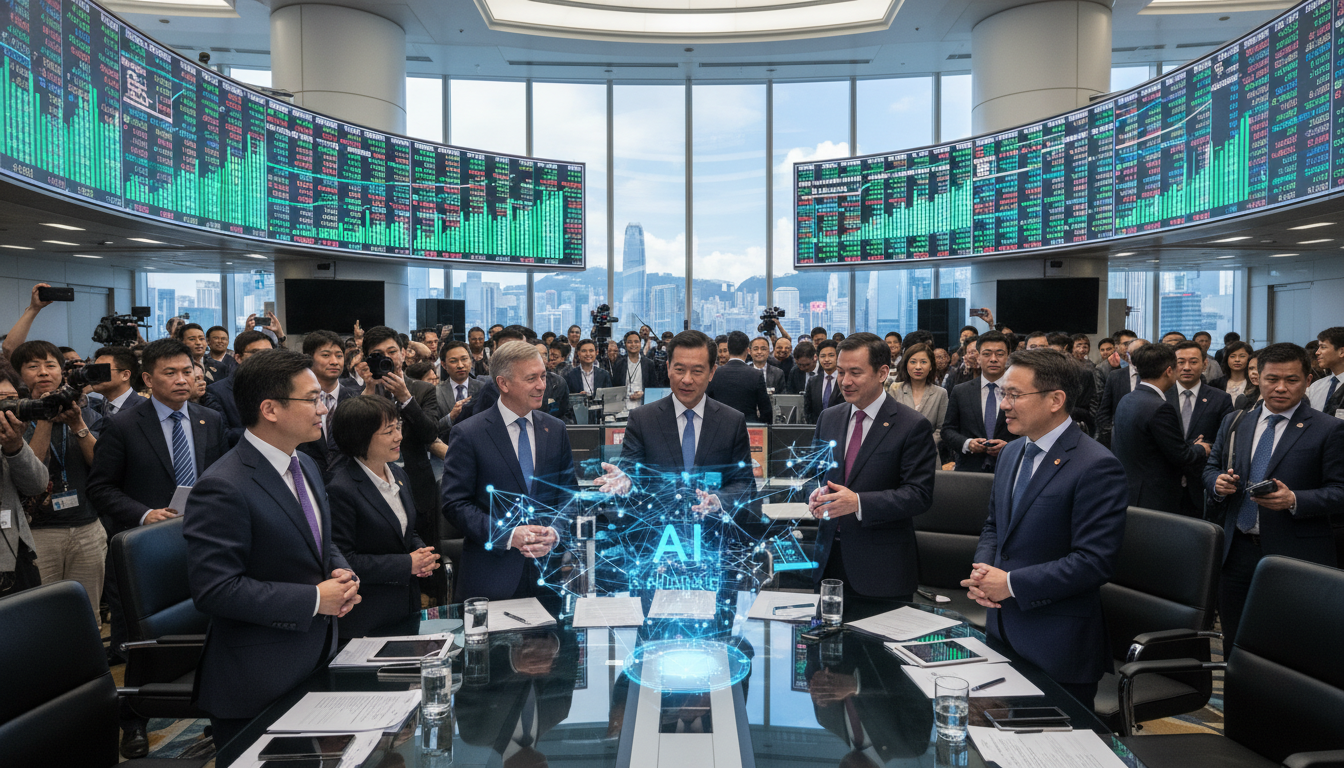
Hong Kong IPO market surges as AI and tech listings drive billions; HKEX shows 409 applications
Hong Kong IPO market sees AI and tech lead billions in funds as HKEX reports 409 listing applications under processing, surpassing Nasdaq and NYSE combined.
Strong investor demand and a wave of technology listings have propelled the Hong Kong IPO market into the global spotlight, with the exchange reporting that total capital raised in recent weeks has outpaced both Nasdaq and the New York Stock Exchange combined. The Hong Kong Exchanges and Clearing said on May 4, 2026 that 409 listing applications were “under processing,” as companies in artificial intelligence and related tech sectors dominated new filings. Market participants described the surge as a convergence of regulatory clarity, deep regional capital pools and renewed confidence among issuers based in Asia.
AI and tech firms are leading new listings
According to exchange figures, a notable share of the pipeline is comprised of companies in AI, cloud computing and semiconductor-related services. These technology issuers have attracted disproportionate investor interest, translating into multi-billion-dollar initial public offering proceeds in aggregate. Several bankers and fund managers said the excitement reflects both the global appetite for AI exposure and Hong Kong’s positioning as a venue for Asian-headquartered tech companies seeking international capital.
Underwriters report that AI and software-as-a-service businesses are commanding higher valuations than more traditional sectors, helping to lift overall deal sizes. The concentration of tech listings has created a virtuous cycle: larger deals draw institutional attention, which in turn improves pricing power for subsequent issuers. Market-watchers cautioned, however, that sector concentration raises questions about valuation dispersion if investor sentiment shifts.
Capital raised outstrips Nasdaq and NYSE combined
HKEX’s summary on May 4, 2026 highlighted that aggregate proceeds from recent primary listings in Hong Kong surpassed the combined totals recorded on Nasdaq and the NYSE over the same period. Analysts said the comparison underscores the shift of marquee listings and growth capital toward Asia this year. While precise timeframes for the comparison were not specified in all public statements, exchange data used by advisers point to a clear uptick in headline fundraising volumes.
Financial institutions involved in deal syndicates emphasized that large-scale transactions in AI and chip design were decisive contributors to the headline figures. The result has prompted renewed debate among global capital market strategists about the balance of listing venues and the comparative advantages offered by Asian exchanges in accommodating high-growth, pre-profit tech companies. Some observers noted that the scale of recent deals would have been difficult to replicate elsewhere without similar investor depth.
HKEX reports 409 listing applications under processing
The Hong Kong exchange said that 409 listing applications were currently “under processing,” signaling a robust pipeline of potential debuts. That backlog covers a wide range of industries but is weighted toward technology, life sciences and advanced manufacturing. Exchange officials said processing timelines remain subject to regulatory checks, due diligence and disclosure standards that aim to protect investor interests even amid heightened activity.
Market participants described the volume as unusually large relative to prior years, attributing the inflow to a combination of companies delaying older plans until market windows improved and a fresh cohort of tech firms opting to list now. Advisers warned that not all applications will reach completion; filtration through regulatory and market-driven criteria will narrow the list, though a significant share is expected to proceed to pricing and trading.
Investor appetite reshapes pricing and demand
Institutional investors have been sharpening their allocation strategies to capture exposure to AI and tech IPOs in Hong Kong, with many adjusting mandates to allow for higher growth and, in some cases, greater volatility. Demand from long-only funds and dedicated tech investors has supported robust bookbuilding processes, allowing underwriters to lift target ranges in several deals. Active traders and hedge funds have also shown interest, increasing liquidity in new issues post-listing.
However, some buy-side officials warned against uniform enthusiasm, pointing to the need for careful company selection amid heightened valuations. They stressed evaluation of revenue quality, gross margins and the trajectory toward profitability. Analysts said that secondary market performance will be key to sustaining the cycle: if newly listed stocks show healthy post-listing trading, confidence will reinforce the pipeline; if not, a correction in sentiment could slow issuance.
Regulatory context and regional implications
Regulatory clarity provided by Hong Kong authorities, including updated disclosure rules and engagement with mainland Chinese regulators, appears to have played a meaningful role in attracting issuers. Policymakers have signaled a pragmatic approach to listing standards while maintaining investor protections, which has helped restore confidence among corporate issuers and global investors. That balance has been cited by advisors as a competitive advantage over other venues.
The shift toward Hong Kong has broader implications for regional capital markets, potentially redirecting the flow of listing activity and investment west-to-east for certain sectors. Governments and exchanges in Asia are likely to monitor the trend closely, as sustained momentum could encourage more companies to prioritize Asian exchanges for their public debuts. At the same time, officials in the United States and Europe will be watching how regulatory and market dynamics evolve in response.
Investor scrutiny, combined with ongoing geopolitical and macroeconomic uncertainties, means the market’s next phase will be shaped by execution and performance rather than headline volume alone. Demand for AI and tech exposure is strong, but long-term confidence will hinge on transparent reporting, disciplined capital allocation by issuers, and steady post-listing performance.
As the next tranche of companies progresses through HKEX’s review process, market participants say the coming months will test whether the current surge represents a durable realignment of global listing flows or a cyclical concentration driven by short-term sector enthusiasm. The exchange’s May 4, 2026 update—highlighting the 409 applications and record fundraising—marks a pivotal moment for Hong Kong’s role in the global IPO landscape.

