
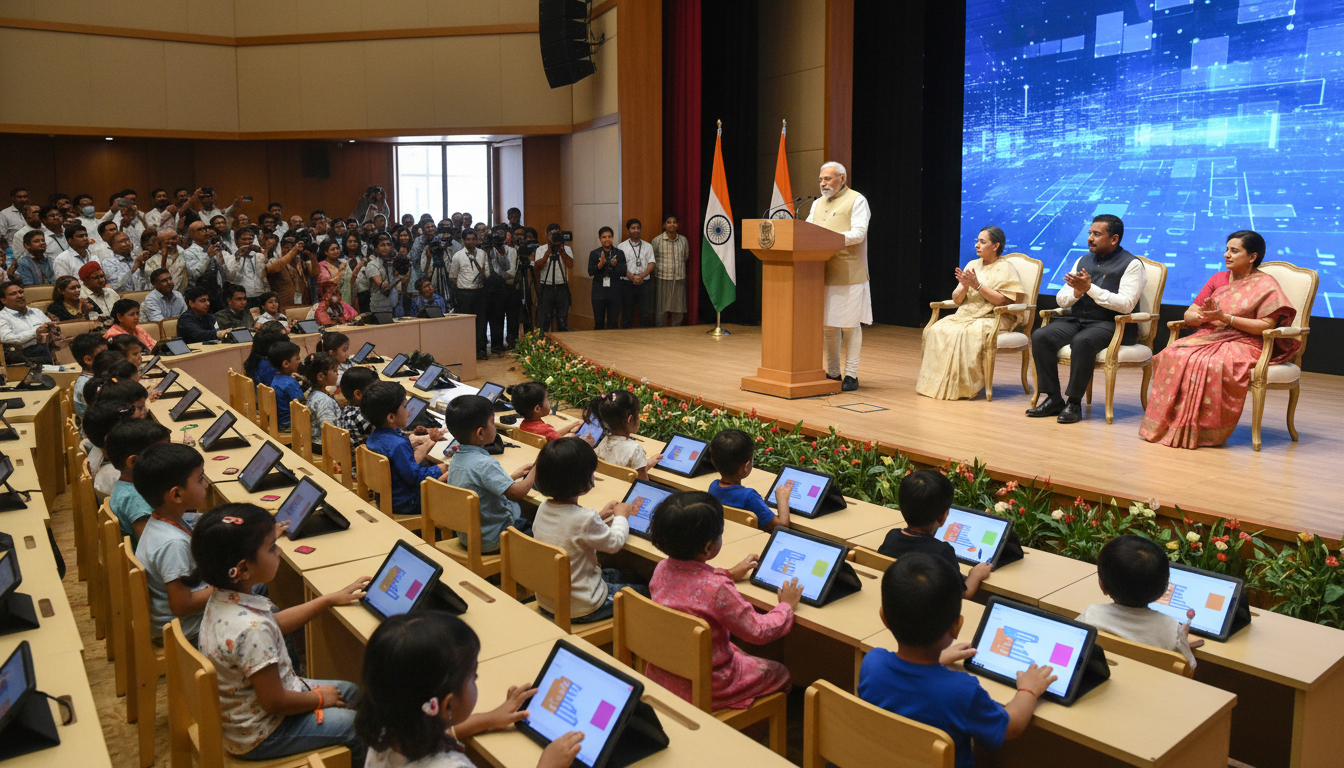
India AI education strategy targets children from age 3 to build future AI leaders
India’s AI education strategy targets children from age 3, blending language learning and IT skills to prepare youth for an AI-driven economy and global competition.
India has unveiled a national education strategy that begins formal AI-related learning from age 3, aiming to reframe early childhood education around language, digital literacy and computational thinking. The plan positions the India AI education strategy as a cornerstone of long-term economic and human-capital goals, with officials emphasizing the need to cultivate adaptable thinkers as generative AI transforms work and society.
Policy goals and government rationale
India’s government frames the strategy as a response to rapid advances in artificial intelligence and their implications for jobs and civic life. Officials argue that instilling strong language skills and foundational IT knowledge early will give children tools to engage with AI critically and creatively.
The policy document signals a shift in priorities for ministries overseeing education and technology, linking early childhood pedagogy to national ambitions for talent development and global competitiveness. Authorities say the approach is intended to produce graduates fluent in both humanistic reasoning and technical concepts.
Curriculum changes and age-3 focus
Under the plan, curriculum revisions will introduce age-appropriate activities that encourage pattern recognition, sequencing, storytelling and basic digital interactions starting at age 3. These modules are designed to blend play-based learning with early exposure to logic, cause-and-effect reasoning and multilingual communication.
For older primary grades, the strategy proposes progressively complex units in computational thinking, data awareness and ethical discussions about technology. The staged model aims to avoid premature technical training while establishing cognitive habits prized in AI-era workplaces.
Language emphasis and multilingual learning
Language skills feature centrally in the strategy, reflecting the government’s belief that linguistic agility supports learning and international engagement. Programs aim to strengthen proficiency in regional languages alongside English and computational “languages” such as coding concepts.
Officials argue that multilingual children can better navigate global knowledge networks and collaborate on technology projects, enhancing India’s prospects in international AI research and industry. Education planners also see language instruction as a vehicle for cultural continuity while integrating new digital literacies.
Teacher training and classroom resources
A major pillar of the plan is targeted teacher training, with proposals for nationwide professional development in digital pedagogy and early-childhood AI awareness. The government plans to roll out training modules for pre-school and primary educators to ensure consistent classroom practice across urban and rural settings.
Classroom resources will include low-cost digital tools, open-source lesson plans and community-based learning kits, according to policy briefs. Officials acknowledge the challenge of scaling teacher support and say pilot programs will test different models before a national expansion.
Pilot programs and regional rollout
The strategy calls for phased pilots in selected states and union territories to refine curriculum content and delivery methods. These pilots are expected to evaluate outcomes on language development, digital competence and teacher readiness before nationwide implementation.
Regional variability in infrastructure, teacher supply and socioeconomic conditions will shape rollout timelines, with the government indicating priority for districts that already host technology hubs. Monitoring and evaluation frameworks are slated to measure both cognitive outcomes and equity impacts.
Expert concerns and equity challenges
Education specialists welcomed the ambition but cautioned about potential pitfalls, including widening inequities and excessive screen time for very young children. Observers stressed the need for robust safeguards on data privacy and a focus on play-based, human-centered pedagogy rather than early technical certification.
Critics also warned that without major investments in teacher numbers and school infrastructure, the India AI education strategy risks benefiting already-advantaged communities. Some experts urged transparent metrics and independent evaluation to track whether the initiative improves learning for the most vulnerable children.
India’s approach to early AI education represents a novel attempt to align child development with national technology goals, blending language, ethics and digital competence into foundational schooling. Its success will depend on practical implementation, resourcing, and careful balancing of innovation with developmental science.
The strategy will be watched internationally as countries consider how to prepare young citizens for an AI-rich future, while domestic debates center on equity, pedagogy and the role of schools in shaping the next generation’s relationship with technology.

