
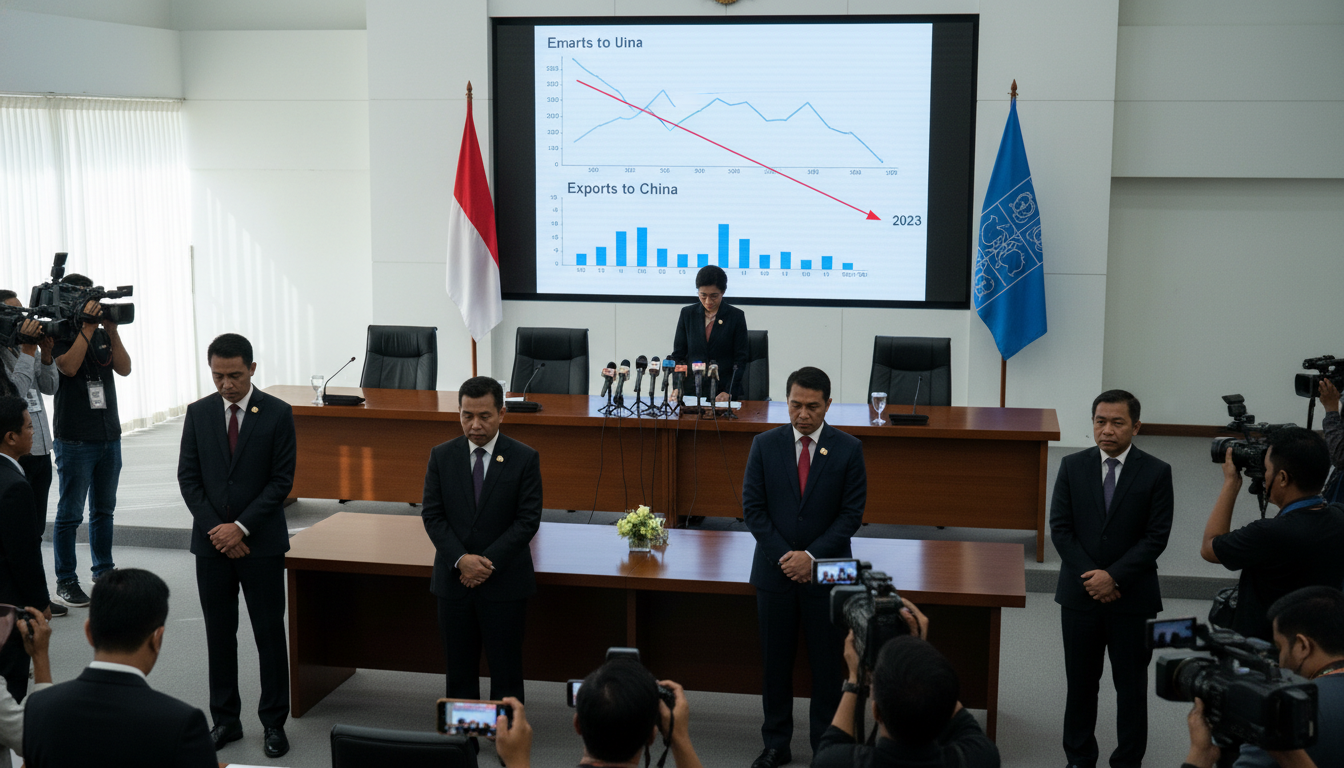
Indonesia trade surplus narrows to six-year low as imports surge
Indonesia trade surplus fell to its smallest in over six years in April as a weaker rupiah, rising global costs and stronger domestic demand pushed imports higher.
Indonesia recorded its smallest trade surplus in more than six years in April, driven by a sharp rise in imports after the rupiah weakened and global costs climbed. The decline in the surplus, officials said, reflects a mix of external price pressures tied to the Iran war, higher chip prices and pro-growth policies that have boosted domestic demand. Economists warn the outlook for the Indonesia trade surplus could worsen if demand from China softens further.
April trade surplus hits six-year low
The April reading marks a notable shift after months of more favorable external balances for Indonesia. Data released by government agencies showed imports accelerating across energy, capital goods and electronics components, while export values were constrained by price and volume dynamics.
Analysts pointed to a combination of currency depreciation and commodity price swings as key factors behind the change. The government’s stimulus measures to sustain growth have also contributed by lifting domestic spending and import-intense activity.
Imports rise as rupiah weakness increases costs
A weaker rupiah raised the local-currency price of imported goods, encouraging higher nominal import values even where volumes were mixed. Firms reliant on foreign components, particularly in electronics and automotive supply chains, reported rising import bills amid higher international chip prices.
Geopolitical tensions, notably the Iran war, have pushed up energy and freight costs, compounding the effect of currency depreciation. The result was a broader import bill that outpaced export receipts in April, narrowing the trade buffer that had helped fiscal and external stability.
Exports face headwinds from China and commodity markets
Economists warn that a slowdown in China — a major buyer of Indonesian commodities and manufacturing — could weigh on export performance going forward. Lower Chinese industrial activity would likely damp commodity demand, affecting key Indonesian exports such as coal and palm products.
Barges loaded with coal, one of Indonesia’s most important export commodities, remain a visible reminder of the country’s commodity exposure, and any contraction in Chinese imports could quickly transmit to export volumes and values. Diversifying export markets and moving up the value chain are recurring policy recommendations to reduce vulnerability to a single market.
Policy stimulus lifted domestic demand but widened deficit pressures
Pro-growth fiscal policies and targeted subsidies aimed at maintaining expansion have supported household spending and corporate investment. Those measures, however, have a trade-off: stronger domestic demand tends to boost imports of raw materials, machinery and consumer goods, pressuring the trade balance.
Policymakers face a balancing act between sustaining near-term growth and preserving external buffers. Monetary authorities and the finance ministry will need to monitor currency moves, capital flows and inflationary pressures while calibrating policy support.
Supply-chain effects and industry implications
Higher input costs and chip-price volatility have ripple effects through manufacturing and export-oriented sectors. Companies that source semiconductors and intermediate goods from abroad may see margins squeezed or slow production if supplies become costlier or constrained.
Smaller firms that lack hedging capacity are particularly exposed to sudden exchange-rate shifts and global price shocks. Industry associations have urged clearer policy signals and support measures to bridge temporary disruptions without creating long-term dependence on imports.
Near-term outlook and risks to recovery
The near-term outlook for the Indonesia trade surplus is uncertain, shaped by currency developments, commodity price trajectories and external demand patterns. Renewed weakness in the rupiah or a sharper-than-expected slowdown in China would increase the risk of further narrowing or even a temporary deficit.
Conversely, a stabilization of global energy prices, improved semiconductor supply conditions and stronger non-China markets could help shore up export receipts. Analysts emphasize the importance of policies that encourage higher-value exports and reduce reliance on imported inputs.
The government and market participants are now watching incoming monthly data closely to assess whether April’s reading signals a sustained shift or a temporary hiccup in an otherwise resilient external position.

