
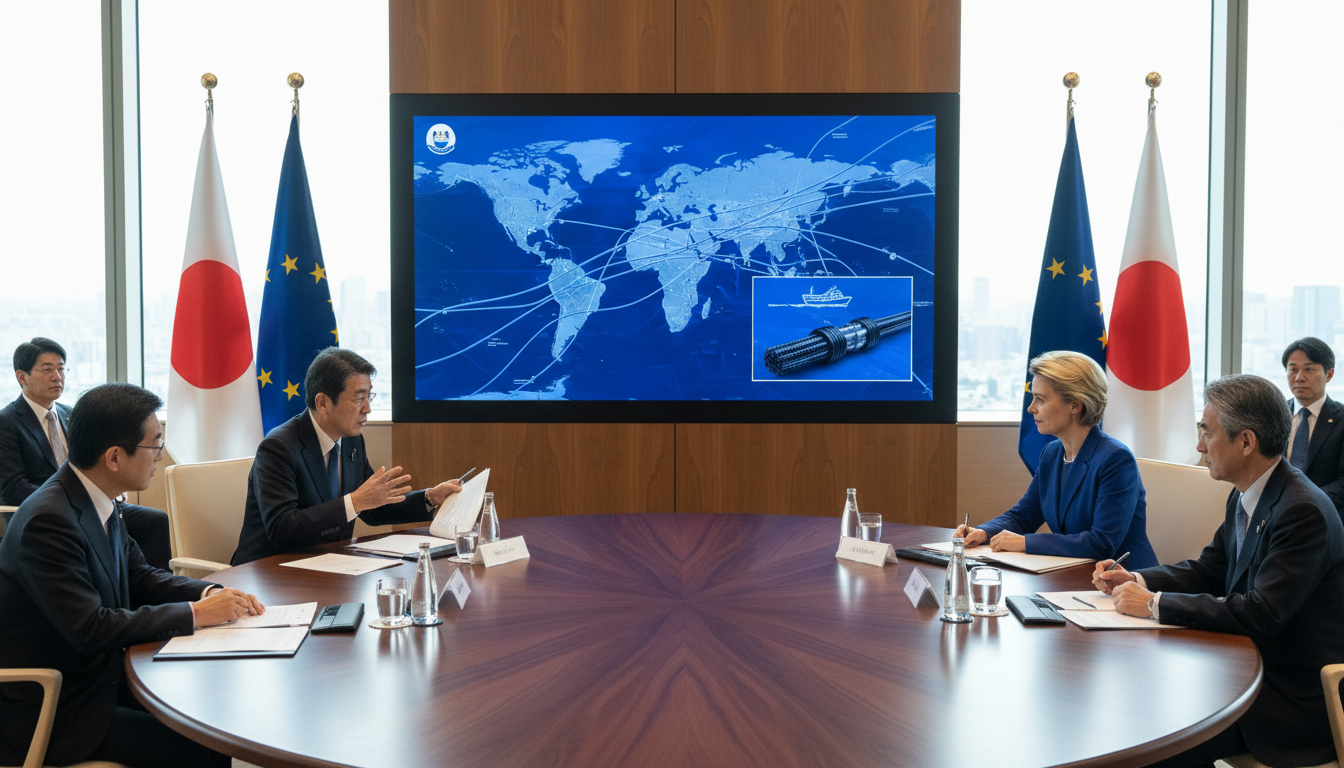
Japan and EU to Cooperate on Submarine Cable Protection, Laying and Maintenance
Japan will cooperate with the European Union to strengthen technology and protocols for protecting, laying and maintaining submarine cables amid a rise in attacks since 2022, officials said. Submarine cables carry the vast majority of global cross-border data traffic and are central to economic and national security, making their resilience a growing priority. The agreement signals closer Tokyo‑Brussels coordination on technical standards, rapid repair capabilities and information sharing to safeguard undersea links.
Japan and EU to Share Submarine Cable Technology
The cooperation will focus on developing and exchanging technologies for detection, rapid repair and secure cable deployment across contested maritime zones. Japanese and EU officials outlined plans to coordinate research, pool operational expertise and test new sensor and remote‑operated vehicle systems. This technical partnership aims to reduce downtime after incidents and improve the speed and safety of laying and maintenance operations.
Security Concerns Intensify After 2022 Ukraine Invasion
Officials cite a rise in deliberate and accidental damage to undersea infrastructure following the 2022 invasion of Ukraine, which exposed vulnerabilities in global networks. Governments and operators have reported increased instances of suspicious activity near cable routes as well as higher risks from drifting fishing gear and maritime accidents. The heightened threat environment has pushed allies to prioritize hardening undersea links against sabotage, espionage and incidental damage.
Technical Measures: Detection, Repair and Redundancy
Planned measures include expanded use of seabed sensors, autonomous underwater vehicles and improved real‑time monitoring to detect tampering or faults quickly. Authorities will promote standardized rapid‑response procedures for cable repairs and invest in additional cable‑laying vessels and spare parts to shorten outages. Operators are also evaluating route diversification and greater use of buried or armoured cable segments in high‑risk areas to enhance redundancy.
International Coordination and Legal Hurdles
Cooperation between states raises complex legal and operational questions over jurisdiction, information sharing and access in exclusive economic zones and international waters. Japan and the EU will need to align regulatory frameworks, incident reporting standards and search‑and‑rescue protocols to enable cross‑border missions and joint repairs. Negotiators say overcoming these hurdles will require greater transparency between navies, coast guards and civilian telecom operators.
Private Sector Role and Infrastructure Investment
Telecom companies, maritime contractors and subsea engineering firms will play a central role in implementing the new measures and absorbing upfront costs for heightened resilience. Public‑private partnerships are expected to finance upgrades, while governments may offer incentives for additional cable capacity and security features. Industry leaders cautioned that long lead times for manufacturing specialized vessels and equipment mean investment decisions made now will shape network resilience for years.
Strategic Implications for Supply Chains and Defense
Securing submarine cables is increasingly seen as both an economic safeguard and a national security priority, with implications for trade, finance and defense communications. Disruption to undersea links can ripple across supply chains, affect financial transactions and constrain military command systems, prompting policymakers to treat cable security as part of broader resilience planning. The Japan‑EU initiative underscores a shift toward integrated civil‑military approaches to protect critical global infrastructure.
The cooperation will be rolled out through a series of technical exchanges, pilot deployments and joint exercises, with officials stressing the need for regular drills and transparent reporting. As undersea infrastructure becomes more contested, the pact aims to set interoperable standards and faster repair timelines to limit the economic and strategic fallout from outages. Continued collaboration between governments, industry and allied navies will be vital to keeping submarine cables operational and secure.

