
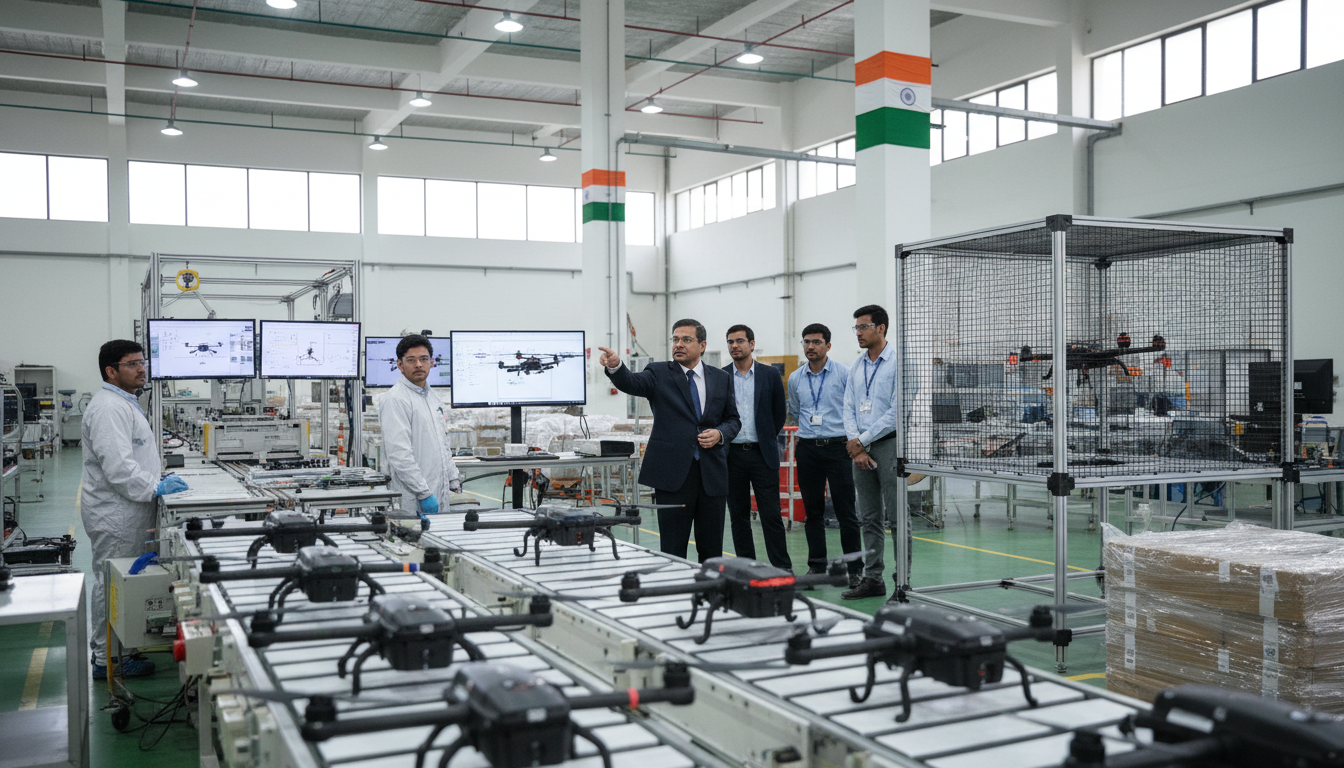
India’s arms indigenization accelerates as Bengaluru firms, Bharat Electronics expand production and drone capabilities
India’s arms indigenization accelerates as Bengaluru firms and Bharat Electronics expand production and drone capabilities, while R&D shortfalls remain.
India is fast-tracking its arms indigenization push as state-owned and private firms in Bengaluru ramp up production, technology partnerships and new unmanned systems to meet expanding defence requirements. The initiative centers on boosting domestic supply chains and co-producing advanced equipment while addressing persistent gaps in manufacturing and research spending. The shift reflects New Delhi’s broader strategy to reduce import dependence and position India as a regional defence supplier.
Bengaluru emerges as a defence manufacturing hub
Bengaluru, long known for its information technology cluster, has become a focal point for defence manufacturing and systems development. Major public and private firms, along with startups, have concentrated research, prototyping and small-series production facilities around the city, drawing on local engineering talent and electronics expertise.
This concentration is feeding a wider industrial ecosystem that supports avionics, radar, communications and electronic warfare systems. Observers say the mix of legacy public enterprises and nimble private startups is creating new pathways for rapid development and fielding of equipment.
Bharat Electronics expands output and international collaborations
Bharat Electronics Limited (BEL), founded in the 1950s, has taken a central role in the indigenization drive by producing long-range surface-to-air missiles, carrier communications gear and electronic warfare equipment. The company reported a sharp rise in sales over recent years, reflecting growing domestic orders and an emphasis on local content in procurement.
BEL has pursued technology transfers and co-production arrangements with foreign defence firms, building original-equipment-manufacturer ties in roughly 10 countries and forming technological partnerships across about 60 nations. Such collaborations are intended to accelerate capability upgrades while enabling indigenous manufacture of complex systems.
Private sector growth and the MSME innovation network
Since private firms were formally allowed into defence production in the early 2000s, their share of the Indian defence market has steadily grown. The private sector portion rose from roughly 21% to 23% within a year, signaling an expanding role for non-state companies in supply and systems integration.
Government-backed initiatives have sought to nurture small and medium enterprises as defence suppliers. A nonprofit innovation vehicle set up in recent years provides grants and incubation to startups and MSMEs, and officials estimate tens of thousands of small firms now participate in defence production, supplying components, subsystems and testing services.
Startups drive drone swarms and autonomous ground systems
A new generation of Bengaluru-based startups is developing loitering munitions, unmanned ground vehicles (UGVs) and AI-enabled controllers that allow multiple drones to operate in coordinated swarms. Some firms have reported orders from the Indian armed forces for integrated drone–UGV packages that include onboard power systems and embedded processors.
Companies say their near-term focus is fulfilling domestic demand and maturing systems for reliability, with plans to enter export markets once production scales. Executives predict growing international interest in swarm-capable systems as militaries worldwide seek affordable ways to achieve massed effects with unmanned assets.
Shortfalls in R&D and large-scale manufacturing remain constraints
Despite momentum in systems and prototypes, India’s overall manufacturing base and research investment lag established defence exporters. Manufacturing accounts for a relatively small share of GDP, and national R&D spending is well below the levels seen in advanced economies, limiting sustained development of cutting-edge platforms.
These structural limits have contributed to delays in complex programs, including next-generation fighter development, where peers that began similar efforts earlier have already flown prototypes. Analysts argue that improving industrial capacity and boosting sustained R&D spending will be essential if indigenization is to move beyond component production to full-spectrum systems design and serial manufacture.
India’s position as an English-speaking, technologically literate nation with diverse testing environments is seen as an advantage in scaling defence production. However, experts caution that technology partnerships, export controls, and the need to upgrade factory capacity will determine how quickly indigenization converts into competitive export industries.
The government’s push to align procurement, foster private participation and fund innovation has produced visible progress in electronics and unmanned systems, but the path to self-reliance requires sustained investment in manufacturing infrastructure and research institutions. As domestic firms mature and partnerships deepen, New Delhi’s ambition to transform India from a major importer into a regional defence producer will be tested by how effectively it narrows the gap in large-scale production and long-term R&D.

