
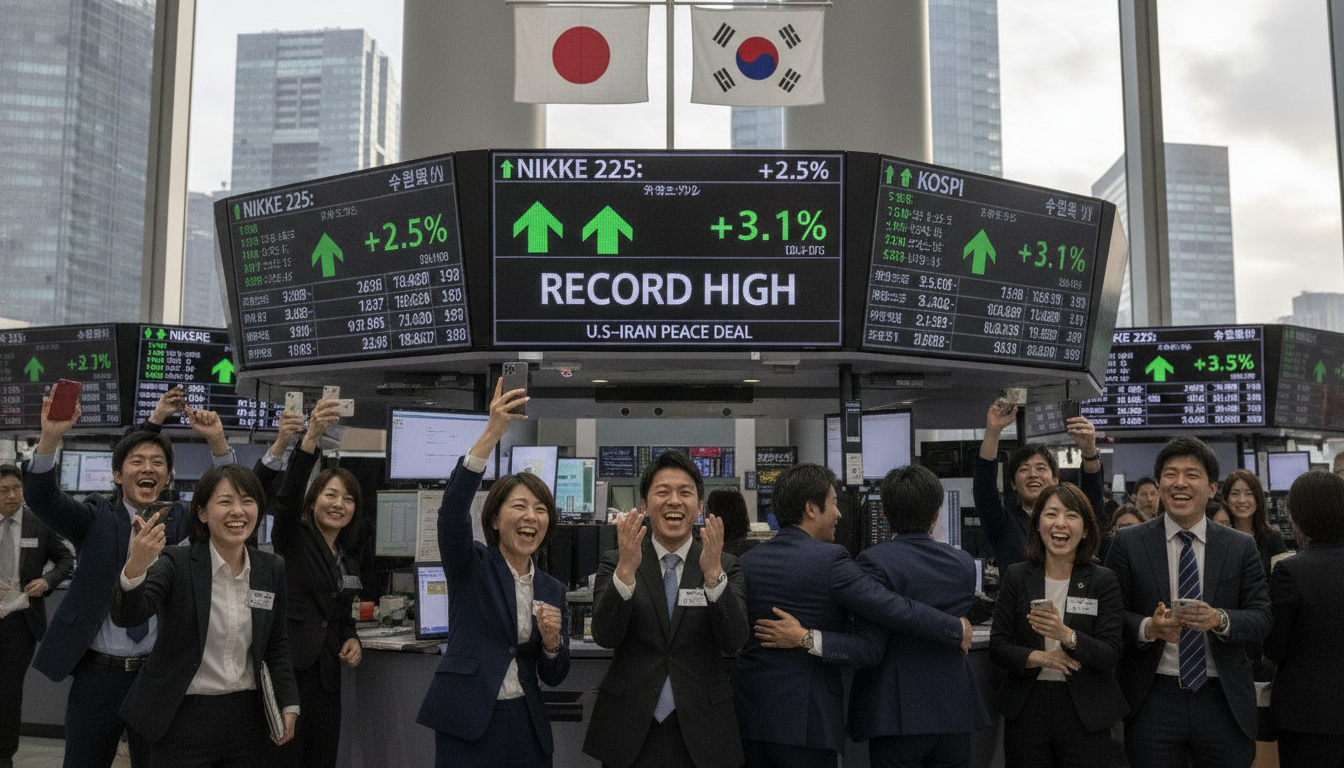
Japan and South Korea stocks surge to record highs after U.S.-Iran deal and AI optimism
Japan and South Korea stocks rose to record highs on June 18, 2026, driven by a U.S.-Iran peace agreement, renewed AI investment optimism and confidence in the Bank of Japan’s policy path.
Markets reach fresh peaks on June 18, 2026
Japanese and South Korean equity markets closed at new highs on Thursday, reflecting a broad lift in investor sentiment across the region. The rally combined relief over a diplomatic breakthrough in the Middle East with continued enthusiasm for artificial intelligence-related investments. Market participants cited a calmer geopolitical outlook alongside strong corporate earnings expectations as key near-term catalysts.
Foreign and domestic investors alike moved into both technology and export-oriented names, pushing major benchmarks to intraday and closing records. Traders described the move as a coordinated rebound rather than a narrow sector spike, noting breadth across small-, mid- and large-cap stocks. The momentum extended gains seen earlier in the week as confidence spread through regional trading desks.
U.S.-Iran deal reduces geopolitical risk premium
Deal announcements that aim to end hostilities involving Iran removed a significant risk premium that had weighed on global markets. Investors reacted to the possibility of fewer supply disruptions and lower spikes in energy prices, which had been a major source of volatility. The calming of geopolitical risk improved appetite for equities, particularly in markets sensitive to trade and shipping routes.
Analysts said the timing of the agreement intersected with other market-positive forces, amplifying its effect. With oil prices stabilizing, companies that had faced higher input costs saw revised profit forecasts and valuations slightly re-rate. Market participants emphasized that while the deal reduces immediate tail risks, geopolitical uncertainty remains a watchpoint for the months ahead.
AI investment drives gains in technology and chipmakers
Artificial intelligence-related optimism continued to be a dominant narrative, lifting software, semiconductor and hardware names across both markets. Investors increased allocations to firms positioned to benefit from AI adoption, including cloud services, specialized chips and industrial automation suppliers. The technology-led advance contributed materially to headline index gains as large-cap tech weights outperformed.
Venture and institutional flows into AI projects and related equities reinforced positive sentiment, encouraging broader market participation. Equity strategists noted that expectations for sustained capital spending on AI by corporations had become an important driver of earnings upgrades. Market participants also highlighted increased M&A and strategic partnerships as evidence that companies are prioritizing AI capabilities.
Bank of Japan’s gradual normalization eases policy uncertainty
Japan’s central bank signaled a gradual and predictable approach to policy normalization, which reassured investors concerned about abrupt shifts in monetary conditions. The perception that the Bank of Japan would move carefully reduced fears of sudden rate-induced market stress. This policy clarity supported risk-taking in equities while allowing bond yields to adjust without sharp dislocations.
Market commentators said a measured BOJ stance helped the yen trade more stably, which in turn supported export-oriented corporations. Financial markets interpreted forward guidance as an effort to balance inflation control with economic stability. Traders added that coordination between monetary signals and fiscal cues would be crucial for sustaining the rally.
Winners by sector and implications for exporters
Semiconductors, software platforms and industrial automation firms emerged as clear winners amid the rally, while select financial and consumer goods names also gained ground. Exporters that benefit from a stable currency and improving global demand saw renewed interest from institutional investors. Analysts observed rotation into cyclical stocks that stand to gain from a pickup in capital expenditure tied to AI and infrastructure projects.
Liquidity conditions and improved earnings visibility helped smaller caps participate in the advance, narrowing performance gaps across market capitalizations. Portfolio managers said they were trimming some lofty positions to rebalance risk but remained constructive on sectors linked to technology adoption. Persistent investor demand for growth exposures kept valuations under scrutiny, however.
Risks to the upswing and monitoring points
Despite the positive momentum, market strategists cautioned that several risks could temper gains, including inflationary surprises, renewed geopolitical flare-ups or setbacks in global trade negotiations. Energy market shocks remain a possible disruptor, particularly if diplomatic progress stalls or fails to translate into durable stability. Central bank moves outside Japan and Korea, especially in the United States and Europe, could also influence flows and valuation dynamics.
Investors will watch corporate guidance and macro prints in the coming weeks for confirmation that earnings can justify higher multiples. Market participants emphasized the need for continued clarity on policy paths, corporate capital spending plans for AI, and the sustainability of foreign inflows into regional equities.
The rally on June 18, 2026, reflected an interplay of diplomatic progress, technological excitement and central bank assurances, but analysts urged disciplined risk management as conditions evolve.

