
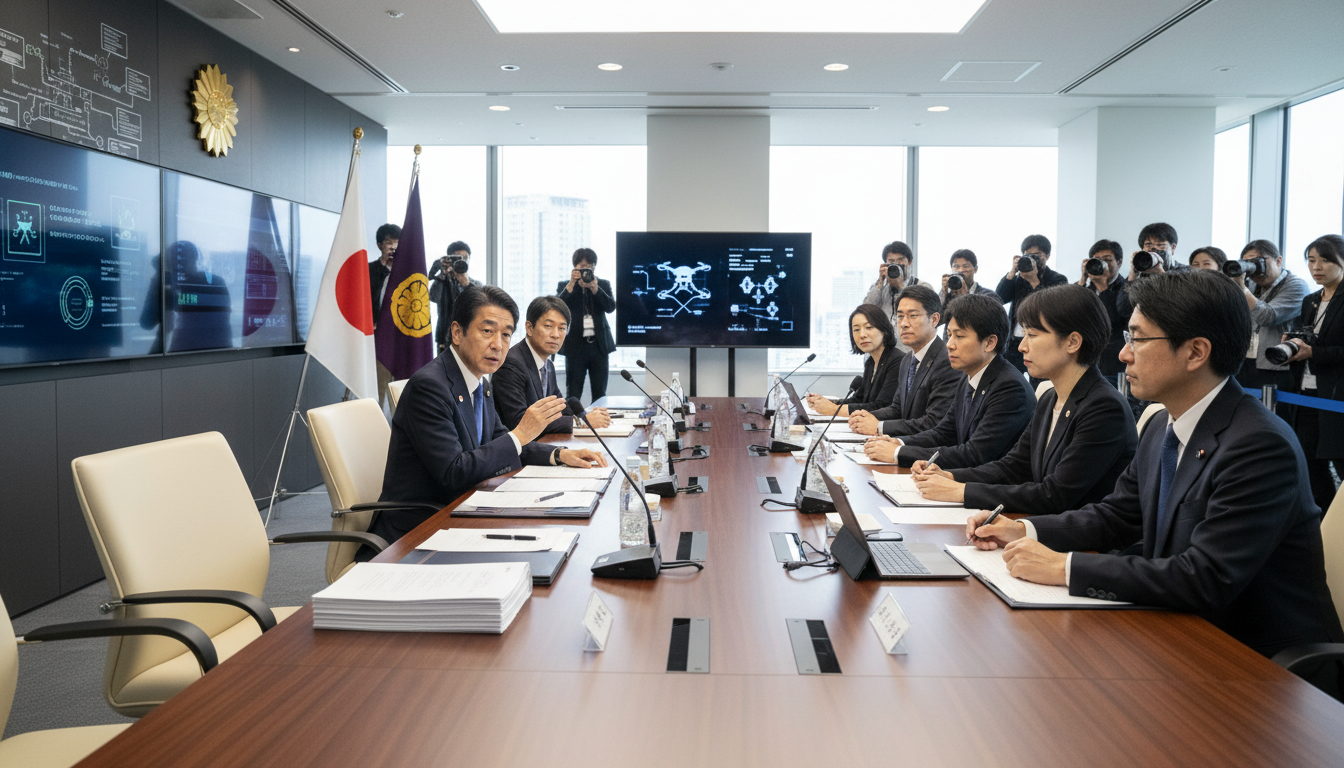
Japan launches expert panel to revise security documents, highlighting drones and AI preparedness
Japan will revise its security documents this year, focusing on drones, AI and funding for higher defense spending.
The government convened the first meeting of an expert panel on April 27, 2026, to begin work on revisions to Japan’s security documents, a process Tokyo says is necessary to adapt to changing conflict dynamics. Prime Minister Sanae Takaichi told the meeting that lessons from Russia’s invasion of Ukraine and recent Middle East tensions make it essential to prepare for "new ways of warfare" and protracted conflicts. The review will cover priority technological areas and the fiscal framework for any increase in defense spending as officials aim to complete revisions by the end of 2026.
Government holds first expert meeting on security documents
The inaugural session of the expert panel on April 27 brought together academics, former officials and industry figures to assess threats and policy options. Officials described the gathering as the start of a year-long process to update the three core security documents that guide Japan’s defense and foreign policy. Those three documents — the National Security Strategy, the National Defense Program Guidelines and the Mid-Term Defense Program — set force posture, procurement priorities and spending plans.
Members discussed a wide agenda that includes threat assessment, capability priorities and budgetary options. The meeting did not finalize recommendations, but ministers said it would inform cabinet deliberations and the drafting teams that will produce revised texts. Government officials emphasized the need for a broad, cross-disciplinary review that links strategic intent with technological and fiscal realities.
Prime Minister frames the revision as response to changing battlefields
Prime Minister Takaichi framed the revisions as urgent, citing battlefield trends that have altered how states fight and prepare for conflict. She told attendees that Japan must "respond to new ways of fighting and prepare for long-term conflict," invoking the Russian military campaign in Ukraine and instability in the Middle East as wake-up calls. Her remarks signaled a push for a security posture that anticipates hybrid and technology-driven warfare.
The prime minister also stressed national resilience and alliance coordination as pillars of the review. Tokyo’s leadership underscored that any doctrinal or capability shifts would be designed to strengthen deterrence while remaining consistent with Japan’s constitutional and diplomatic commitments.
Emphasis placed on drones, artificial intelligence and emerging systems
A central focus of the discussions was the integration of unmanned systems and artificial intelligence into defense planning. Officials and experts identified drones, automated sensors and AI-enabled decision support as priorities for investment and doctrine development. Participants noted that conflicts in Ukraine and elsewhere have showcased how relatively low-cost, rapidly deployable technologies can change tactical and operational dynamics.
Panel members explored how to accelerate acquisition cycles and domestic development while strengthening industrial partnerships abroad. They also raised questions about command-and-control safeguards, rules of engagement for autonomous systems and ethical considerations for AI use in defense applications.
Fiscal debate looms over proposed defense spending increases
One of the thorniest issues flagged at the meeting was financing for a potential boost in defense outlays. Government planners are weighing whether and how to allocate additional funds to accelerate procurement and sustain new capabilities over the long term. Experts on the panel highlighted trade-offs between near-term stockpiling, research-and-development spending and long-term maintenance costs.
Options under consideration reportedly include phased budget increases, special fiscal vehicles, and reallocations within existing spending envelopes. Lawmakers and ministry officials will need to reconcile political appetite for higher defense budgets with limits on public finances and competing domestic priorities.
Selection of experts seen as indicator of policy direction
Observers noted that the composition of the expert panel offers clues to the government’s intended policy tilt. Appointees include specialists in defense technology, former security officials and advisers with industry links, reflecting a tilt toward capability modernization and industrial mobilization. Analysts said the mix of participants suggests Tokyo intends to prioritize technological adaptation alongside traditional deterrence measures.
Some civil society and opposition figures cautioned against an overly narrow focus on hardware, urging the panel to weigh diplomacy, resilience and legal constraints as part of any revision. The government responded that the panel’s remit is broad and that its findings will be considered alongside cabinet-level input.
Next steps set timeline toward year-end revisions
Officials expect the expert panel to hold a series of meetings and produce interim findings that will feed into official drafts over the coming months. The government has set an internal target to finalize revisions to the security documents by the end of 2026, with public release and parliamentary engagement to follow. Drafting teams within the relevant ministries will use the panel’s assessments to shape procurement timelines and strategic language.
The process will test Tokyo’s ability to balance rapid technological change with fiscal constraints and legal oversight. As Japan moves to update its security documents, policymakers face the twin tasks of preparing for emerging forms of warfare while maintaining transparent public debate over costs and strategy.
Japan’s security documents are now entering a high-stakes review that could redefine defense priorities for the coming decade. The expert panel’s work through 2026 will be closely watched by domestic and international partners as Tokyo seeks to adapt strategy, capabilities and budgets to a more uncertain security environment.

